

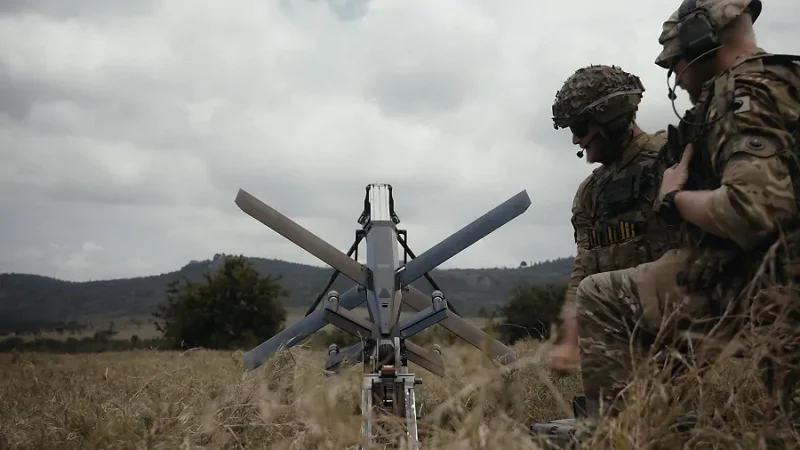
British Army infantrymen have successfully conducted extended field trials of new reconnaissance and strike drone systems in Kenya, operating the platforms independently after minimal training. The exercise, a part of Exercise HARAKA STORM, tested the Altra ISR and HX-2 “recce-strike” systems, developed by European software and artificial intelligence (AI) company Helsing.
The trials, which took place over 18 days, were not a controlled developer demonstration but a series of repeated tactical scenarios. They were supported by the 4th Infantry Brigade (4X) and the British Army Training Unit Kenya (BATUK), which provides a realistic and demanding expeditionary environment of heat, dust, and rugged terrain.
The core objective was to validate the systems’ use by non-specialist soldiers. This aligns with urgent capability lessons drawn from the war in Ukraine, where small, distributed units have used unmanned aircraft systems (UAS) to find and destroy targets.
Infantry-Operated Precision Strike
The most notable aspect of the trial was the rapid adoption of the technology by regular troops. Personnel from 2 SCOTS (The Royal Highland Fusiliers, 2nd Battalion, The Royal Regiment of Scotland) were given a brief familiarisation period before taking full control.
According to Helsing’s Callum Cameron, who was on-site, after the first day, the 2 SCOTS soldiers “conducted all but one of the 15 HX-2 strike missions.” The ease of use and effective Human-Machine Interface (HMI) led observers to adopt a new feedback standard: “it’s even Pipes and Drums proof,” a reference to soldiers from non-technical backgrounds being able to employ the system effectively.
This simplicity is critical. It suggests a move away from specialist-only equipment toward a distributed capability, enabling infantry platoons or companies to manage their own “kill chain”—from detection to destruction—without relying on corps-level assets like artillery or attack helicopters, which can be slow to deploy.
The trials were supported by the 4X Medium Range Effector team, which provided realistic scenarios. This strongly suggests the HX-2 is being evaluated as a candidate for the British Army’s search for a Medium Range Effector, a system to provide precision fire for light forces. Images from the exercise showed the HX-2 successfully engaging mock-up armoured vehicle targets.
Software-Defined, AI-Enabled Hardware
The systems under trial are the Altra ISR and the HX-2. The Altra is a small UAS for Intelligence, Surveillance, and Reconnaissance (ISR), acting as the “eyes” for the unit. The HX-2 is a loitering munition, or “strike” drone, that provides the “fist.”
What distinguishes these platforms is Helsing’s software-defined approach. The company is primarily an AI and software house, developing autonomous systems that can be integrated onto various hardware platforms. This focus on AI is what enables the high mission autonomy and networked operation described by the developer.
The AI is designed to process data from the drone’s sensors—likely an Electro-Optical/Infrared (EO/IR) turret—to assist with target detection and identification. This reduces the cognitive load on the operator, allowing them to remain “human-on-the-loop.” Instead of manually flying the drone and searching a video feed, the operator can supervise the system as it finds potential targets, giving them final authority to engage.
Cameron noted the “ferocious of iteration cycles” from the Helsing team over the past six months, where the AI, software, and hardware were repeatedly tested to their limits. This software-centric model allows for rapid capability updates, a stark contrast to the multi-year development cycles of traditional defence hardware. The HX-2 is also described as being compatible with different warheads to meet various mission demands.
A Path to Rapid Acquisition
The deployment in Kenya also demonstrates a potential path for accelerated capability fielding. The 4th Infantry Brigade staff undertook extensive planning to secure the necessary flight and safety permissions.
The UK’s Military Aviation Authority (MAA) “worked with all sides from the off to unlock permissions, while maintaining a pragmatic safety envelope.” This type of close, pragmatic cooperation between regulators, industry, and the end-user is essential for getting new systems from the lab to the field at the speed warfare now demands.
For the British Army, the success of this trial provides a clear data point. It shows that AI-enabled, “recce-strike” capabilities can be pushed down to the tactical edge, giving small infantry units the organic firepower needed to survive and win on a battlefield dominated by sensors and precision weapons.


