The Bamako Fair and Exhibition Centre served as the geopolitical focal point for West Africa last week, as the inaugural International Defence and Security Exhibition of Bamako (BAMEX 2025) concluded its four-day run. While officially billed as a pan-African platform for “homegrown capacities,” the event, held from November 11 to 14, functioned largely as a showcase for the Turkish defence industry’s deep integration into the security architecture of the Alliance of Sahel States (AES).
The exhibition represents a pivotal moment for the AES—comprising Mali, Burkina Faso, and Niger—which has steadily decoupled from Western military alliances over the past three years. By hosting BAMEX 2025, Mali’s Prime Minister Abdoulaye Maïga has signalled that the vacuum left by the departure of French and other Western forces is being filled not just by political rhetoric, but by Turkish hardware and industrial partnership.
A Turkish Show of Force
Although delegations from over 50 nations, including Iran, Libya, and Morocco, attended the event to discuss strategy, the exhibition floor itself told a singular story. The Turkish Defense Industries Secretariat (SSB) coordinated the presence of approximately 30 companies, effectively making Turkey the sole exhibitor of major hardware. This monopoly on the floor space underscores Ankara’s status as the principal material partner for the AES.
Turkish Ambassador Efe Ceylan described the event as a demonstration of Mali’s “determination to take a leading role on the international stage,” yet the hardware on display reflected Turkey’s specific export strategy: cost-effective, combat-proven systems suited for asymmetric warfare in arid environments.
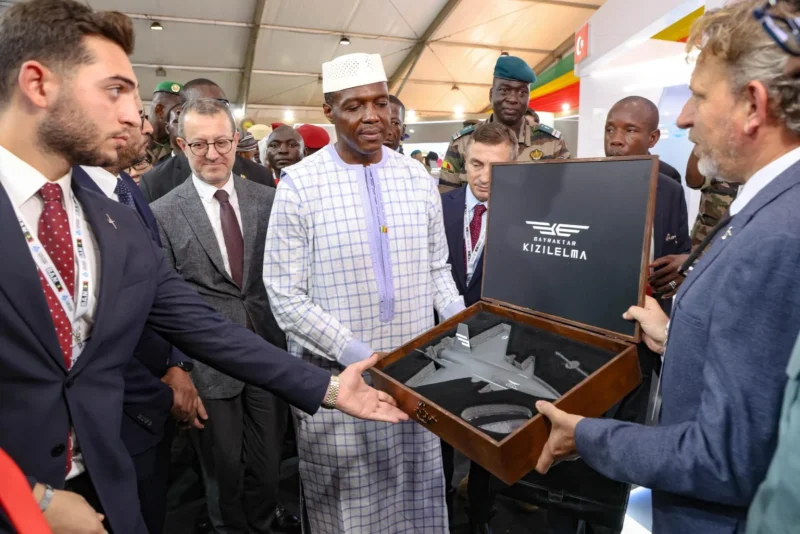
Baykar, the manufacturer of the ubiquitous Bayraktar TB2, held a commanding presence. The TB2 has been operational in Mali since at least early 2024, providing the Malian Armed Forces (FAMa) with persistent Intelligence, Surveillance, and Reconnaissance (ISR) capabilities alongside precision strike options. The platform’s endurance of up to 27 hours and operational ceiling of 25,000 feet allow it to patrol the vast, ungoverned spaces of the Liptako-Gourma region, where insurgent groups like ISGS and JNIM operate.
While Baykar’s stand drew attention, industry analysts noted the relevance of the heavier Akinci platform for future procurement. With a payload capacity significantly higher than the TB2, the Akinci offers the potential to carry heavier munitions and advanced AESA radars, effectively bridging the gap between drone warfare and manned strike aircraft for air forces with limited budgets.
On the ground systems front, Otokar showcased its tactical mobility solutions. The company’s Cobra II 4×4 tactical wheeled armoured vehicle was a centrepiece. The Cobra II is particularly relevant to the Sahelian theatre due to its protection against Improvised Explosive Devices (IEDs) and landmines—the leading cause of casualties for UN peacekeepers and national armies in the region. The vehicle features a modular hull that supports various configurations, from troop transport to medical evacuation, a necessity for forces operating hundreds of kilometres from established bases.
Perhaps the most critical displays for the evolving threat landscape came from STM and Aselsan. STM presented its rotary-wing loitering munitions, likely the Kargu series. These “kamikaze drones” offer a “fire-and-forget” capability that allows infantry to engage targets behind cover or in urban environments without direct line-of-sight.
Prime Minister Maïga’s opening remarks specifically addressed this technological shift. He noted that terrorism “is no longer confined to weapons or explosives but is undergoing a profound operational transformation that utilises artificial intelligence (AI).” The Kargu system utilises machine learning algorithms for target classification, directly addressing the Prime Minister’s concerns about modernising the counter-terror response.
Aselsan, Turkey’s electronics giant, rounded out the offerings with solutions for the invisible war. Their portfolio includes the Ilgar combat electronic warfare system and counter-UAS (C-UAS) solutions. As insurgent groups increasingly adopt commercial drones for surveillance and attacks, electronic countermeasures have shifted from a luxury to a necessity for base protection in the Sahel.
A unique feature of BAMEX 2025 was the inclusion of “demo days” during the final 48 hours of the exhibition. Unlike static European airshows, the Malian organisers designated a specific operating zone where international delegations could witness systems in live conditions.
For potential buyers, this offered a chance to verify claims regarding heat tolerance and dust ingress protection—two factors that frequently degrade sophisticated Western equipment in the Sahel. The ability to test secure communications gear and optical sensors in the actual thermal environment of Bamako provides a level of validation that brochures cannot replicate.
A notable diplomatic development was the attendance of Nigeria’s Minister of Defence, Mohammed Badaru Abubakar. His arrival at the Military Wing of Bamako International Airport, where he was received by his Malian counterpart General Sadio Camara, marks a thawing of tensions within the Economic Community of West African States (ECOWAS).
Nigeria had previously led the bloc’s hardline stance against the military governments in Bamako, Niamey, and Ouagadougou. Badaru’s presence, supported by a ceremonial guard parade, suggests a pragmatic shift in Abuja. Facing its own security crisis in the north, Nigeria seems willing to prioritise military-to-military cooperation over political differences. The shared threat of cross-border terrorism appears to be driving a realignment where functional security ties supersede diplomatic disputes.
Financial Sovereignty and Future Cooperation
The rhetoric at BAMEX 2025 extended beyond hardware to the economics of defence. Prime Minister Maïga utilised the platform to criticise “traditional defence financing models” dependent on foreign aid and loans—a veiled reference to previous arrangements with European powers.
He called instead for “industrial cooperation and co-financing,” a model Ankara has successfully pitched to other developing nations. This approach often involves technology transfer or local assembly options, appealing to the AES goal of “homegrown capacities.”
For Mali, the exhibition served two purposes: it demonstrated domestic stability to an international audience and solidified its pivot East. By allowing Turkey to monopolise the exhibitor space, Bamako has effectively declared its primary procurement partner for the foreseeable future. As the delegations depart and the static displays are packed away, the success of BAMEX 2025 will be measured not by the speeches delivered but by the performance of Turkish systems in the ongoing and brutal campaign to secure the Sahel.