

Unlock the White House Watch newsletter for free
Your guide to what Trump’s second term means for Washington, business and the world


Donald Trump has not gone out of his way to endear himself to Africans. He has slashed life-saving aid, threatened crushing tariffs and banned many of them from travelling to the US. He has praised the president of Liberia (official language English) for his beautiful English, suggested that neither Lesotho nor the Democratic Republic of Congo really exist and turned the history of apartheid on its head by insisting that the real victims in South Africa are white.
Still, with the exception of South Africa, many people across Africa seem to like the US president. In a poll of 24 countries, the Pew Research Center found that two of the top three approval ratings for Trump were African. In Nigeria, Africa’s most populous nation, and Kenya, 79 per cent and 64 per cent of respondents respectively expressed confidence in Trump “to do the right thing regarding world affairs”.
One poll in two countries is hardly conclusive. But we do know that Trump’s leadership style is familiar. Many of his actions, from appointing relatives to key positions to circulating his own merchandise, are common in a continent where “big men” have all too often triumphed over institutions. And Trump’s blunt honesty is seen by some as less hypocritical than the pious do-goodery and coded finger-wagging of more earnest international interlocutors.
Still, when it comes to dialling up executive power, Trump can take a few lessons from some African counterparts. The US president has hinted at a third term. At 92, Paul Biya, president of Cameroon since 1982, is currently going for his eighth, after heeding “the numerous and persistent calls” from his citizens to continue running his country (into the ground). And as for gift-taking, Trump has nothing on King Mswati III, head of state and real-life absolute monarch of Eswatini, who accepted multiple Rolls-Royces for himself, his mother and for multiple wives. (Trump, on wife number three, is slacking in that department too.)
It is easy to mock Trump’s approach. But in at least two areas, his Africa policy is worth taking seriously.
First, his transactional diplomacy. In eastern DR Congo, home to a wealth of minerals and one of the world’s longest-running conflicts, the negotiating tactics of Massad Boulos, Trump’s senior adviser for Africa and father-in-law of Trump’s daughter Tiffany, has gone down well. Boulos has managed to pull off a tentative peace agreement between Rwanda and DR Congo, in which the outlines of a minerals-for-security deal are taking shape.
No one should put too much faith in a process driven almost entirely by commercial interest. On the other hand, any progress towards peace is better than none. And this approach could yet yield other surprises in other conflicts.
The second area is Trump’s dictum — somewhat countermanded by punitive tariffs on countries like Lesotho and Madagascar — of trade not aid. This has been a mantra in Africa itself at least since Nana Akufo Addo, former president of Ghana, said in 2016 that Africa wanted a “fair chance to trade”, not sympathy or aid.
The end of easy access to the American market, which accounts for only about 5 per cent of total African trade, should stir greater urgency in putting the African Continental Free Trade Area into proper effect. If African economies can produce goods that other African countries want — and there is no reason, for example, why Lesotho can’t sell its clothes on the same continent — that would be an excellent start on the journey to trading themselves to higher incomes.
On aid, the manner in which Trump’s administration slashed assistance overnight has been brutal. It will cost lives. Yet it has not elicited much complaint from Africa, where many leaders know they relied too heavily on foreign assistance — and most citizens blame their own governments for decrepit health systems. Africa’s increasingly politicised young populations should hold them to account if they do not now step up.
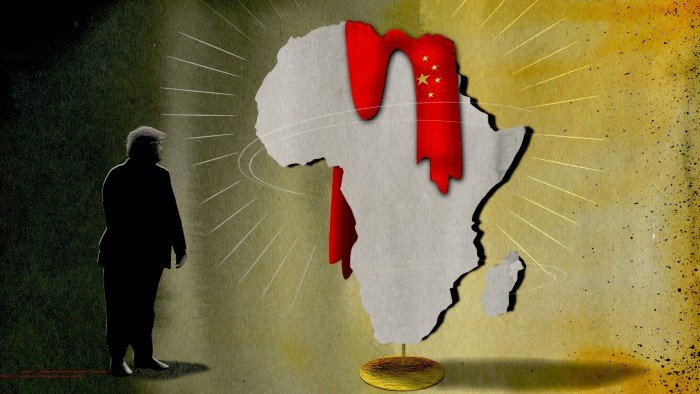
None of this is to say that Trump’s policy on Africa is either coherent or positive. It is neither. If anything, it has made China appear the more reliable partner. Beijing may not be rushing to fill the gap left by American aid, but it has seized the opportunity on trade, offering tariff-free access to 53 African countries on virtually all goods.
Another recent poll, by Afrobarometer, showed that China has now surpassed the US as the most popular country on the continent. The ultimate winner of Trump’s Africa Second policy may be Xi Jinping.
david.pilling@ft.com


