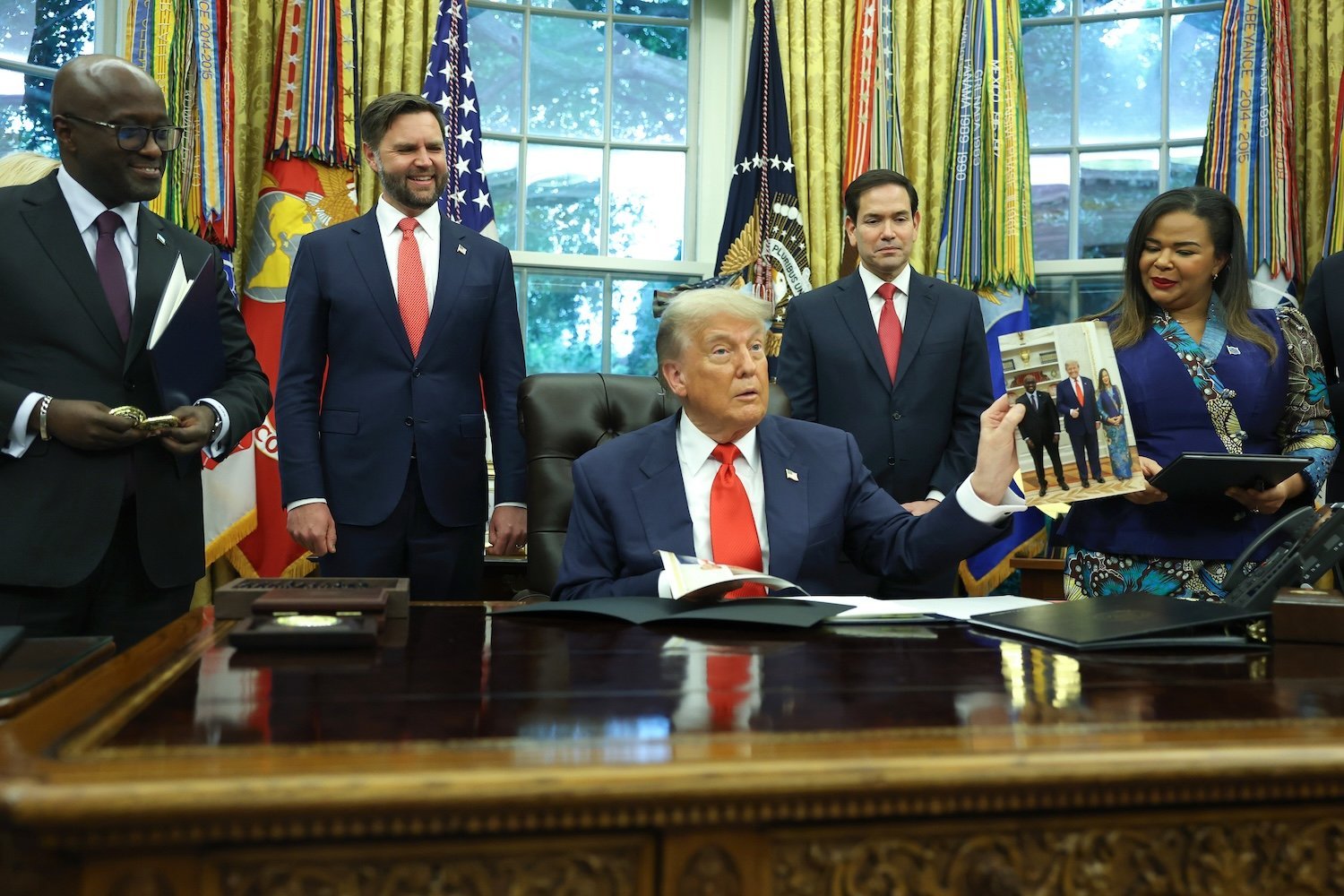

In June, U.S. President Donald Trump hosted leaders from the Democratic Republic of the Congo (DRC) and Rwanda in the Oval Office to sign a peace deal, declaring, “Today, the violence and destruction comes to an end.” The United States and Qatar are negotiating a series of peace and mineral deals regarding the DRC, and comprehensive peace and economic agreements are expected in the coming weeks.
Whether the deals result in peace or intensified conflict depends on what Washington does next. So far, there has been little change in conflict dynamics on the ground, and there is no realistic plan for dismantling the Rwandan-backed rebel group M23 or the DRC-backed militia, the Democratic Forces for the Liberation of Rwanda (FDLR). Most concerning is that the financial pressure that helped lead to the agreements is waning.
In June, U.S. President Donald Trump hosted leaders from the Democratic Republic of the Congo (DRC) and Rwanda in the Oval Office to sign a peace deal, declaring, “Today, the violence and destruction comes to an end.” The United States and Qatar are negotiating a series of peace and mineral deals regarding the DRC, and comprehensive peace and economic agreements are expected in the coming weeks.
Whether the deals result in peace or intensified conflict depends on what Washington does next. So far, there has been little change in conflict dynamics on the ground, and there is no realistic plan for dismantling the Rwandan-backed rebel group M23 or the DRC-backed militia, the Democratic Forces for the Liberation of Rwanda (FDLR). Most concerning is that the financial pressure that helped lead to the agreements is waning.
Going forward, the Trump administration should continue to apply financial pressure to consolidate peace and ensure transparency is a part of all mineral deals. It should also maintain sanctions against both Rwandan and Congolese officials who are backing violent actors in the region, thereby ensuring accountability and supporting Congo’s sovereignty.
The Trump administration has made the DRC its highest priority in Africa due to critical minerals and third-country resettlement. With rising global demand for electric cars and AI, competition for minerals needed to power these technologies is accelerating, especially between China and the United States. The DRC houses a large concentration of these minerals—it’s the world’s largest supplier of tantalum and cobalt and has large deposits of copper, tin, tungsten, and gold—but has been a risky place to invest, because of war, invasions, and corruption.
These risks have only grown more grave. Since Trump took office, Rwanda has ramped up its invasion of eastern Congo with up to 12,000 troops and command and control over M23, creating a human tragedy. Nearly 8 million people are displaced, thousands have been killed, and M23 forces have committed possible war crimes. M23 controls much of eastern Congo, including numerous mines. Meanwhile, the Congolese government supports violent militias like the FDLR, which includes remnants of the militia responsible for the 1994 Rwandan genocide.
In early 2025, the United States and Europe placed sanctions on Rwandan and Congolese officials and companies backing the M23 and threatened measures against Congolese officials backing the FDLR. The resulting pressure on both Rwanda and the DRC was sufficient to bring about the current negotiations. A U.S. team led by senior advisor Massad Boulos helped secure the June peace agreement, while Qatar brokered a vaguely worded deal between the DRC and M23 in July.
But the incentives that could secure lasting peace—an economic accord and mining investments—are still being negotiated. The goal is to have each country invest in the other’s legitimate economies, building a new and self-sustaining dynamic. Until now, Rwanda has mainly “invested” in illicit, violent exploitation of people and minerals in the DRC, and Congolese leaders have “invested” in deeply corrupt mining deals. But if Rwanda put its money to work in long-term DRC mining, processing, and cross-border infrastructure, and the DRC invested in mining services, financial, and other cross-border projects, that could create new incentives for stability. These strategies have been effective in Malaysia, Singapore, and Indonesia, whose economies grew over the past 50 years through mutually beneficial investments.
Part of the key is expanding the economic pie through new investments, and the U.S. is bringing new investors, including a Bill Gates/Jeff Bezos-backed company and potentially one supported by Trump confidant Gentry Beach. But whether the new deals bring sustainable peace or worsen the situation depends on three key lessons from past DRC peace processes.
First, all deals must be fully transparent. A system of violent kleptocracy exists in the DRC in which ruling elites and their commercial partners personally profit from hijacking the nation’s economy and government institutions.
This will continue unless there is transparency to prevent corruption. All new minerals deals should follow contract transparency standards embedded in the Extractive Industries Transparency Initiative. All beneficial owners should be disclosed, minerals traceability should be made more transparent, greater support should be provided to formalize artisanal mining and mine inspections, and human capital development and technology transfer should be included. With property rights, bank accounts, and conflict-free certification, artisanal miners can contribute to the DRC’s and Rwanda’s legitimate economies.
The war and the kleptocratic system will also continue unless there are consequences for illicit behavior. Critically, the pressure that led to the peace deals must continue. A recent congressional resolution from Rep. Chris Smith calling for the administration to use sanctions to buttress the peace process is a good first step. M23 continues to take new territory and says it has no intention of withdrawing, while the existing peace agreements leave massive wiggle room for Rwanda to keep its troops in the DRC.
Peace requires respect for the DRC’s sovereignty. This means Rwanda withdrawing its troops and dismantling M23, and the DRC disarming the FDLR. To incentivize this, the United States, EU, and United Kingdom should double down on sanctioning Rwandan and DRC officials as well as business networks involved in aiding M23, the FDLR, and other illegal armed groups. Networks that were previously sanctioned should not be delisted.
Multilateral aid from the World Bank and International Monetary Fund is another pressure point. The U.S. and European countries should suspend it until both Rwanda and the DRC take action on the armed groups. Such leverage, even during a mediation effort, is the only proven strategy: Rwanda withdrew M23 a dozen years ago under similar pressure. The administration’s focus on DRC-related sanctions is also waning, but renewed congressional pressure could help change this.
Finally, the DRC suffers from a severe democratic deficit that could lead to a coup d’état, which would in turn undermine progress toward peace. To prevent this, the final peace deals should prioritize good governance. U.S. pressure can help curb Congolese President Felix Tshisekedi’s corruption and repression and ensure that he abides by the constitution and doesn’t run for a third term. Washington should also work to ensure that Tshisekedi actively participates in a dialogue process led by the Catholic and Protestant churches to increase national unity and democracy. Trump should make agreeing to this dialogue a precondition for inviting Tshisekedi to the Oval Office to sign a final peace deal—a visit that is currently under discussion.
As governments and companies from the United States, Europe, and elsewhere seek out peace and strategic minerals in this region, they all stand to benefit from transparency and accountability. The excitement of the initial peace agreements should not lead the U.S. and Europe to reduce the pressure that contributed to the current progress. Without accountability for the illicit actors and protections for transparency, any new peace and minerals deals could easily go awry, leading to lost investment, increased conflict, and massive human suffering.