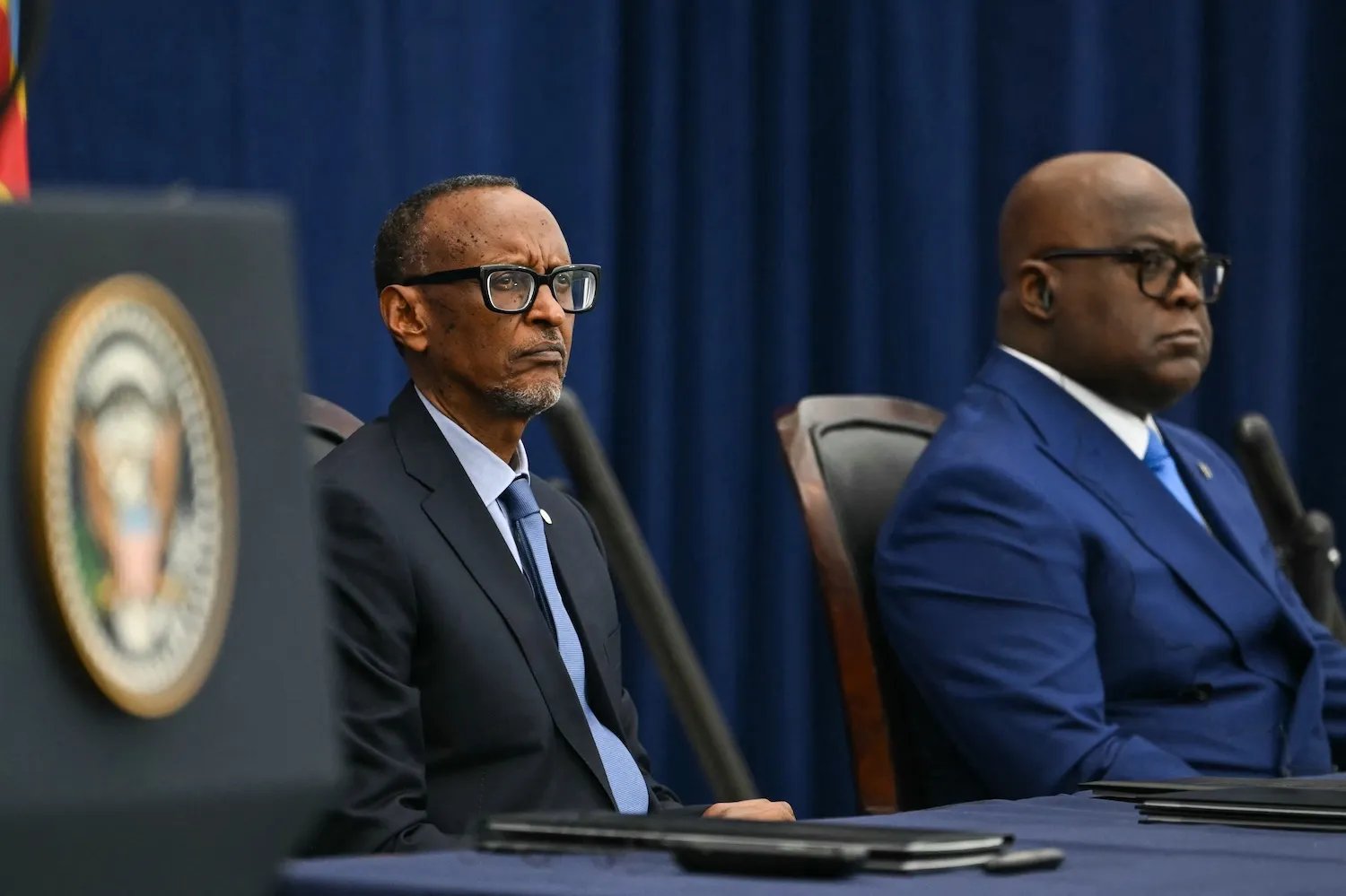

In late 2025, U.S. President Donald Trump hosted the presidents of the Democratic Republic of the Congo (DRC) and Rwanda to sign a peace accord aimed at ending the long-running and deadly conflict in eastern Congo. International security has turned on its head since then, following the U.S. operation to capture Venezuelan President Nicolás Maduro and U.S. threats to annex Greenland over critical minerals.
Two key factors make the Congo-Rwanda peace deal still highly relevant for U.S. foreign policy. But for the United States to realize tangible benefits from the Trump-brokered deal, his administration will need to ratchet up its financial pressure with more decisive action.
In late 2025, U.S. President Donald Trump hosted the presidents of the Democratic Republic of the Congo (DRC) and Rwanda to sign a peace accord aimed at ending the long-running and deadly conflict in eastern Congo. International security has turned on its head since then, following the U.S. operation to capture Venezuelan President Nicolás Maduro and U.S. threats to annex Greenland over critical minerals.
Two key factors make the Congo-Rwanda peace deal still highly relevant for U.S. foreign policy. But for the United States to realize tangible benefits from the Trump-brokered deal, his administration will need to ratchet up its financial pressure with more decisive action.
First, critical minerals are at the heart of why the administration has taken such an interest in the DRC. It is the world’s largest producer of cobalt and tantalum; the second-largest producer of copper; and has large concentrations of lithium, tin, and gold. American companies are now in talks with the DRC government over critical mineral mines, and a U.S.-backed venture has already started shipping copper to the United States.
But continued conflict, particularly driven by Rwanda’s ongoing intervention in Congo’s east, creates instability and prevents U.S. companies from accessing several major mines. A few low-cost, targeted steps by the administration would help secure greater stability and critical minerals access.
Second, continued Rwandan military intervention in eastern DRC is making a mockery of Trump’s peacemaking efforts. Rwanda’s overt nonimplementation of the deal that President Paul Kagame had just signed in Trump’s presence likely creates grounds to hope that the Trump administration will respond.
Immediately after Trump hosted the two presidents in December, Rwandan troops and Rwanda-backed March 23 Movement (M23) rebel forces led a major new offensive that displaced 200,000 civilians.
The administration’s immediate lashing out at Rwanda clearly show that the incursion hit a nerve in Washington. Secretary of State Marco Rubio stated that “Rwanda’s actions in eastern DRC are a clear violation of the Washington Accords … and the United States will take action to ensure promises made to the President are kept.” And U.S. Ambassador to the United Nations Mike Waltz declared that “Rwanda is leading the region … toward war.”
Rwanda-backed forces continue to occupy most of eastern DRC and are not following through on the Washington Accords, and neither is the DRC government implementing its promises to halt support for its armed groups.
Since March 2025, the United States cornerstone effort in Africa has been its peace process in coordination with Qatar to end the war in eastern DRC. Since 1998, conflict in the Congo has left more than 5 million people dead with another 5 million currently displaced, including 2 million people newly displaced over the past year. Rwanda’s invasion includes more than 7,000 troops and command and control over the M23 rebels, who have undertaken ethnically targeted mass killings, torture, and forced deportations.
The peace process has produced the signing of three peace accords, including deals between the governments of the DRC and Rwanda, between the DRC and the M23, and an economics-for-peace agreement. But on the ground, the conflict is worsening. The M23 significantly expanded its territory in 2025, and the DRC government collaborates with the Democratic Forces for the Liberation of Rwanda, the remnants of the Rwandan genocidaires from 1994, and deadly armed groups such as the Wazalendo. A continued kleptocratic system, escalating repression, and an inability or unwillingness to protect civilians all fall on the DRC government.
A major reason for the continued fighting, though not the only one, is money. M23 controls important gold and critical minerals mines, looting $70 million worth of gold from one mine alone since May using Rwandan technicians. The rebels have smuggled gold and tantalum to Rwanda, and Rwanda is estimated to have to exported a record $2 billion worth of gold in 2025, up more than fivefold in just four years.
Likewise, DRC-backed armed groups control many gold mines and smuggle gold to Uganda. The conflict gold from both countries flows unchecked to the United Arab Emirates (UAE), where it is laundered into the global gold trade.
The missing ingredient to stopping the fighting is sustained financial pressure led by the United States. U.S. and European pressure in early 2025 directly led Rwanda to come to the peace table, as it feared that the U.S. sanctions on a government minister and European Union sanctions against nine officials and Rwanda’s main gold refiner could escalate significantly.
But no new pressure has been applied in nearly a year despite no change in behavior by the conflicting parties. This led congressional Republicans to introduce a resolution that calls on the administration to use sanctions to support the peace process.
In sum, there have been no costs for Rwanda’s escalating invasion or the DRC government’s backing of armed groups. The cost-benefit calculation for both governments is to continue to pillage eastern DRC through proxy war machines, make deals with the United States, and face no consequences. That is a recipe for continued war.
The growing risk is that the peace process will, in fact, lay the groundwork for a de facto partition of Congo, with a Rwanda-backed armed group controlling the strategic and mineral-rich Kivu provinces, violating the DRC’s sovereignty and creating a living hell for millions of civilians. And indeed, United Nations experts reported recently that the M23 was setting up a enclave in eastern DRC.
For the United States to access Congo’s minerals and to stop the warring parties’ continued defiance of the Trump-brokered Washington Accords, the Trump administration should now issue a series of escalating sanctions on Rwandan, Congolese, and UAE-based networks undermining peace. These should include senior officials, state-owned companies, and business networks engaged in supporting armed groups, smuggling conflict gold, and/or engaging in grand corruption. The European Union and United Kingdom should follow suit, and all three should maintain their existing sanctions against illicit actors in the region, such as U.S. sanctions on mining magnate Dan Gertler. Importantly, all minerals deals should be fully transparent, following contract transparency standards defined by the Extractive Industries Transparency Initiative.
Meanwhile, Congolese civil society remains paradoxically the most politically legitimate actor yet the most marginalized in the peace process. Its systematic exclusion is leading to technocratic agreements that are disconnected from local realities and lacking mechanisms for accountability.
No peace agreement can survive without the support, participation, and control of the directly affected populations, including citizen movements, women, and local communities They are the only guarantees that the agreements will hold, since they represent the affected populations and increase transparency. The United States, United Kingdom, and EU should also support a transitional justice mechanism to investigate and prosecute war crimes and crimes against humanity as well as a credible, inclusive, and transparent national dialogue in the DRC.
The private sector also has an important role to play, particularly banks and global gold refiners. They should conduct enhanced due diligence of gold purchases from Rwanda, Uganda, and the UAE because of the increased flows of DRC conflict gold to those countries.
The peace agreements that have already been signed lay out a vision for the future of eastern DRC. They include plans for peaceful, transparent economic development and consequences for illicit actors. But without serious consequences for the spoilers of peace, more transparent mining governance and reforms, and a more prominent role for civil society, the peace accords won’t end the war. Instead, they could lead to a permanent fragmentation of Congolese sovereignty and will undermine U.S. access to critical minerals.
Decisive action by Washington could secure a much better outcome, one in which the United States secures mineral access, Trump is hailed as a peacemaker, and the Congolese people could finally see some measure of stability in the war-torn east. The key is to impose serious financial repercussions for the parties undermining the Trump-brokered Washington Accords. A lasting peace in eastern DRC can only emerge from a realignment of political and economic incentives, making war more costly than peace for all actors involved. If the Rwandan and DRC governments undermine Trump’s deal, then those repercussions cannot come soon enough.