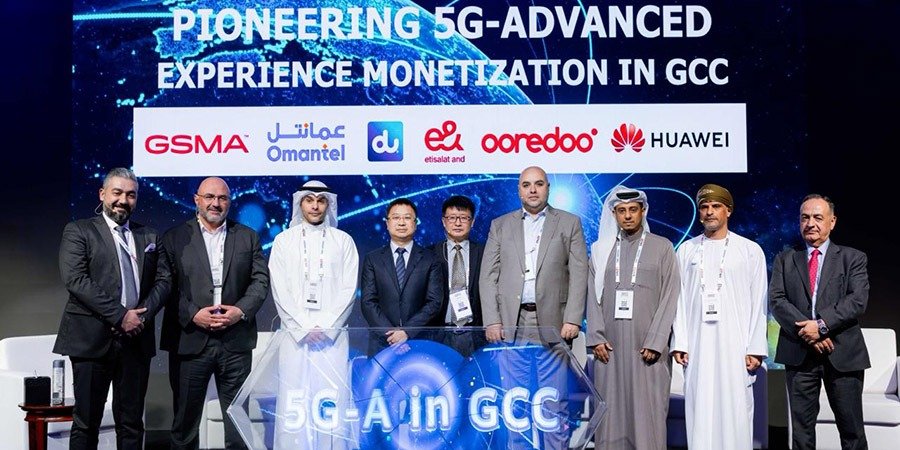
The 19th edition of the Telecom Review Leaders’ Summit, held under the theme ‘Tech Intelligence Beyond Mobility’ from 10-11 December 2025 in Dubai, UAE, set the stage for high-impact dialogue on the GCC’s experience-driven, monetizable, connected future. During the ‘Pioneering 5G-Advanced Experience Monetization in GCC’ panel, industry leaders examined how 5G-Advanced (5G-A) is reshaping networks, business models, and customer experiences across the Gulf.
In his welcome note, Toni Eid, Founder of Telecom Review Group and CEO of Trace Media International, underscored the GCC’s position as a global frontrunner in 5G-Advanced connectivity. He noted that the region has invested early, laying the foundation for smarter networks, AI-powered operations, and new monetizable experiences.
Moderated by Issam Eid, CMO of Telecom Review Group, the discussion shed light on how AI, automation, and 5G-A capabilities are converging to unlock the next wave of digital value.
Essa Haidar, CTO, Ooredoo Kuwait, emphasized that GCC nations consistently rank among global 5G leaders, an achievement rooted in national visions that place digital infrastructure at the center of economic transformation. He said Ooredoo Kuwait is investing early in 5G-A to enable low-latency, autonomous networks, which he described as essential to emerging AI-as-a-Service models.
As networks grow more complex and customer expectations rise, Haidar noted the crucial interplay between AI and 5G-Advanced, particularly in enabling new revenue opportunities, such as context-aware premium services and enhanced gaming experiences.
Jawad Abbassi, Head of MENA, GSMA, reiterated the GSMA’s long-standing position: competitive markets empower innovation.
He highlighted that artificial network limitations undermine operators, especially as GCC countries move aggressively toward 5G-A and standalone 5G deployments.
He pointed to projections showing 90% 5G adoption in the GCC by 2030, driven initially by fixed wireless access (FWA). However, monetization gaps have surfaced early on, consequently necessitating the need for the GSMA’s Open Gateway initiative, which has been designed to unlock cross-border and cross-vertical 5G services. China, he noted, remains the benchmark for large-scale 5G revenue realization.
Ayman Magdy Abousenna, Vice President/Mobile Data Core & Services, e& UAE, said 5G-Advanced is “a milestone,” and highlighted e&’s commercial 5.5G launch, which has since enabled high-speed, low-latency connectivity and more dynamic network slicing. The technology is already supporting high-demand events, from Formula 1 to emerging drone services.
He stressed that AI goes beyond automation, explaining that “It’s about transforming the network fundamentally, making operations smarter and customer experiences more intelligent.” Trust, he added, is essential for monetization. With AI-driven insights, operators can tailor services, predict user needs, and deliver premium experiences that drive new revenue streams.
Qadri Al Ahdal, Director, Core Network Planning, Infra Technology Planning, du, elaborated on the company’s long 5G journey spanning early 5G, 5G Standalone, and now 5G-Advanced. As bandwidth demand grows, fueled by applications such as autonomous and immersive services, 5G-A introduces powerful capabilities to enhance performance and reliability.
Releases 18 and 19, he noted, will enable cross-domain analysis and strengthen network security. AI will be instrumental, providing the “quick action layer” needed to secure modern networks. In terms of monetization, du sees the greatest opportunities in packaging superior, segmented experience services that match varying customer needs.
Dr. Ali Al Hashmi, General Manager, Infrastructure Planning & Design, Omantel, reflected on Oman’s unique geographical and infrastructural challenges, describing telecommunications as “a basic human right, like food and shelter,” particularly for remote communities.
He added that through new spectrum allocations such as 2.6 GHz and 800 MHz and a vision aligned with Oman’s digital ambitions, Omantel is advancing toward a fully modernized 5G-A landscape. He stressed that no human alone can manage future networks. AI will play a significant role in monetizing mobile traffic, guaranteeing differentiated service levels, allocating spectrum per customer segment, and understanding emotional customer experience.
He reiterated that future revenue depends on operators aligning with government ambitions and interoperating with sectors such as logistics and oil and gas.
David Li, Chief Expert of Strategy Marketing, Huawei, highlighted the ecosystem-level potential of 5G-Advanced, especially in home connectivity and high-bandwidth consumer applications. The integration of AI with 5G-A is not optional, he said; it is essential for accuracy, network efficiency, and future innovation.
He underscored the importance of collaboration between vendors and operators, particularly in open OSS/BSS frameworks and Mobile AI, to build the world’s most intelligent networks.
The panel concluded with a ceremonial launch marking the GCC’s next leap into 5G-Advanced. It symbolized not just a technological evolution but a regional commitment to monetizing intelligent networks, enhancing customer value, and shaping a digitally empowered future.