Over recent months, the UK government has been consulting on the introduction of Sustainable Industry Rewards (SIRs) (formerly non-price factors) such as supply chain sustainability, capacity building, skills, and innovation to the 2025 auction round of its contracts for difference (CfD) scheme.
This is in response to tough market conditions and the low margins associated with renewable energy projects which have made it more challenging for renewables developers, including those in offshore wind, to make longer-term investments in these key areas whilst also bringing due attention to carbon, social value and biodiversity.
There is a risk that, if left unaddressed, this lack of investment will lead to deployment challenges and bottlenecks.
Although it has yet to be confirmed which Sustainable Industry Rewards will be introduced, the initial consultation received majority support for SIRs that would drive economic, social and environmental value.
This change to the CfD scheme would reinforce a recent move by the Crown Estate to contractually commit bidders in its next offshore leasing round to ensure their projects will generate positive social and environmental impacts.
 © Supplied by COWI/Aspectus
Together this marks a significant change, with both processes having been entirely cost-driven up until now. One of the key areas that requires industry input is how SIRs will be measured to ensure that stated project contributions can be verified and compared.
As an example, there is no single methodology that acts as an industry standard for developers to assess the embodied carbon of their projects.
Industry wide methodology
To assist the industry in better understanding, quantifying and managing carbon associated with offshore wind projects, the ORE Catapult, as a driver of innovation in the wind industry, recently commissioned COWI to develop carbon assessment guidance and a taxonomy for offshore wind.
The work includes a framework to classify components based on input from across the supply value chain, facilitating the progressive assessment of carbon through all life cycles stages for both bottom fixed and floating offshore wind developments.
The work draws on good practice and has been developed with broad stakeholder engagement, including the Crown Estate and major energy developers.
 © Supplied by Vattenfall
It aligns with the carbon management principles set out in PAS 2080 and guidance has been developed to support users throughout assessment and reporting.
Initial outcomes from the work highlight significant potential to improve project decision making to help the offshore wind industry more effectively meet its net zero goals.
To support initiatives to manage and reduce carbon, the carbon assessment guidance will help drive transparency, facilitate benchmarking, and supply chain collaboration in support of better project outcomes.
The work is aligned to and supports an expected industry-wide methodology which is planned to be published later in 2024.
A carbon rating system for offshore wind
In parallel, within COWI we have developed a carbon rating system for offshore wind foundations to help designers of these bespoke elements understand ‘what good looks like’ with respect to upfront carbon.
The rating system was developed using COWI’s vast embodied carbon project database for offshore wind as well as drawing upon the experience from the development of a similar scheme launched in 2021 – the Structural Carbon Rating Scheme for Bridges.
The carbon rating methodology, which produces an embodied carbon rating for bridges, is already being used by engineers to benchmark carbon and underpin carbon reduction targets, and decarbonisation of new bridges both in the UK and internationally.
 © Supplied by Ocean Winds
Inspired by this rating system, COWI developed the proposal for a structural carbon rating system for offshore wind turbine foundations to provide a clear indication of carbon performance of a project against an A++ to G rating.
The proposed rating system has been benchmarked using over 100 bottom-fixed offshore wind foundation designs from COWI’s project database with carbon emission factors typically based on global averages, aligning with the international supply chains used for major components in offshore wind.
The paper is due to be published in July 2024 and will be freely available.
Creating transparency and striving for better
With transparency a key outcome of both projects, it will in time, help to improve decision making around embodied carbon – particularly as and when Sustainable Industry Rewards are included within the CfD scheme.
The next 5-10 years presents a massive opportunity for carbon savings given that the upfront carbon associated with achieving the target of 50GW by 2030 stands at around 23 million tonnes of carbon for the foundations alone based on COWI’s database for carbon in offshore wind foundations (650 tCO2e/MW power rating average for bottom fixed foundations).
To put the scale into perspective, the embodied carbon of this expected build-out of offshore wind will be roughly equivalent to rebuilding all the office space in the City of London five times over.
A 10-15% saving would be an excellent achievement, but as an industry we could be more ambitious.
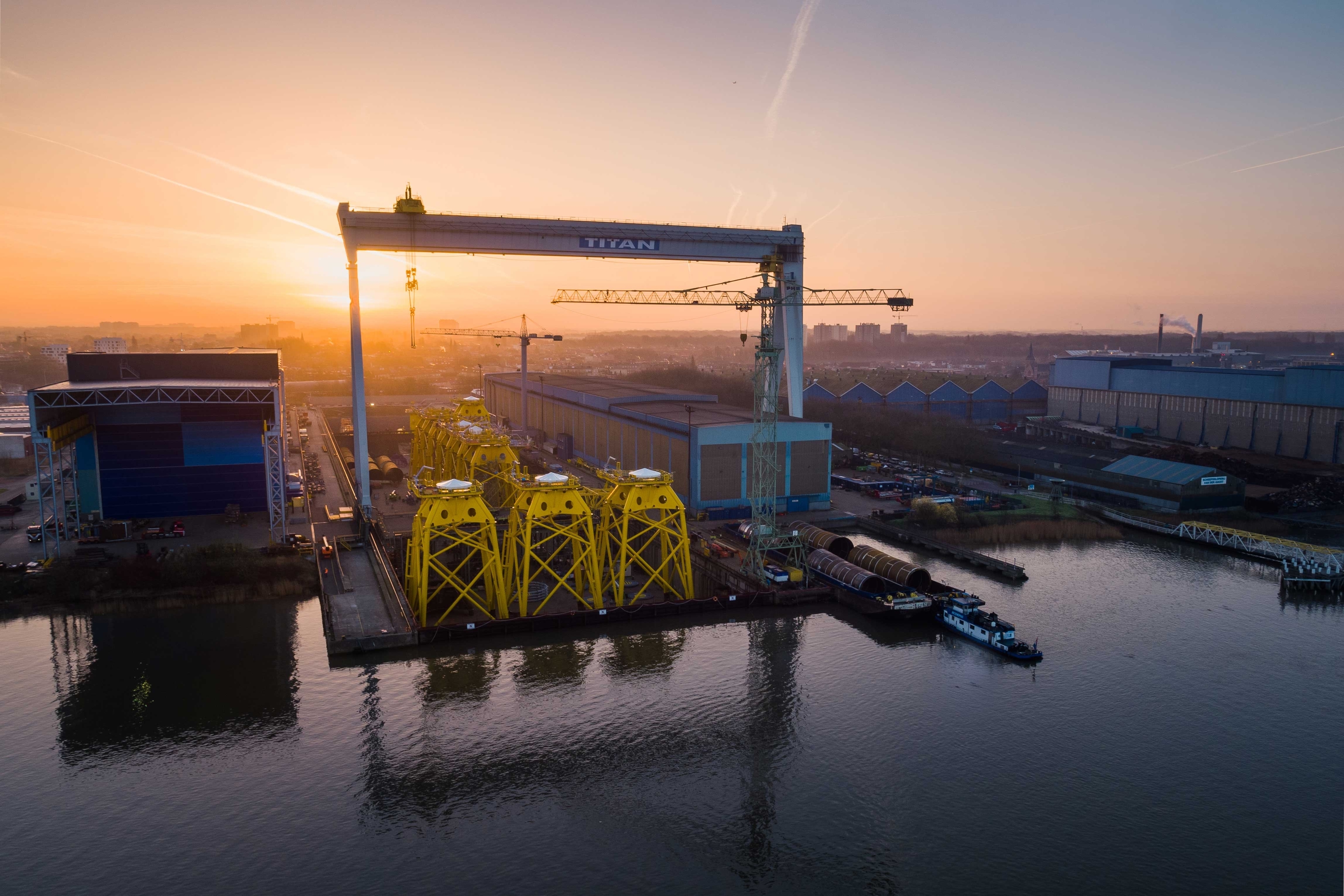
At present the average offshore wind turbine foundation equates to approximately 650tCO2e/MW – to remain aligned to a net zero trajectory, we would need to reduce this to 325tCO2e/MW by 2030 whilst not slowing down the deployment programme.
To achieve net zero itself will require a multi-industry push across the supply chain – from design and manufacture through to shipping.
This push will be supported by ongoing grid decarbonisation initiatives, creating a positive feedback loop.
As a first step though, every supplier within the industry will need to benchmark the emissions of their products and services.
Several pieces of good guidance already exist, but for those that require something that is offshore wind specific, work is ongoing in the industry and with public sector stakeholders to define a single carbon foot printing methodology.
The UK’s integration of Sustainable Industry Awards into its renewable energy procurement strategy marks a significant shift towards prioritising economic, social and environmental value in offshore wind development more evenly.
With the Crown Estate and government initiatives pushing for positive environmental impacts, the industry must get ready to adopt a standard carbon assessment methodology to standardise project data and enhance transparency.
Recommended for you