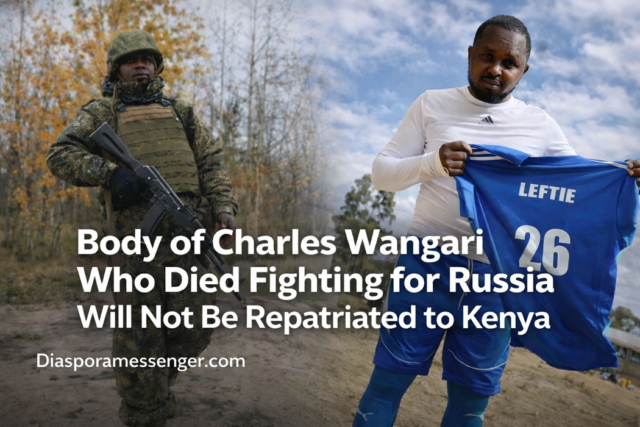
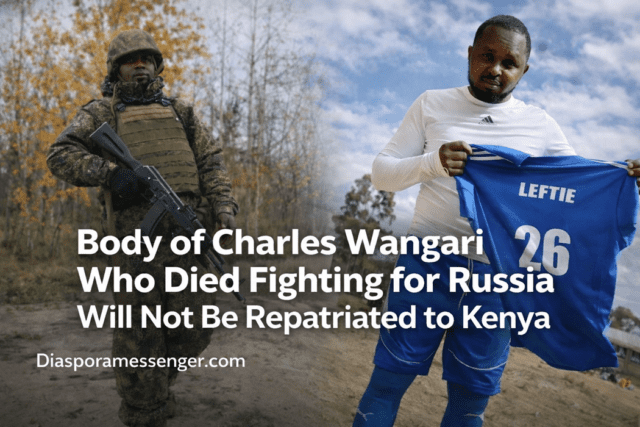
The body of Charles Wangari, a Kenyan former footballer who died while fighting for the Russian Army, will not be repatriated to Kenya, according to multiple reports received in January 2026.
Wangari, popularly known as “Leftie” in football circles, was a former player for Kubali FC in Laikipia West. He died on December 25, 2025, while deployed in the ongoing Russia–Ukraine war. As a result, he became one of several Kenyans whose deaths abroad have been linked to the conflict.
Journey from Kenya to the Russian Army
According to family sources and community members, Wangari left Kenya in 2025 with the hope of securing employment abroad. He wanted to eventually relocate to Sweden. Like many young Kenyans seeking better economic opportunities, he was reportedly recruited through informal channels. These channels promised work in Europe.
However, upon arrival in Russia, Wangari was allegedly subjected to military training and later enlisted into the Russian Armed Forces, where he was deployed to the frontlines in Ukraine.
His death on Christmas Day shocked relatives and the wider Laikipia community. In particular, it shocked the local football fraternity, where he had built a reputation as a talented and disciplined defender.
No Repatriation for Burial in Kenya
Reports now indicate that Wangari’s remains will not be returned to Kenya. This will deny his family the opportunity to conduct a proper burial and final farewell in his homeland.
The decision not to repatriate the body is consistent with similar cases involving foreign nationals who died while fighting for Russia. In many instances, bodies of foreign fighters are either buried in Russia or in undisclosed locations. As a result, families are left without closure.
For Wangari’s family, this has added another layer of pain to an already devastating loss.
“We were hoping at least to bring him home and give him a decent burial,” said a family member who requested anonymity. “Now we may never even see his body.”
Grief in Laikipia Football Community
In Laikipia West, where Wangari played for Kubali FC, news of his death and the non-repatriation of his body has deeply affected teammates, coaches, and fans.
Tributes have poured in across social media, with many describing him as a humble, hardworking, and talented player. His football career was cut short by circumstances beyond his control.
Local sports officials say Wangari’s story reflects a growing and worrying trend. Many young Kenyan men are being lured abroad with false promises, only to end up in dangerous and exploitative situations.
Growing Concern Over Kenyans in the Russia–Ukraine War
Wangari’s case adds to a rising list of Kenyans reportedly killed, injured, or stranded in Russia and Ukraine, after being recruited under the guise of employment.
Kenyan government officials have repeatedly warned citizens against unverified overseas job offers, particularly in Eastern Europe and conflict zones.
As the Russia–Ukraine war continues into 2026, diaspora and human rights groups are calling on Kenyan authorities to strengthen travel advisories. They want recruitment regulations and diplomatic interventions to prevent further loss of life.
A Life Lost, A Family Without Closure
For the Wangari family, the absence of his body means there will be no physical grave to mourn, no final rituals, and no closure.
Instead, his memory lives on through the football fields of Laikipia. Here, “Leftie” once chased dreams—never imagining his journey would end on a distant battlefield.