• Business
  • Markets
  • Politics
  • Crypto
  • Finance
  • Intelligence
    • Policy Intelligence
    • Security Intelligence
    • Economic Intelligence
    • Fashion Intelligence
  • Energy
  • Technology
  • Taxes
  • Creator Economy
  • Wealth Management
  • LBNN Blueprints
  • Business
  • Markets
  • Politics
  • Crypto
  • Finance
  • Intelligence
    • Policy Intelligence
    • Security Intelligence
    • Economic Intelligence
    • Fashion Intelligence
  • Energy
  • Technology
  • Taxes
  • Creator Economy
  • Wealth Management
  • LBNN Blueprints

This startup’s metal stacks could help solve AI’s massive heat problem

Simon Osuji by Simon Osuji
November 6, 2025
in Creator Economy
0
This startup’s metal stacks could help solve AI’s massive heat problem
0
SHARES
2
VIEWS
Share on FacebookShare on Twitter

When Nvidia announced its Rubin series of GPUs in March, it also dropped a bomb: Racks built with the Ultra version of the chip, which is expected to be released in 2027, could draw up to 600 kilowatts of electricity. That’s nearly twice as much juice as some of the fastest EV chargers can deliver today.

As data center racks become that power hungry, one of the biggest hurdles will be figuring out how to keep them cool. One startup thinks stacks of metal are the answer.

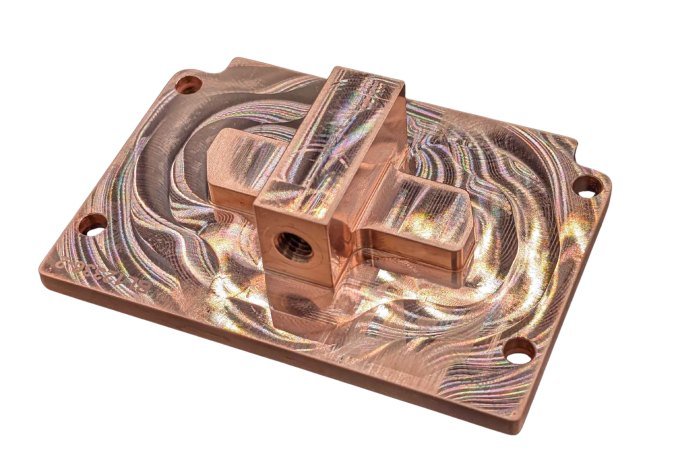
Alloy Enterprises has developed a technology that turns sheets of copper into solid cooling plates for GPUs and for peripheral chips, the supporting components like memory and networking hardware that account for about 20% of a server’s cooling load. 

“We didn’t care too much about that 20% when racks were 120 kilowatts,” Ali Forsyth, co-founder and CEO of Alloy Enterprises, told TechCrunch. But now, as racks have hit 480 kilowatts on their way to 600 kilowatts, engineers have to figure out how to liquid cool everything from RAM to networking chips, parts for which there are no solutions available today.

Alloy’s approach uses additive manufacturing (building objects layer by layer) to produce cold plates that are capable of squeezing into tight spots while withstanding the high pressures that liquid cooling can demand.

A copper cooling plate is shown against a white background.
Image Credits:Alloy Enterprises

But the startup doesn’t use 3D printing. Rather, it takes sheets of metal and forces them to bond using a combination of heat and pressure. It’s more expensive than traditional machining, but cheaper than 3D printing.

The result is a cold plate that, for all intents and purposes, is a single block of metal. There’s no seam, unlike machined products, and it’s solid metal, unlike 3D-printed versions, which can be porous. “We hit raw material properties,” Forsyth said. “The copper is just as strong as if you had machined it.”

Techcrunch event

San Francisco
|
October 13-15, 2026

Most cold plates are machined, a process that uses tools to carve out features. Because the tools are large, each half of the plate has to be machined separately. The two halves are then sintered together — a process that fuses metal powders using heat — which introduces a seam that could potentially leak under high pressure. Alloy’s process, a type of diffusion bonding it calls “stack forging,” makes seamless cold plates. 

Related posts

TechCrunch Mobility: ‘Physical AI’ enters the hype machine

TechCrunch Mobility: Rivian’s savior | TechCrunch

February 15, 2026
‘Clueless’ -inspired app Alta partners with brand Public School to start integrating styling tools into websites

‘Clueless’ -inspired app Alta partners with brand Public School to start integrating styling tools into websites

February 14, 2026

Stack forging can also make smaller features, down to 50 microns, about half the width of a human hair, allowing more coolant to flow past the metal. Alloy’s cold plates have 35% better thermal performance than competitors, Forsyth said.

Because of the complexities of stack forging, Alloy does most of the internal design. Customers submit key specifications and dimensions, and the startup’s software helps translate those into a shape that works for the company’s manufacturing process.

In Alloy’s factory, rolls of copper are first prepped and cut to size. The features are then cut out using a laser. Parts of the design that the company doesn’t want to bond to each other are coated with an inhibitor. When completed, each slice of a cold plate is registered and stacked before heading into a diffusion bonding machine, which uses heat and pressure to press the stacked slices into a single piece of metal.

Forsyth said her company is working with “all the big names” in the data center world, though she wouldn’t disclose specifics. 

Initially, the company had designed the technology to work with a widely used aluminum alloy, but as it received more interest from data centers, it ported the process to work with copper, which conducts heat well and resists corrosion. When Alloy announced the product in June, “things just blew up,” Forsyth said.


Source link

Previous Post

As algorithms learn from famous artists, researcher questions boundaries of artistic ownership and originality

Next Post

Ghana continues to break economic projections with the fastest inflation recovery in years

Next Post
Ghana continues to break economic projections with the fastest inflation recovery in years

Ghana continues to break economic projections with the fastest inflation recovery in years

Leave a Reply Cancel reply

Your email address will not be published. Required fields are marked *

RECOMMENDED NEWS

Symbolic Pics of the Month (02/23)

3 years ago
Nigerian manufacturers say Dangote’s new product could save country $267m

Nigerian manufacturers say Dangote’s new product could save country $267m

11 months ago
Why Shiba Inu (SHIB) Will Survive the Next Cycle

Why Shiba Inu (SHIB) Will Survive the Next Cycle

3 months ago
African Energy Chamber Reaffirms Commitment to Host African Energy Week (AEW) in Cape Town Through 2030

African Energy Chamber Reaffirms Commitment to Host African Energy Week (AEW) in Cape Town Through 2030

1 year ago

POPULAR NEWS

  • Ghana to build three oil refineries, five petrochemical plants in energy sector overhaul

    Ghana to build three oil refineries, five petrochemical plants in energy sector overhaul

    0 shares
    Share 0 Tweet 0
  • The world’s top 10 most valuable car brands in 2025

    0 shares
    Share 0 Tweet 0
  • Top 10 African countries with the highest GDP per capita in 2025

    0 shares
    Share 0 Tweet 0
  • Global ranking of Top 5 smartphone brands in Q3, 2024

    0 shares
    Share 0 Tweet 0
  • When Will SHIB Reach $1? Here’s What ChatGPT Says

    0 shares
    Share 0 Tweet 0

Get strategic intelligence you won’t find anywhere else. Subscribe to the Limitless Beliefs Newsletter for monthly insights on overlooked business opportunities across Africa.

Subscription Form

© 2026 LBNN – All rights reserved.

Privacy Policy | About Us | Contact

Tiktok Youtube Telegram Instagram Linkedin X-twitter
No Result
View All Result
  • Home
  • Business
  • Politics
  • Markets
  • Crypto
  • Economics
    • Manufacturing
    • Real Estate
    • Infrastructure
  • Finance
  • Energy
  • Creator Economy
  • Wealth Management
  • Taxes
  • Telecoms
  • Military & Defense
  • Careers
  • Technology
  • Artificial Intelligence
  • Investigative journalism
  • Art & Culture
  • LBNN Blueprints
  • Quizzes
    • Enneagram quiz
  • Fashion Intelligence

© 2023 LBNN - All rights reserved.