

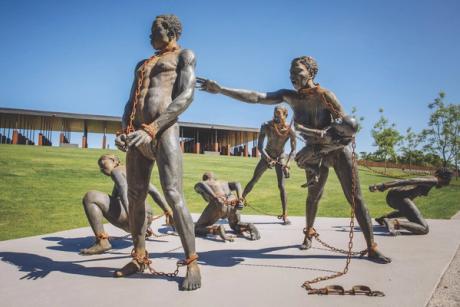
This spring, I visited a sculpture park unlike any I have ever experienced. The Freedom Monument Sculpture Park in Montgomery, Alabama, which opened to the public on 27 March, is more than a collection of works by artists including Rashid Johnson, Kehinde Wiley, Alison Saar and Simone Leigh. It is a 17-acre site with an ambitious aim: to honour the lives of the 10 million Black people who were enslaved in the US through art, first-person narratives, artefacts, historical research and monuments. In the process, it seeks to change the way Americans think about their history at a moment when powerful, deep-pocketed figures in government, higher education and the corporate world are uniting behind the scenes to keep that very thing from happening.
Does that sound dramatic? It is not. Just one week after my visit, the governor of Alabama signed a law banning state funding of diversity, equity and inclusion (DEI) programmes in schools and state agencies. The legislation outlaws public funding for any programme that directs a student or employee to acknowledge “a sense of guilt [or] complicity … on the basis of his or her race”. Also forbidden is the perpetuation of the idea that anyone is subconsciously “racist … or oppressive”—a notion that runs counter to decades of social science examining inherent bias.
Opposing pulls
This series of events exemplifies the opposing forces tugging at American culture. On one end, there is the desire to dismantle old systems that were built to benefit a select few (some call it “wokeness”). On the other, there is the full-throated belief that anything but the status quo is unjust and un-American (“anti-wokeness”). Since 2020, when the murder of George Floyd ushered in a mainstream reckoning with systemic racism in the US, the “anti-woke” crowd has worked to claw back considerable influence. Since 2023, 80 anti-DEI bills have been introduced, according to The Chronicle of Higher Education, and eight states have signed them into law.
DEI has gone from buzzword to hot potato amid a flurry of lawsuits
In corporate America, DEI has gone from buzzword to hot potato amid a flurry of lawsuits over the past two years claiming that programmes designed to support women and people of colour are discriminatory. But what does all this have to do with museums? There are already reverberations: in late March, the Smithsonian’s National Museum of the American Latino in Washington, DC, settled a lawsuit over its internship programme, which had been designed for Latinx college students, by agreeing to consider applicants of all races. (The man behind the lawsuit, Edward Blum, was also a key player in the US Supreme Court case that dismantled affirmative action.)
Unlike the Latino museum, the Equal Justice Initiative (EJI)—the civil rights organisation behind the $15m sculpture park in Alabama—is not funded by the federal government. Nor does it receive state funding, putting it out of reach of the new anti-DEI regulations. But it is tax-exempt, which amounts to a kind of subsidy from the federal government—one that some cultural leaders fear is in danger amid the current culture war. Glenn Lowry, the director of the Museum of Modern Art, recently said he worries that “in an effort to punish institutions, the whole system can get unravelled”.
A legal conundrum
How should institutions balance the desire to tell more honest stories about history with the fear that initiatives to diversify their audiences, programmes and staff might make them vulnerable to lawsuits or other kinds of public scrutiny? I cannot solve the legal conundrum. But I can say that EJI’s work offers a model for how to communicate difficult truths in a way that is hard to dismiss or wilfully misinterpret. EJI started out in 1989 providing free legal representation for people on death row and, in 2018, opened a memorial and museum in Montgomery. Its cultural strategy, as I see it, is threefold. First: do not engage on other people’s terms. Second: rely on first-person narratives. Third: create new and indelible visuals.
At EJI’s sites, it is as if the noisy culture-war meta-narrative does not exist. All language is direct, unflinching and precise. (Speaking of not engaging on other people’s terms, EJI’s director, Bryan Stevenson, declined to participate in this story; a spokesperson said he does not comment on politics for fear of jeopardising EJI’s legal work.) The name of EJI’s museum, the Legacy Museum: From Enslavement to Mass Incarceration, sets out a historical narrative from the get-go, never entertaining the notion that there is no connection between slavery and a prison system in which Black people are four times as likely to be incarcerated as white people. Meanwhile, the National Memorial for Peace and Justice records what EJI describes as “racial terror lynchings”, a term that underscores the fact that these acts were intended to traumatise and re-establish racial hierarchy. They were terrorism, even if they have not historically been described that way.
But EJI is not rewinding through the US-history curriculum to pick apart exactly where the education system got it wrong. It simply starts at the beginning and tells a truer version of the story. (Even what qualifies as the beginning gets a rethink: the new park opens with sculpture by Native artists and information about the Maskoke people, who inhabited the land prior to the arrival of Europeans.)
First-person accounts erase the distance we often create between ourselves and the past
There are two other prongs to EJI’s strategy. First-person accounts are deployed strategically and abundantly to bring the stories of individuals forward. The dramatic 1847 narrative of the novelist William Wells Brown’s escape from captivity in Kentucky is doled out on placards throughout the park. This approach erases the distance we often create between ourselves and the past, making the information heavier and more difficult to minimise.
Bigotry grows in empty spaces
The final element of EJI’s approach is one that will be familiar to arts advocates everywhere: the power of changing the US’s visual landscape. The National Memorial for Peace and Justice and the new Freedom Monument—a 43ft-tall open book inscribed with more than 122,000 surnames that Black people chose for themselves when they were recorded for the first time as free individuals in the 1870 US Census—are immersive and overwhelming in scale. They are, in other words, undeniable. “Americans believe in memorials; we just seem not to believe in memorials that reflect our failings,” Stevenson told Artforum in 2018. “I think we have thereby created empty spaces that leave us vulnerable to tolerating more bigotry. The monuments are intended to disrupt those empty spaces.”
Social progress is never linear. The current flurry of anti-DEI lawsuits is, in many ways, an aftershock of the lawsuits over sex and racial discrimination that first sparked the expansion of corporate diversity efforts in the late 1990s and early 2000s. Throughout history, progressive reform has usually been followed by a wave of conservatism. What EJI has figured out, and what other cultural organisations can learn from it, is how to take the long view. Its monuments will outlast the culture wars. A true story—told with rigour and courage, from the beginning and from the perspective of those who lived it—has a kind of power that can outlive the most reactionary law.