



Yinka Atunde
Interview with Yinka Atunde
FOUNDER and CEO, YIKODEEN


Lives in: Lagos, Nigeria
** Due to technical difficulties, this story unfortunately doesn’t have accompanying video or audio.**
In 2016, Yinka Atunde established the Nigerian footwear manufacturer Yikodeen. Although the company began by making fashion shoes, it has since carved out a niche in industrial safety boots and footwear for the security services.
Starting out in the footwear game
Atunde studied computer science at Babcock University in Nigeria, graduating in 2014. However, he sought a different path, drawn instead to design and the artistic process. It was this interest that eventually led him into footwear.
To expand his industry knowledge, he travelled to Italy for a course in shoemaking, a programme that included placements at Italian footwear companies. There, he witnessed the immense detail and passion inherent in Italian production.
In search of a different perspective, he also toured factories in China – the world’s biggest footwear manufacturer – to understand their techniques. He found the Chinese process was markedly different, characterised by a faster pace and a more commercial focus.
Upon his return to Nigeria in 2015, Atunde made a decision that dismayed his family: he took a manual role in a local shoe factory. It was a calculated move, designed to give him an unvarnished view of production on the ground.
In Nigeria, the manufacturing approach differed from the models he had studied overseas. “It wasn’t as formal as the Italian process and they were not as focused as the Chinese in terms of making those volumes,” he says. Furthermore, he found there was less focus on quality.
Seeing an opportunity to change the way shoes were made in Nigeria, he started Yikodeen in 2016. Atunde blended his experiences from Italy, China, and the local factories, focusing initially on fashion shoes.
The big break
A turning point for the company came when it landed a contract to make 10,000 shoes for the police. At the time, the Nigerian government was aggressively pushing for public institutions to procure locally manufactured products. Until then, most police footwear had been imported.
Atunde’s team produced samples and submitted them for testing. Once satisfied with the results, the police placed the order.
At the time, however, Yikodeen was producing only a few hundred pairs of shoes a month. To fulfil the 10,000-unit order, the company required additional machinery. Although the police had paid an upfront deposit, Yikodeen still lacked the budget to import new equipment.
The young CEO turned to Nigeria’s defunct footwear factories, many of which had closed decades ago but still housed machinery. He tracked down the owners – or their children – to purchase the idle equipment, which the company then refurbished.
The expansion was not limited to machinery. Yikodeen, which had previously employed about 15 people, increased its staff to roughly 50 to produce the order.
Following that first contract with the police, the company added smaller defence agencies and eventually the military to its client list. Atunde says the military deal came about after Yikodeen showcased its products at a security event, and the army subsequently became a regular client.
Although the business began by focusing on fashion shoes, Atunde notes that it was always the intention to move into functional work footwear.
Despite the success the company had achieved by this stage – supplying boots to large clients like the military and police – Atunde never felt the business had truly arrived. “We’re very far from where we’re supposed to be,” he notes. “So from the beginning, once we make money, we always put it back into the business.” He adds that the company consistently reinvests in equipment.
Going into safety boots
In 2018, Yikodeen began developing its line of safety boots. However, securing the necessary certifications took some time and the Covid-19 pandemic caused further delays.
Things eventually moved forward when Italian oil services company Saipem, which had significant operations in Nigeria, agreed to purchase the boots after trialing them for an extensive period. “That email came in 2022 … it was just the happiest moment I’ve had in the business because it was the first time we knew the trajectory was about to change and we’re not just going to make military shoes,” Atunde says.
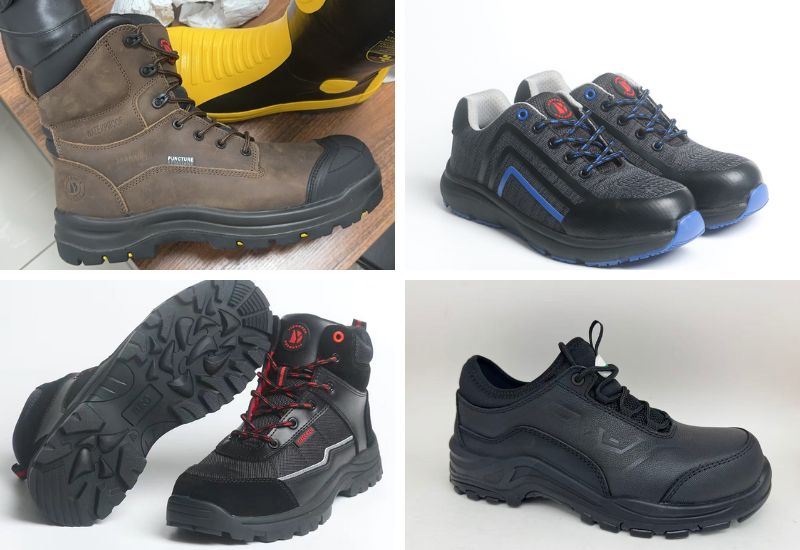
A selection of Yikodeen’s safety shoes.
The decision to first pitch to a multinational like Saipem was calculated. Atunde specifically targeted a leading oil and gas contractor, knowing that meeting their rigorous health and safety standards would validate his product. “I said, let’s give the highest-end clients the product to try out,” he recalls.
For Atunde, the deal brought his journey full circle: the country where he had originally trained to make shoes was now home to his first major corporate client.
Yikodeen is benefitting from Nigeria’s push for ‘local content’ – policies that require oil and gas companies to buy Nigerian-made goods and hire local staff instead of importing them. It is certified by the Nigerian Content Development and Monitoring Board to supply safety footwear to the sector.
These days, Yikodeen’s production line is dominated by safety boots. The company manufactures a broad spectrum of protective footwear, with capabilities ranging from waterproofing to heat, slip, and electric current resistance. Beyond the oil and gas sector, the client list has expanded to include manufacturing and construction firms.
“For the whole of last year we did just primarily safety boots,” Atunde says. “We didn’t even [make] military footwear. We had to reject all military footwear orders because … we had so much volume of safety boots that we didn’t even have the capacity to make military shoes.”
While the oil and gas industry has traditionally maintained strict health and safety requirements, other Nigerian industries are now placing greater emphasis on these measures – a shift that bodes well for safety shoe sales. Atunde explains that in states like Lagos, this change is largely regulation-driven. For instance, whereas workers on small construction projects might have previously worn flip-flops, the Lagos State Safety Commission now inspects these sites to ensure compliance with proper gear, such as hard hats and safety boots.
Receiving private equity investment
In 2025, Lagos-based private equity firm Aruwa Capital Management invested $1.5 million in Yikodeen.
In an earlier interview with How we made it in Africa, Aruwa’s managing partner, Adesuwa Okunbo Rhodes, explained that the investment is allowing the company to ramp up manufacturing volumes. “They had the capacity to do about 30,000 pairs of safety boots annually before we invested. With our investment, we’re actually 10x-ing that capacity,” she said.
Okunbo Rhodes also noted that many of Yikodeen’s corporate clients pay in US dollars, creating a natural hedge against volatility of the Nigerian naira, which has seen a sharp depreciation in recent years. This is particularly important for private equity funds reporting returns in dollars, as a weakening currency can quickly erode business gains.
Watch our full interview with Adesuwa Okunbo Rhodes: Behind the scenes of building a private equity firm in Nigeria
The challenge of managing people
Yikodeen currently employs just over 250 people. Atunde admits that human resources remains the most challenging aspect of the business, noting that success begins with recruitment – getting the right people through the door. He says the next step is ensuring staff understand the company’s vision and feel part of it.
However, for lower-wage factory workers, he argues that the company must first meet their basic needs – specifically providing meals and accommodation near the workplace. Atunde notes that if these necessities aren’t met, it is difficult for employees to care about the company’s mission.
Lessons learnt and advice
Reflecting on lessons learnt, the founder wishes he had understood the industry’s procurement cycles earlier. He explains that corporate clients have specific purchasing seasons; once a window closes, they won’t buy again until the next cycle. “I assumed that they would buy any time I brought the product to them … That’s not how it was,” he explains. “Some people will buy every two years … Some people sign contracts for three years and once they sign the contract for three years, that’s the end, they can’t buy from me in three years until that contract is over.”
When it comes to advice for other entrepreneurs, Atunde emphasises the importance of simply taking action, regardless of resources. “One lesson I’ve learnt is you can start with anything,” he says. “You shouldn’t be ashamed of what you have… just start doing what you want to do and you get it running.”


