


In December 2015, Dr Erna Blancquaert made history when she became the first woman of colour in Africa to obtain a PhD in viticulture. She is now a lecturer and researcher in grapevine and wine sciences at Stellenbosch University.


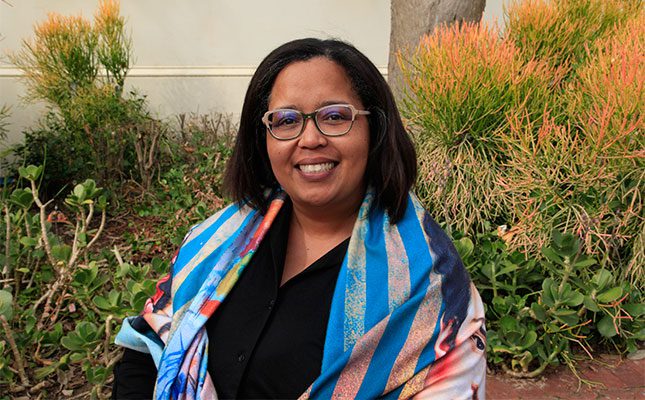
Photo: Glenneis Kriel
At Stellenbosch University’s Department of Viticulture and Oenology, it’s clear that everyone knows Dr Erna Blancquaert. As she walks down the corridors, colleagues, students, and staff greet her warmly; a small yet telling sign of the respect she has earned in a field in which she’s a trailblazer.
When speaking about her journey into agriculture, Blancquaert jokes that the sector chose her.
“I grew up in Paarl, surrounded by vineyards, and my dad used to work at Nederburg Wines. I was intrigued by the descriptors on wine labels long before I understood their meaning.
“After school, I considered studying medicine or engineering, but my love for science and mathematics, along with a natural curiosity for solving problems, led me to explore a field that was fairly unknown,” she says.
At first, like so many others today, she leaned towards oenology, the science of winemaking. But she soon realised her true interest lay in viticulture: “My decision was grounded in the realisation that great wine begins in the vineyard, long before it arrives at the cellar. Without the right grapes, there won’t be any great wine.”
Blancquaert’s decision to specialise in viticulture would eventually lead her to break barriers. In December 2015, she became the first woman of colour in Africa to obtain a PhD in the field, an achievement that continues to inspire her students and others who are considering a future in the industry. Since then, she has also won numerous accolades for her work.
However, she points out that viticulturist remain in short supply: “Viticulturists aren’t celebrated in the same way as winemakers, although more and more wineries are acknowledging the contribution of viticulturists to winemaking success.”
The work is also tough, requiring long hours, while the harvest also often coincides with the December holidays.
“Not everyone is cut out to analyse grapes from as early as 2am, as our researchers sometimes must. On top of that, you’re going to struggle if you’re afraid of insects, spiders, snakes, and even leopards,” she adds with a smile.
Nevertheless, she says the work is incredibly rewarding, allowing her to tackle challenges that threaten not only the domestic industry but the international one, too.
These challenges range from climate adaptation to the adoption of more environmentally responsible production practices and meeting the growing demand from consumers for sustainable wines.
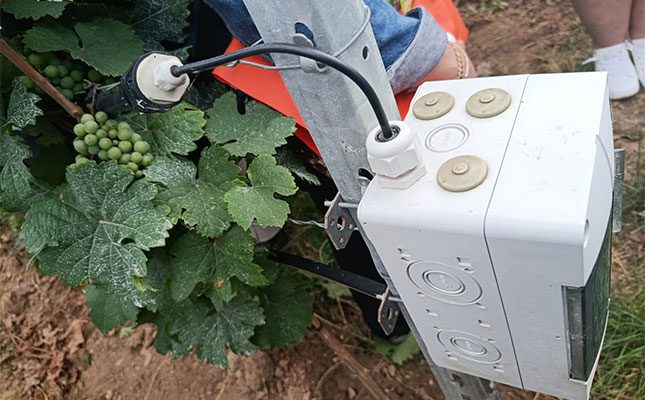
Her own studies focus on the use of greener alternatives to mitigate environmental stress. These include the use of biostimulants derived from seaweed and other protein sources.
She’s also studying regenerative agricultural practices and the impact of introducing cattle into vineyards to improve grapevine functioning, fruiting, and the final quality.
Blancquaert’s position as researcher and lecturer gives her the opportunity to travel overseas, exposing her to viticulture practices from around the world.
“Visiting vineyards and research sites and collaborating with researchers from other countries allows me to see how other countries are tackling challenges, benchmark [South Africa] against them, and bring the lessons back home,” she says.
In Germany, for instance, she observed trials in which ultraviolet machines were used to manage fungal diseases to reduce the industry’s alliance on fungicides and reduce spray drift.
She has also seen trials of vineyards covered by solar panels (a practice called agrivoltaics) which generate electricity while reducing evaporation and protecting the grapes against hail. In some of the trials, heat wires, powered by solar energy, were used in the trellis supports to protect the vines against frost.
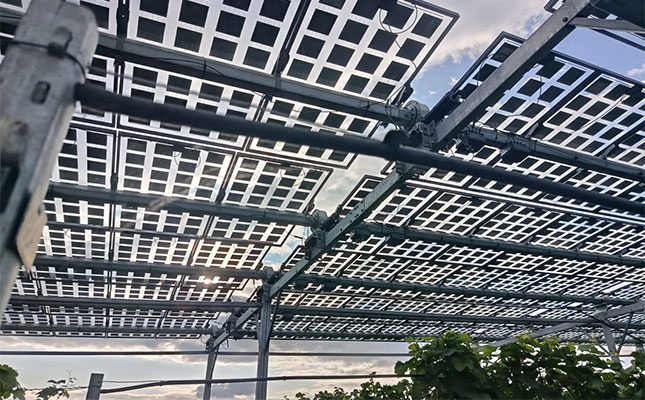
“It is fascinating to see the innovative ways other regions are adapting to environmental and climate challenges. I think the greatest barrier for adoption so far has been the cost, which would be even more significant in South Africa considering the weakness of the rand,” she adds.
These experiences feed directly into Blancquaert’s teaching, helping students understand the latest global trends and technologies in viticulture and broadening their perspective on what might be possible in the future.
Viticulture remains a male-dominated industry, but Blancquaert believes women can leave a unique mark on the industry due to their generally greater attention to detail.
“Women have an incredible eye for precision, which is so important in viticulture and as a researcher. If you are willing to work hard and embrace the challenges, you can contribute in ways that are uniquely yours,” she says.
She adds that regardless of their gender, viticulturists, like winemakers, should travel and work on farms abroad.
“Exposing yourself to international practices helps ensure that the South African wine industry remains a leader in wine quality and production.”
Along with this, she advises students to be passionate about what they’re doing and make time to relax: “Schedule time off to avoid burnout and keep yourself sharp. Remember that health is wealth,” she says.


