In East London, a company is changing how South Africa thinks about food waste. Nambu, founded in 2018, initially focused on farming insects as a protein source for livestock. Today, the business is positioning insects as an essential service in organic waste management.
“We originally focused on insects as a protein source for livestock feed,” says Lowell Scarr, Managing Director of Nambu. “That required high levels of biosecurity, which limited the waste streams we could use. Abattoir waste, catering leftovers and other high-risk materials were excluded because of the potential for disease transfer.”
The company’s early model produced high-quality protein meal, but Scarr says the South African market is not yet ready to adopt insect protein on a large scale. “The production costs are too high for it to be commercially viable right now. There are niche opportunities, but not enough to sustain us if that is the only focus.” Instead of walking away from the sector, Nambu has repositioned. “We realised that if we keep chasing revenue only from larvae sales, we would always be limited,” says Scarr.
“By shifting our model towards waste management, we can take in a much broader range of organic waste streams and generate revenue from managing those. The larvae become a tool to process waste, and what we harvest is then a by-product.”
This shift allows the company to process post-consumer food waste, abattoir waste and meat scraps that were previously excluded. “We see the larvae less as the end product and more as the treatment tool,” Scarr explains. “We can use them ourselves to feed our own poultry and pigs, instead of selling them off, which means we carry any biosecurity risk. Or we can sell them at a lower price to clients who are comfortable with that.”
Insects as a Service

Nambu is exploring waste treatment using black soldier fly larvae
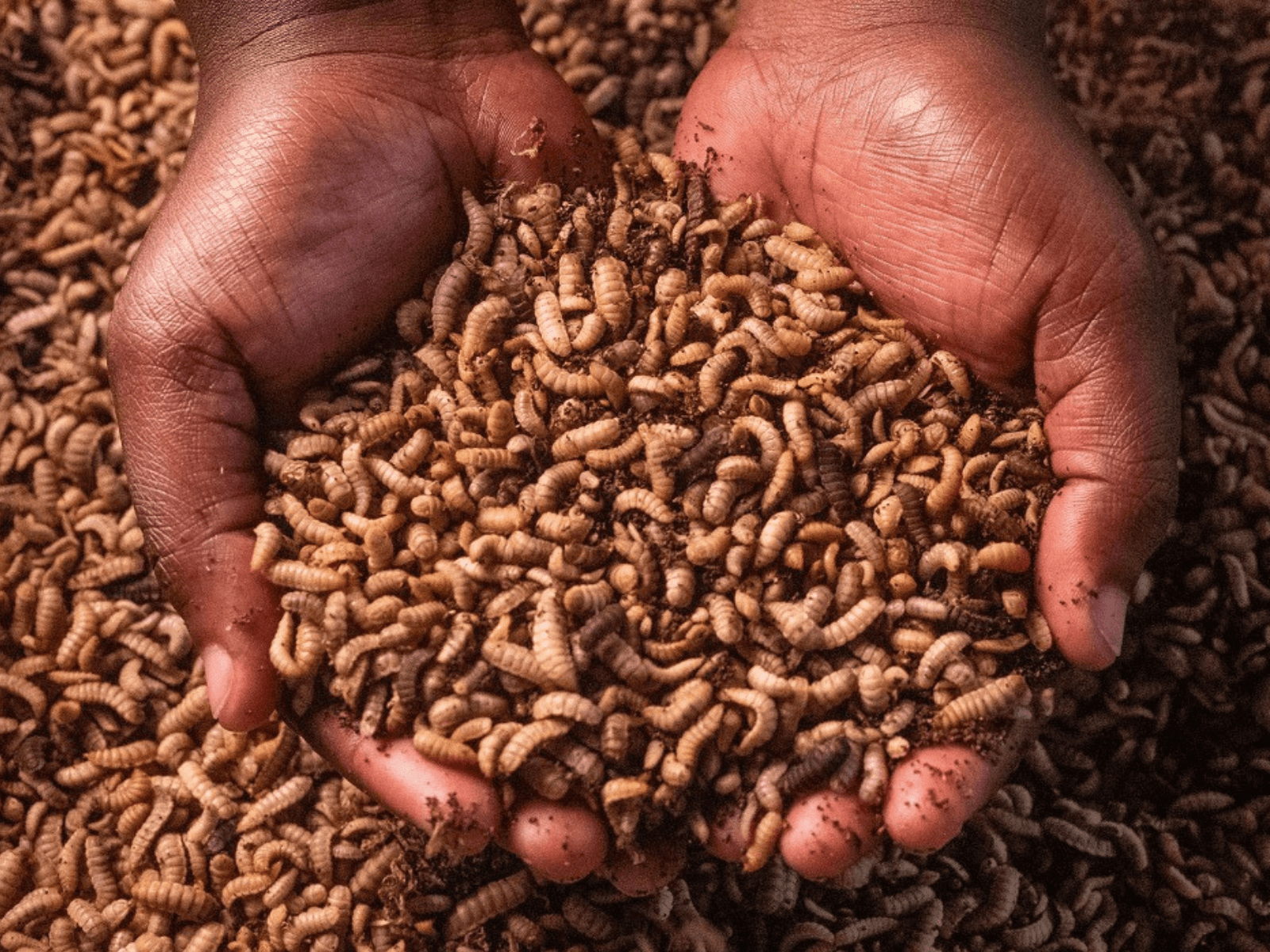
Scarr describes the pivot as moving from insects as a commodity to insects as a service. “It is about treating waste streams that would otherwise end up in landfill or low-value composting,” he says. “This way, we can service more clients, increase our volumes and respond to the immediate need for sustainable food and organic waste management.” Black soldier fly larvae are at the heart of the system. They rapidly consume food waste and convert it into useful products.

“By feeding waste to larvae, we produce proteins and fats that can be used in animal feed, biodiesel and even pharmaceuticals,” says Scarr. “We also produce frass, which is a nutrient-rich soil enhancer with far greater value than basic compost.”
The environmental benefits are significant. “Compared to composting, using black soldier fly larvae can cut carbon emissions by up to 50 percent,” Scarr explains. “The process is also faster, taking about two weeks, whereas composting can take six months.” This positions insect treatment for waste as an economically beneficial alternative to just composting, which Scarr says, “is still very important in the larger context of organic waste.”

Low tech for local context

By products include frass and protein, adding value to waste
Scarr stresses that Nambu has developed a model suited to South Africa’s conditions. “Our approach is pragmatic and relatively low tech. We rely less on expensive machinery and more on available labour. That is not a disadvantage in South Africa, where there is a need for more job creation and less reliance on unstable energy supply.” Instead of expensive HVAC systems and automated machinery, Nambu uses simple equipment and adaptable processes. “We look at what can be bought locally, what can be operated by staff with training, and what can function without heavy reliance on water or electricity,” says Scarr. “It makes the business more resilient and allows us to scale in contexts where capital is scarce.” He points out that interest rates and financing conditions make capital-intensive projects more difficult in South Africa than in Europe or North America. “Here, borrowing is more expensive, so building systems that are less capital-heavy makes sense. We have to adapt to the reality we are in, not the one we wish we had.”
Overcoming the “Yuck Factor”

The black soldier fly, a natural solution to manmade problems
Insects and waste come with stigma, but Scarr believes curiosity outweighs disgust. “People do find insects and food waste unpleasant, but they are also intrigued. Even those who recoil at first are often fascinated once they see what we are doing. We have had visitors who start by refusing to step into a facility, and end up with their hands in a container of larvae because they are so interested.” The challenge, he says, is often with waste producers themselves. “There is still a tendency to treat waste and those who handle it with disdain. If you are providing a paid service, you are treated with respect. If it is a free service, you are treated like waste yourself. That culture needs to change. Waste is the producer’s responsibility. We are there to help them deal with it.” Nambu’s shift reflects a wider movement in the insect protein industry. “Many of us started with a pure focus on insect protein,” says Scarr. “But the market has shown us that in South Africa, it is premature. A pragmatic choice is to move towards waste management. That way, the industry keeps developing, the businesses stay viable, and the technology improves.” He remains optimistic about the future. “At some point, the market for insect protein will mature, and then we may see a shift back towards a protein-first model. For now, we are following the money, and the opportunity that we see is in waste. It is the best way to keep the lights on and to keep building the sector.”

Storage and safe management is essential for this waste stream