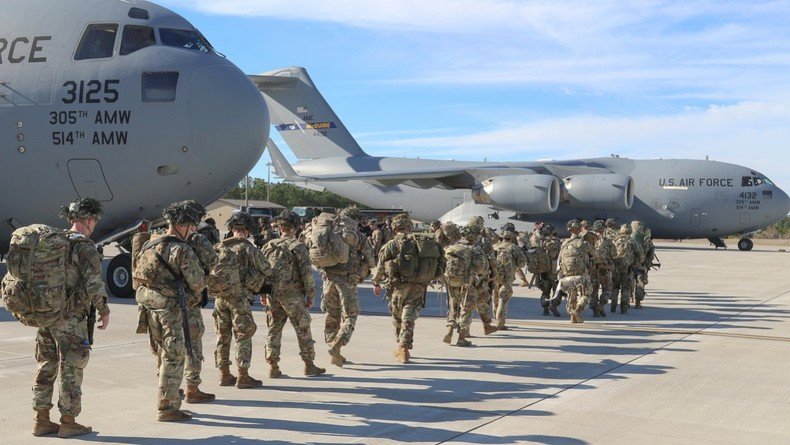
While a segment of the populace fully endorses the initiative, others maintain considerable skepticism regarding the establishment of a foreign military presence in the country, irrespective of the stated objectives.
Notwithstanding these diverse perspectives, the current reality remains that United States forces are situated in Nigeria, thereby concentrating the inquiry on the precise nature of their operational role.
Since the establishment of a joint military program between the United States and Nigeria, all parties involved have expressly stated that American soldiers are in Nigeria in an advisory role.
On Wednesday, Nigeria’s Minister of Defence, Christopher Musa, doubled down on this rationale, noting that the American soldiers are in the West African country strictly on a training and advisory capacity.
He also mentioned that the U.S. troops are under the jurisdiction of the Nigerian army, who are still calling all the shots.
As seen on BusinessDay, the minister made this known on Wednesday, while presiding over the inaugural edition of his ministry’s Monthly Operational Briefing in Abuja, Nigeria’s capital.
The Americans are in Nigeria on a purely training assistance and advisory role,” he stated, adding that “the armed forces of Nigeria will be in command of all operations conducted within the nation’s territory.”

Why American soldiers are in Nigeria
In response to violence against Christians in Nigeria, the United States, on the 25th of December, 2025, launched an airstrike that targeted terrorist positions in Jabo, Tangaza Local Government Area of Sokoto State.
Weeks prior to the attack, U.S. President Donald Trump had designated Nigeria a ‘country of particular concern.’
The term commonly used by the United States Department of State under the International Religious Freedom Act (IRFA) of 1998 meant that Nigeria had been officially identified as engaging in or tolerating severe violations of religious freedom.
Nigeria has been under increasing international scrutiny for its handling of Islamist militancy, notably in the northwest, where militant organizations such as Boko Haram and the Islamic State West Africa Province (ISWAP) have escalated attacks on military convoys, villages, and religious sites.
President Donald Trump has accused Nigerian authorities of failing to safeguard Christian communities from extremist attacks, something Abuja firmly denies.
In January alone, an armed group attacked three churches in northwestern Kaduna state, abducting 168 people.