

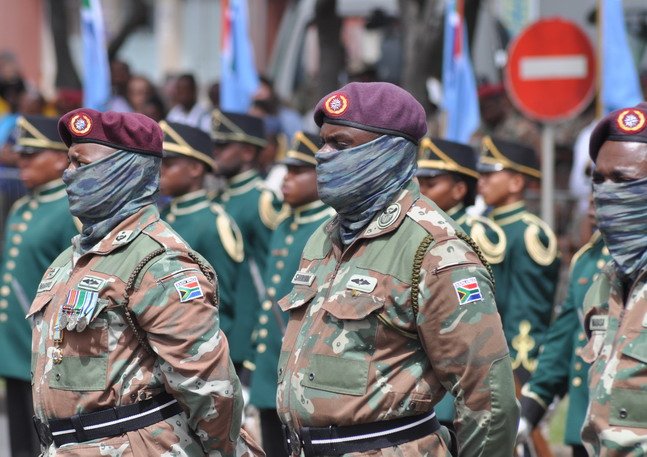

In the early hours of a training exercise, a small team moves quietly through a darkened structure. Communication is minimal. Hand signals replace words. One operator prepares a breaching tool while another covers a hallway, scanning angles and potential threats. Within seconds the door is opened and the team moves with controlled precision clearing rooms, communicating silently, maintaining overlapping fields of observation.
For decades, scenes like this were associated almost exclusively with elite military formations or specialised police tactical units.
Today, however, similar training environments are increasingly found outside traditional state institutions.
Across the world — and particularly in regions with complex security environments such as Africa — a new class of highly trained security professionals is emerging. These individuals are not soldiers in the traditional sense, yet their training increasingly reflects special operations doctrine. They operate in private security, close protection teams, anti-poaching units, and high-risk corporate environments.
They represent what could be described as the next generation of Special Forces — operators trained in advanced tactical capabilities, but functioning outside conventional military structures.
The Origins of Special Forces
To understand this evolution, it is useful to briefly consider where the concept of “special forces” originated.
During the Second World War, several nations recognised the need for small, highly trained units capable of conducting missions beyond the scope of conventional armies. One of the most famous examples was the British Special Air Service (SAS), formed in 1941 to conduct deep penetration raids against Axis forces in North Africa.
These early special operations units focused on missions such as:
- sabotage behind enemy lines
- reconnaissance and intelligence gathering
- unconventional warfare
- raids on strategic targets
Their success demonstrated the value of small, highly trained teams capable of operating independently and adapting rapidly to changing environments.
After the war, many countries developed their own special operations units. These formations became known for extremely demanding selection processes, specialised training, and operational flexibility.
By the late twentieth century, special operations forces were widely regarded as the elite edge of military capability.
The Expansion of Tactical Knowledge
For much of modern history, the knowledge and doctrine of special operations units remained confined to military and law enforcement institutions.
However, the end of the Cold War, the expansion of global security markets, and the rise of private security companies gradually changed this dynamic.
Former members of:
- military special operations units
- police tactical teams
- intelligence services
- VIP protection units
began transitioning into the private sector.
Rather than leaving their experience behind, many of these professionals established specialised training institutions dedicated to transferring tactical knowledge.
These institutions now train a diverse range of individuals, including:
- private security professionals
- anti-poaching rangers
- close protection teams
- law enforcement officers
- military personnel
- corporate security specialists
- civilians seeking advanced defensive skills
The result has been the gradual spread of tactical knowledge once restricted to elite units.
The Tactical Toolbox
Modern training institutions increasingly offer comprehensive programmes designed to develop a wide range of operational capabilities.
Advanced Firearms Training
Students train on multiple weapon systems while learning principles such as:
- fire and movement
- combat shooting under stress
- low-light engagements
- weapon transitions
- close-quarters battle (CQB)
- Force on force training with simunition
The emphasis is not simply on shooting accuracy but on applying weapons effectively within complex and dynamic environments.
Urban Tactical Operations
Urban training environments often include instruction in:
- tactical mission planning
- room-clearing techniques
- dynamic and stealth breaching (mechanical and non-mechanical)
- small-team movement through buildings
- hostage rescue simulations
- verbal and non-verbal communication under pressure
- rope work and vertical entry techniques
- helicopter orientation
- drone reconnaissance and aerial observation
Operators learn to function as part of coordinated teams rather than as individuals a principle central to modern tactical doctrine.
Rural and Reconnaissance Skills
Many programmes also emphasise rural operational capabilities such as:
- long-distance marksmanship
- tracking and counter-tracking
- surveillance and reconnaissance
- escape and evasion
- bushcraft and navigation
- establishing observation posts
- conducting sustained operations away from base locations
These skills are particularly relevant in regions such as Africa, where vast rural environments demand specialised operational knowledge.
Some institutions even provide parachute training, including equipment jumps, capabilities traditionally associated with military airborne units.
Selection-Style Training
Certain training organisations have adopted models inspired by special operations selection programmes.
Participants may experience:
- endurance challenges
- sleep deprivation exercises
- stress-based decision making
- leadership evaluations
- time-pressured tactical problem solving
The objective is not merely to teach technical skills but to identify individuals capable of operating under extreme stress.
This reflects a long-standing principle within special operations communities:
technical proficiency must be matched by mental resilience.
From Guards to Operators
Historically, private security was associated primarily with static guarding, patrol duties, and access control.
That paradigm is evolving rapidly.
Modern security threats increasingly include:
- kidnapping
- organised crime
- political violence
- armed robbery
- wildlife trafficking
- corporate espionage
To address these threats, some private security teams have developed into highly capable operational units.
Their roles may include:
- high-risk close protection
- counter-kidnapping support
- intelligence gathering
- anti-poaching operations
- convoy protection in hostile environments
- crisis response operations
In some international contexts, private security teams may even support operations against organised crime or terrorist threats.
These units differ significantly from traditional security guards. They operate with structured doctrine, coordinated team tactics, and advanced operational training.
The Rise of Private Military Companies
Parallel to this development has been the rise of private military and security companies (PMSCs).
Since the 1990s, such organisations have increasingly operated in conflict zones, providing services such as:
- security for diplomatic missions
- protection of critical infrastructure
- training for military and police forces
- logistical support in conflict areas
While controversial in some cases, these companies have further contributed to the spread of specialised tactical expertise beyond traditional state structures.
The “All Gear, No Idea” Problem
The rapid expansion of tactical training has also produced a parallel challenge.
The market has seen an increasing number of organisations advertising “special forces-style training.”
Not all of them possess genuine credibility.
Modern social media has made it easy to create the impression of professionalism through dramatic imagery, camouflage uniforms, and expensive equipment.
Yet operational capability is built on far more than appearance.
Two recurring problems increasingly appear within the industry:
All skill, no experience: Individuals may accumulate numerous training certificates but lack real operational exposure.
All gear, no competence: Equipment alone does not substitute for discipline, judgement, and experience.
The most credible institutions remain those led by instructors with verifiable operational backgrounds.
Reputable training providers also implement strict vetting procedures to ensure that training is not provided to criminal or extremist actors.
Experience: The Ultimate Instructor
Training builds competence.
Experience builds judgement.
Real operational environments introduce variables that cannot be fully simulated in controlled training conditions: uncertainty, fear, time pressure, and rapidly changing circumstances.
The most effective operational teams therefore tend to combine individuals from multiple backgrounds:
- former military operators
- former police tactical members
- experienced security professionals
Together they form multidisciplinary teams capable of addressing complex modern threats.
The Changing Meaning of “Special” Language evolves with time.
During much of the twentieth century, the term special forces referred exclusively to elite military units.
Today the term increasingly reflects capability rather than institutional affiliation.
Private security professionals are not soldiers. They do not operate under military command structures.
Yet the knowledge, doctrine, and training methodologies once confined to elite units are gradually spreading into the private sector.
With the right instructors, sufficient resources, and structured training, private sector operators can develop remarkably advanced capabilities.
The Future of Tactical Capability
The global security environment continues to evolve.
Urbanisation, organised crime networks, political instability, and the protection of high-value assets have all increased demand for highly trained security professionals.
As this demand grows, advanced tactical training within the private sector is likely to continue expanding.
The next generation of special forces may not wear national flags on their shoulders.
They may instead be anti-poaching rangers protecting wildlife reserves, security specialists safeguarding corporate infrastructure, or protection teams operating in volatile regions.
Their defining characteristic will not be their uniform. It will be their training, discipline, and operational capability.
Final Thoughts
The concept of “special” has always been about more than equipment or titles. It has been about standards of training, discipline, and performance under pressure.
As tactical knowledge continues to move beyond traditional military institutions, a new generation of professionals is emerging. They may not belong to the armed forces, but in many cases their preparation, skill sets, and operational mind-set reflect the same principles that once defined elite units.
In the end, what truly defines special operators has never been the organisation they belong to.
It has always been what they are capable of doing when the situation demands it.
Armand Badenhorst is a former member of the South African Police Service, where he specialised in Hostage Negotiation and High-Risk law enforcement operations. He holds a National Diploma in Policing and currently oversees residential security operations. Armand is furthering his expertise through advanced studies in business management, with a focus on developing strategic solutions in private security.


