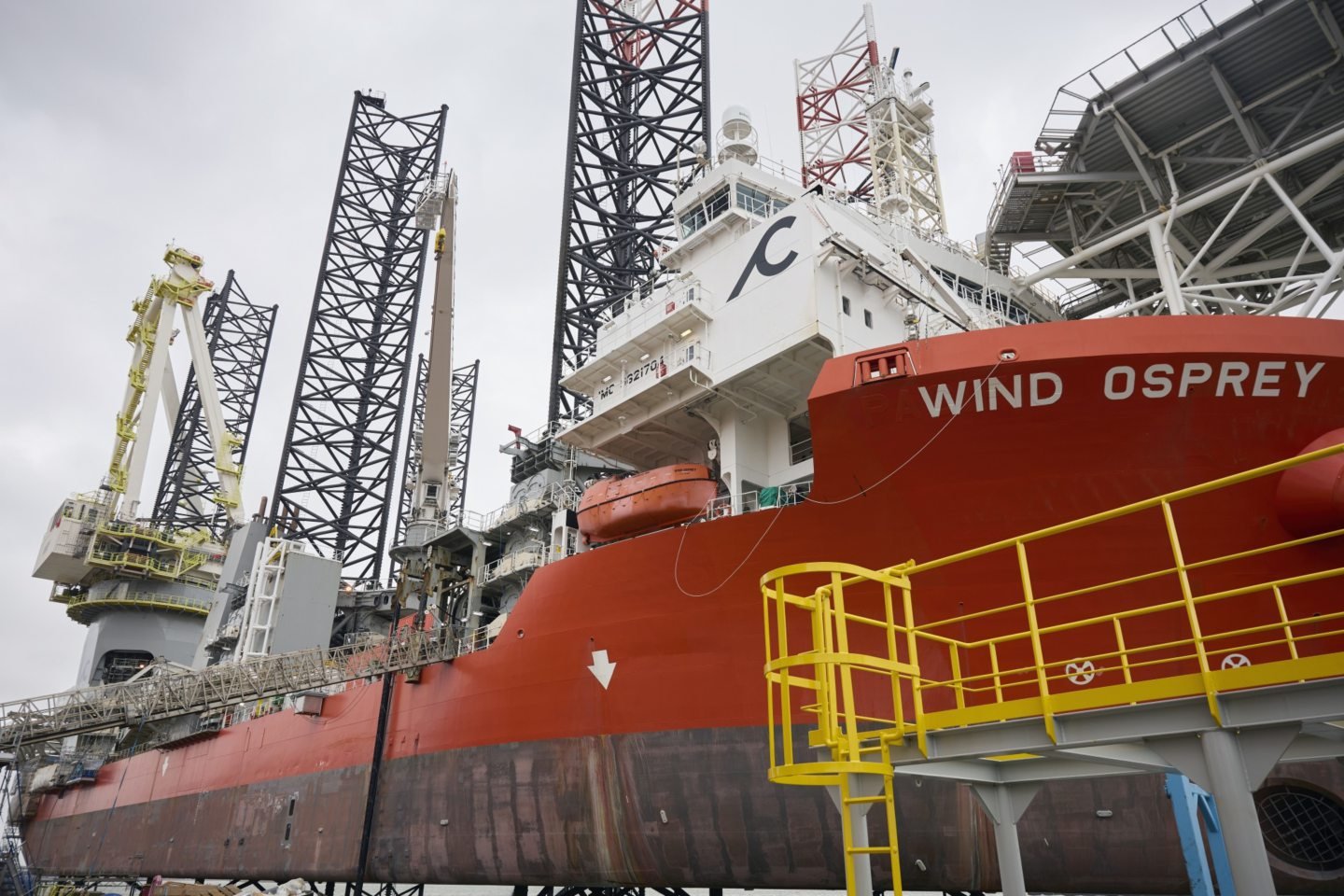
On the outskirts of Rotterdam, a bright orange ship is hoisted above the muddy Rhine with the help of six chunky triangular legs. The vessel has just been retrofit with a huge crane capable of lifting up to 1,600 tons 160 meters above deck. Once the finishing touches have been made, the Wind Osprey will take off for Germany, and return to building wind turbines at sea.
As governments green their economies and utilities retire fossil-fuel power stations, wind installations are emerging as one of the most popular forms of alternative energy. Globally, offshore wind capacity is poised to quintuple between 2022 and the middle of the next decade, according to BloombergNEF, and to squeeze more energy out of the wind, turbines are getting bigger and bigger. That means that ships capable of installing them are in growing demand.
And at the moment, the fleet isn’t expanding quickly enough.
Clarksons Offshore Renewables, a shipping broker that matches vessels with project developers, estimates that there are between 15 and 20 ships outside China able to install turbines with a minimum 15-megawatt capacity, and that more will be needed in the next several years. Consultant Wood Mackenzie Ltd. says that there are about 40 ships operating outside China, though not all are used exclusively for offshore wind. To meet future demand, Woodmac anticipates about $14.8 billion will need to be invested. So far, only about a third of that has actually been committed.
The new crane in gray surrounded by scaffolding. The triangular legs are used to lift and stabilize the ship during installations of wind turbines.
Building an enormous wind turbine is a complicated task on land, never mind on the open ocean. It starts with carefully loading components onto a ship. Towers and blades can be more than 100 meters long, and the container that houses the generator, called a nacelle, is around the size of a villa. Once the ship reaches the future site of the turbine, the pieces must be removed and assembled. It takes roughly three days to install just one turbine, depending on travel time to port.
The looming shortage of ships capable of handling such turbines, some of which are almost as tall as the Chrysler Building, comes on the back of a tumultuous 2023 for the offshore wind industry. While European investment in new offshore wind parks jumped to a record €30 billion ($32.5 billion) last year, up from €400 million the year prior, the industry also faced supply chain snarls, massive writedowns and delays to projects in the US and the UK.
Meanwhile, “everything is getting bigger,” said Wind Osprey captain Matt Christie. “All the components are getting bigger, the ships are getting bigger.”
 © Bloomberg
Aligning supply and demand for giant ships won’t happen overnight. It takes at least three years and $400 million to build a new installation vessel. And this timeframe is likely to stretch as shipyards in Asia fill up with orders for oil and gas carriers, according to a project manager at China’s CIMC Raffles, one of the industry’s main shipbuilders. Raffles is currently building five vessels for the wind industry, including one with a lift capacity of more than 3,000 tons for Havfram AS, a new player in the industry.
Another option, retrofitting older ships, is also time-consuming and expensive. Cadeler A/S, the Danish owner of the Wind Osprey and its sister ship Wind Orca, is spending about €100 million to upgrade both of them at the shipyard in Rotterdam. Work started last autumn, and the firm has recouped some of its investment by selling the ships’ old cranes, which won’t be up to the task of lifting the next generation of turbines.
Lack of ships for offshore wind
“It’s preparation for the future,” said Cadeler’s Chief Executive Officer Mikkel Gleerup from one of Osprey’s common rooms, where the ship’s roughly 40 crew members relax between shifts. Working on a wind installation ship is grueling work – schedules are tight, clients demanding, and the wind can make installations more difficult. The job requires 12-hour shifts, 6am to 6pm and vice versa, four weeks on, four weeks off.
“It is 24 hours,” said Christie, the captain. “So we have to work around the clock.”
This is more true than ever given current demand. Ships in the industry tend to be reserved several years in advance, and Cadeler’s vessels in general are almost fully booked through 2027, said Gleerup, noting that this is a significant change from just a few years ago. The firm also has several new ships on order.
In early April, Wind Osprey will start work on Orsted A/S’s Borkum Riffgrund 3 project in Germany.
The biggest developers, including Denmark’s Orsted and Germany’s RWE AG, are now securing ships on charters that last up to several years. In turn, ships are getting more expensive to hire. Day rates have increased from about $200,000 in 2022 to about $350,000 for the newest and biggest vessels, according to Clarksons. That compares with an rate of about $54,000 per day for a supertanker traveling between China and the Middle East.
“Actual rates are always the best proof of a tight market,” said Jens Egenberg, a director of offshore and renewables at Clarksons.
Havfram, whose first installation ship will be delivered in the second half of 2025, has already signed long-term deals with Orsted and RWE. Chief Executive Officer Ingrid Due-Gundersen says that these arrangements will ensure more use and a more predictable schedule. With a bottleneck expected for vessel access, she wrote via email, more players in the industry may soon follow suit.
Recommended for you