


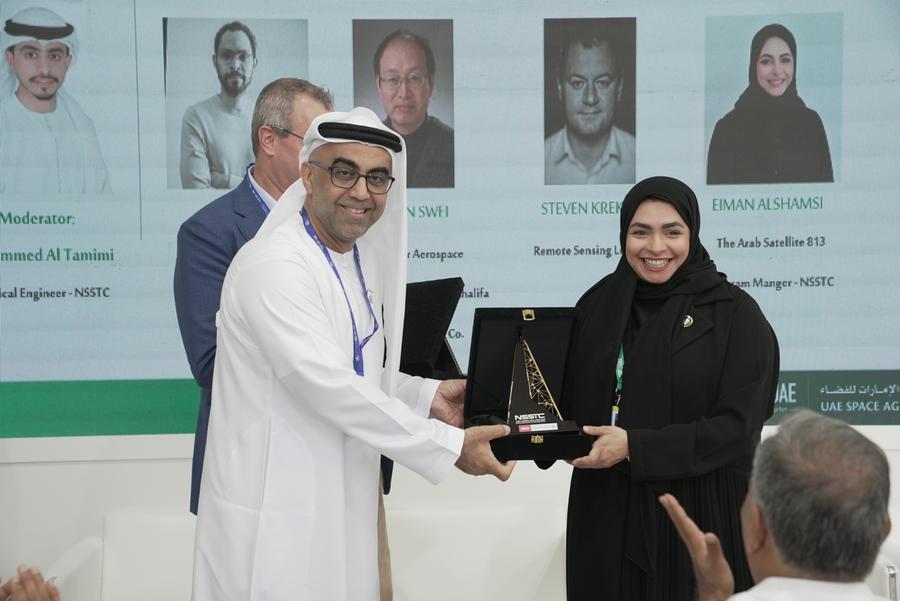
Dubai: The National Space Science and Technology Center (NSSTC) concluded the discussion sessions that were held during its participation in the activities of the COP 28 Conference of the Parties. The contents of the sessions revolved around the space industry and its role in confronting the phenomenon of global warming, with the need to harness satellites to know about climate changes and droughts, and to explore water sources and others. One of the great benefits of satellites is in monitoring climate changes that threaten the world with natural disasters.
Participants in the sessions stressed the need for international cooperation and participation to provide the information, data, and images necessary for studying, conducting research, understanding climate change, anticipating many negative climate phenomena, and finding solutions.
Eng. Muhammad Al-Karbi, GNSSaS Project Manager, said “Remote sensing or hyperspectral technology is the latest imaging technology in the satellite sector. It helps provide a high-resolution and high-quality data image for sectors related to space and climate change from universities, institutes, research centers and bodies.” government to take appropriate decisions regarding climate change.
Eng. Al-Karbi added, “This data and its applications are very important in studying the climate. Through it, it is possible to conclude scientific studies and analyzes of the atmosphere, soil, water, plants, plant health, environmental pollution, and provide accurate data on fish wealth and others.”
Eng. Al-Karbi pointed out that the UAE, through its reliance on remote sensing or hyperspectral technology, is working to provide satellites manufactured in the country with this technology, and then provide this data and images to the Arab countries that are members of the Arab Space Group.
Al-Karbi stressed the importance of training and training for students, engineers, and everyone related to space science to study and understand this technology and create scientific conditions to absorb its amazing developments, as hyperspectral technology is the latest development in space technology in photography.
The center reviewed a realistic experience about the effects of drought in Kenya.
NSSTC reviewed a real-life story facing the people of the Kerio Valley in Kenya after the previously green valley filled with water turned into a dry valley.
The session reviewed a short video showing the state of the Kerio Valley in Kenya after facing lack of rain and groundwater shortages, in addition to the erosion of soil during the rainy period. It became clear that water shortages may become a tragedy that separates life from death.
Philip Kiplimo, a farmer from the Kerio Valley, presented the problem in his local language, while Kipkimboi Kande, an environmental and drylands specialist in Kenya, translated and explained the problem. While Dr. explained Wilson Kipkori, a lecturer at the University of Victoria and founder of the sources of the Nile Basin, explains the effects of this problem on society. The session was moderated by Dr. Anne Bertlett is associate professor of government and society.
In his comment, Dr. They ask that water equals life, and that the people of the Kerio Valley are suffering from a lack of water suitable for drinking, agriculture, or raising livestock. He explained that the people are forced to leave behind the rain every six to eight months, at the lowest standard of living that does not even guarantee the necessities, and that the cost of digging a well is approximately 40 One thousand UAE dirhams.
She also invited Dr. Anne Bertlett, at the end of the session through COP 28, called for concerted humanitarian efforts to confront the problems resulting from climate change, and the duty of the global community to cooperate to combat such problems and work to prevent them from facing them in the future.
In another session, Noura Al-Neyadi reviewed her experience in the Republic of Chad, where she conveyed the real conditions of climate change after living for about a month, during which she recorded the problem of water, desertification, and lack of vegetation cover due to global warming.
Al-Neyadi presented an anthropological study on the people of Niger, their tribes, and their ways of living, with the possibility of providing assistance to the population there, such as health, educational, agricultural, and other support.
Al-Neyadi recorded that the population there is concerned about a major problem that is repeated daily, which is water and food due to drought and the lack of agriculture resulting from the drying up of about 90 percent of Lake Chad, which is shared by Chad, Niger, and Cameroon, which affects about 10 million people.
Al-Neyadi reported details of the daily lives of the people of Chad and their suffering with the environmental problem of lack of water and desertification, which puts the people there at risk, not only humans but also animals, especially since they constitute an important source of income for the people of Chad and neighboring countries.
Al-Neyadi reviewed pictures of the region’s lakes in the past, which were full of water until they began to diminish until many lakes disappeared, leaving only a lake known today as Lake Chad.
Eng. Iman Sultan Al Shamsi, the Satellite 813 Project Manager from NSSTC, stressed the importance of international cooperation in the field of space to understand and monitor geophysical processes and other areas of joint cooperation.
Al Shamsi said, “At the National Space Science Center, we have established a department for Earth observation consisting of a group of students specialized in space sciences and researchers to discuss these issues and develop satellite equipment and others in cooperation with other entities.”
Al Shamsi touched on the Arab Satellite 813 project, which has entered the design stage and is expected to be launched in the year 2025, noting that the 813 satellite data will be shared with the 14 Arab countries concerned with the project.


