

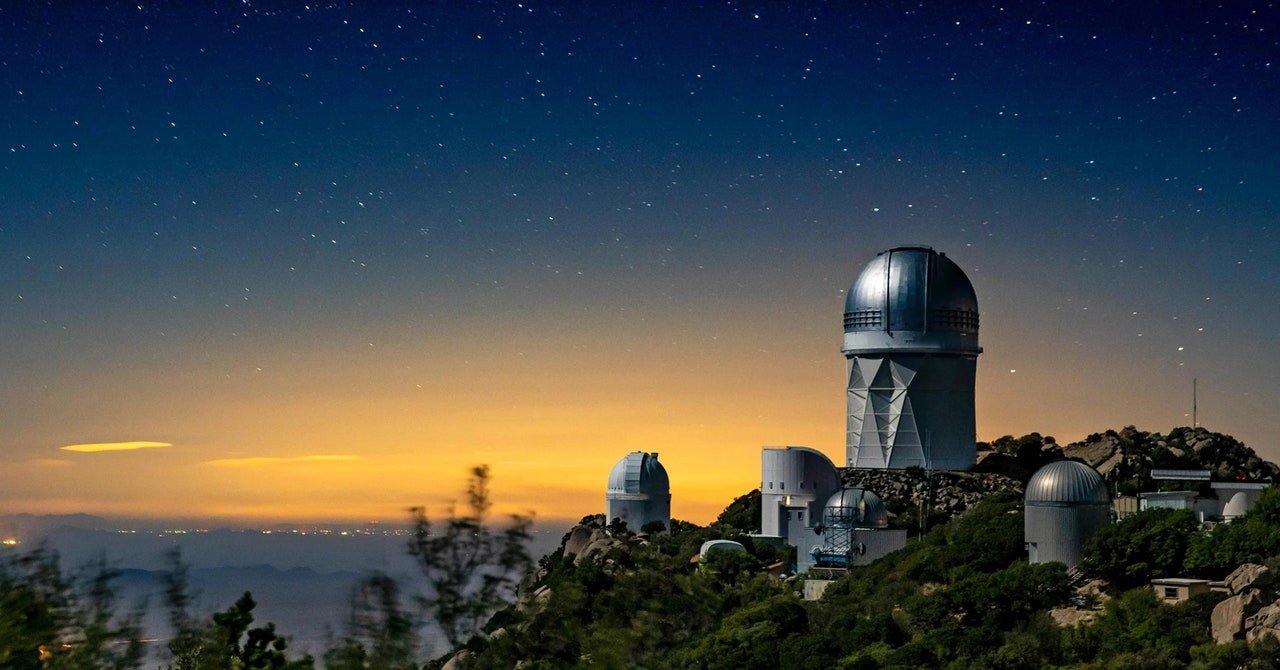
Beyond DESI, a slew of new instruments are coming online in the coming years, including the 8.4-meter Vera Rubin Observatory in Chile, NASA’s Nancy Grace Roman Space Telescope, and the European Space Agency’s Euclid mission.
“Our data in cosmology has made enormous leaps over the last 25 years, and it’s about to make bigger leaps,” Frieman said.
As they amass new observations, researchers may continue to find that dark energy appears as constant as it has for a generation. Or, if the trend continues in the direction suggested by DESI’s results, it could change everything.
New Physics
If dark energy is weakening, it can’t be a cosmological constant. Instead, it may be the same sort of field that many cosmologists think sparked a moment of exponential expansion during the universe’s birth. This kind of “scalar field” could fill space with an amount of energy that looks constant at first—like the cosmological constant—but eventually starts to slip over time.
“The idea that dark energy is varying is very natural,” said Paul Steinhardt, a cosmologist at Princeton University. Otherwise, he continued, “it would be the only form of energy we know which is absolutely constant in space and time.”
But that variability would bring about a profound paradigm shift: We would not be living in a vacuum, which is defined as the lowest-energy state of the universe. Instead, we would inhabit an energized state that’s slowly sliding toward a true vacuum. “We’re used to thinking that we’re living in the vacuum,” Steinhardt said, “but no one promised you that.”
The fate of the cosmos would depend on how quickly the number previously known as the cosmological constant declines, and how far it might go. If it reaches zero, cosmic acceleration would stop. If it dips far enough below zero, the expansion of space would turn to a slow contraction—the sort of reversal required for cyclic theories of cosmology, such as those developed by Steinhardt.
String theorists share a similar outlook. With their proposal that everything boils down to the vibration of strings, they can weave together universes with different numbers of dimensions and all manner of exotic particles and forces. But they can’t easily construct a universe that permanently maintains a stable positive energy, as our universe has seemed to. Instead, in string theory, the energy must either gently fall over the course of billions of years or violently drop to zero or a negative value. “Essentially, all string theorists believe that it’s one or the other. We do not know which one,” said Cumrun Vafa of Harvard University.
Observational evidence for a gradual decline of dark energy would be a boon for the gentle-fall scenario. “That would be amazing. It would be the most important discovery since the discovery of dark energy itself,” Vafa said.
But for now, any such speculations are rooted in the DESI analysis in only the loosest of ways. Cosmologists will have to observe many millions more galaxies before seriously entertaining thoughts of revolution.
“If this holds up, it could light the way to a new, potentially deeper understanding of the universe,” Riess said. “The next few years should be very revealing.”
Original story reprinted with permission from Quanta Magazine, an editorially independent publication of the Simons Foundation whose mission is to enhance public understanding of science by covering research developments and trends in mathematics and the physical and life sciences.


