
Air power is often discussed in Africa through the lens of prestige acquisitions, headline fighter jets, or comparisons with major global powers. Yet this framing obscures the real question African states face: not how to emulate advanced air forces elsewhere, but how to build air capabilities that are affordable, sustainable, and aligned with the continent’s actual security and developmental realities.
In Africa, air power matters not because of high-end state-on-state conflict or power projection across continents, but because the continent’s security challenges are spatial, asymmetric, and time-sensitive. Vast territories, porous borders, insurgencies, transnational crime, and humanitarian crises all demand speed, visibility, and mobility. In this context, air power is less about dominance and more about reach, awareness, and responsiveness.
Ambition versus capability: the reality gap
Over the past decade, many African air forces have experienced a strategic awakening. There is a growing recognition that air power is central to national security, deterrence, and regional stability. This awareness has translated into ambitious modernisation plans and interest in advanced platforms.
However, ambition has frequently run ahead of capacity. Official fleet inventories often mask a deeper reality: the number of aircraft owned is not the same as the number that are airworthy, crewed, and sustainably maintained. Across much of the continent, readiness rates are constrained by maintenance backlogs, spare-parts shortages, skills gaps, and fiscal pressure. As a result, headline numbers can significantly overstate real operational capability.
This gap between inventory and readiness is not merely a technical issue. It reflects deeper institutional and economic constraints that shape what air forces can realistically deliver.
What “modern” really means in the African context
In global defence discourse, “modern air power” is often associated with stealth fighters, network-centric warfare, and high-end state-on-state conflict. For most African countries, this model is neither necessary nor affordable.
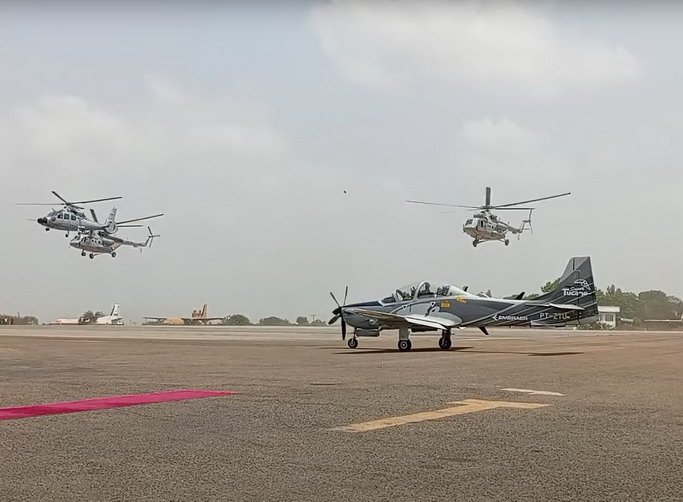
In an African context, modernity should be defined functionally rather than technologically. Modern air power is that which matches mission profiles and delivers reliable outcomes. This includes intelligence, surveillance, and reconnaissance platforms; drones; multirole aircraft; airlift and logistics; and effective command and coordination with ground forces.
Incremental upgrades, interoperability, and sustained availability often matter far more than acquiring the most advanced aircraft on the market.
Evolution, rather than revolution, is the more realistic trajectory.
Defence spending: how much is enough?
The question of defence budgets inevitably arises. Internationally, a benchmark of around 2–2.4% of GDP is often cited as a standard for military spending. This benchmark, however, emerged from alliance-based, industrialised economies with very different threat environments and fiscal capacities.
For most African states, attempting to meet or exceed this threshold risks crowding out essential priorities such as education, healthcare, food security, social welfare, and economic development. The result is often not stronger security, but weaker states and hollow forces.
A more realistic and defensible target for much of Africa is closer to 1.5% of GDP. At this level, countries can fund internal security, border control, peacekeeping contributions, airlift, surveillance, training, and maintenance without undermining development. Crucially, this level of spending forces prioritisation over prestige and rewards efficiency over symbolism.
The strategic challenge, therefore, is not spending more on defence, but spending better.
Institutions and capacity: the real foundation of defence
Sustainable defence capability is an outcome of institutional strength, not a substitute for it. Aircraft and weapons systems cannot compensate for weak governance, fragmented procurement, or underdeveloped skills bases. In fact, high-end acquisitions often expose institutional weaknesses rather than resolving them.
Internal capacity-building is therefore the true first line of defence. This includes professional civil–military relations, transparent procurement systems, predictable budgeting, and investment in human capital. Without these foundations, even well-funded forces struggle to remain operational.
Economic growth plays a decisive role here.
A growing economy expands the tax base, stabilises public finances, and supports the development of technical and industrial skills. Countries that attempt to buy security without first growing their economies tend to import not only weapons, but dependency.
Local industry, skills, and reduced dependency
Defence sovereignty does not require total self-sufficiency, but it does demand meaningful domestic capability. Even partial localisation—such as maintenance, repair, and overhaul facilities; logistics; and technical training—can dramatically improve readiness and resilience.
Building local industry and skills reduces vulnerability to supply disruptions, sanctions, and external political pressure. It also anchors defence spending within society by creating skilled employment and civilian spill-overs into aviation, engineering, and logistics sectors.
Dependence is not eliminated by diversifying suppliers alone; it is reduced by building domestic capability, even incrementally.
Cooperation within Africa: the role of institutions
Given fiscal and capacity constraints, cooperation is not optional — it is essential. No African country needs a full-spectrum air force. Shared challenges demand shared solutions.
Institutions such as the African Union have an important enabling and coordinating role to play, particularly in setting norms, facilitating cooperation, and supporting joint training, peacekeeping, and interoperability among African air forces. While the AU is not designed to function as a collective defence alliance, it can support coordination, norm-setting, joint training, peacekeeping frameworks, early-warning mechanisms, and interoperability standards.
Expectations should be realistic, however. A NATO-style alliance requires uniform threat perceptions, high political trust, economic symmetry, and binding defence commitments—conditions that do not currently exist across Africa or the Global South. Rather than a single collective defence structure, Africa is better served by modular, regional, and functional cooperation: shared training facilities, pooled maintenance hubs, joint airlift and ISR capabilities, and mission-specific coalitions.
Africa does not need a single defence alliance; it needs layered cooperation aligned with regional realities.
A pragmatic vision for the future
Ultimately, the future of air power in Africa will not be decided by who acquires the most advanced aircraft. It will be shaped by which countries build sustainable institutions, grow their economies, invest in skills, and cooperate intelligently with neighbours.
Air power that can fly, adapt, and endure is ultimately more valuable than air power that looks impressive on paper. In that sense, Africa’s path forward is not about imitation, but about designing defence capabilities that reflect its own realities — and priorities.
Dr Joan Swart is a forensic psychologist and military analyst specialising in security studies, geopolitics, and strategic affairs, with a particular focus on Africa. She is currently completing a PhD at the University of Stellenbosch Military Academy.