
Amid airspace and airport closures throughout the Middle East, the U.S. is urging Americans to depart immediately from more than a dozen countries in the region as Israeli Prime Minister Benjamin Netanyahu and President Trump’s war on Iran approaches its fifth day.
The U.S. military’s death toll rose to six on Monday after a strike on a poorly-protected tactical operations center in Kuwait, as CBS News reported Tuesday. Two other Defense Department employees were injured in Bahrain following a drone strike on a hotel there, according to the Washington Post.
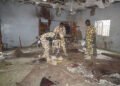

And more than 780 people have been killed inside Iran since the U.S. and Israel launched their attack early Saturday, according to al-Jazeera reporting Tuesday. In an apparent effort to assert some leverage, Iran’s military announced Monday it has closed the Strait of Hormuz and any vessel trying to pass through would be attacked. The closure has sent global oil and gas prices soaring, Reuters reported Tuesday morning. That includes an 11-cent spike across the U.S. overnight, according to AAA. Investors are increasingly worried the war could stoke inflation as global markets tumbled Tuesday, the New York Times reports.
Israel sent more troops into Lebanon Tuesday after Hezbollah militants said they are ready for an open war. Relatedly, “Beirut’s southern suburbs were subjected to a series of strikes in the early afternoon Tuesday that came without warning, and the Israeli military later said it targeted Hezbollah officials,” the Associated Press reports.
The U.S. Embassy in Jerusalem announced Tuesday that it “is not in a position at this time to evacuate or directly assist Americans in departing Israel,” according to an alert posted to social media. By contrast, the British, Germans, Chinese and Indians are all sending planes to evacuate their citizens from the region.
The State Department closed its embassies in Saudi Arabia and Kuwait Tuesday after Iranian drone attacks struck those facilities. “We feel abandoned,” retired U.S. Army Maj. Gen. Randy Manner told CNN Monday amid the abrupt and unplanned evacuation advisories. The State Department is “in survival mode, quite frankly, because as we know, the administration reduced their budgets by almost one half over the past year,” he said. “So this is a difficult situation for people who are not used to being in a combat situation. And that, of course, is, quite frankly, probably 99% of the travelers that are here.”
After giving a variety of answers to nearly a half-dozen news outlets Sunday, Trump said Monday he won’t rule out sending U.S. troops into Iran “if necessary,” he told the New York Post. “I don’t have the yips with respect to boots on the ground. Like every president says, ‘There will be no boots on the ground.’ I don’t say it. I say ‘probably don’t need them,’ [or] ‘if they were necessary,’” he said Monday ahead of an at-times mumbling appearance before reporters at the White House.
By the way: Only 12% of Americans favor sending U.S. ground troops into Iran, and 60% said they do not think Trump has a clear plan for handling the situation. Another 62% think he should get congressional approval for any further military action. That’s according to new survey results published Monday by CNN.
Update: Trump was allegedly “dragged” into Israel’s war against Iran because he thought “he had no choice but to join a strike that Israel would launch…since America would be dragged in anyway.” That’s according to the New York Times, reporting Monday after Trump spoke with right-wing podcaster Tucker Carlson and following a congressional briefing from Secretary of State Marco Rubio and CIA Director John Ratcliffe just a few days before the war.
Rubio echoed that sentiment Monday, telling reporters, “We knew that if Iran was attacked, even by someone else, they would immediately come after us.”
Second opinion: “That’s not the definition of preemptive” Beth Sanner, a former deputy director of National Intelligence told CNN’s Jake Tapper on Monday. “This is all based on the idea that, number one, we can’t control Israel, and number two, our entire war with Iran is because of what Israel is doing. In other words, Israel is the tail wagging the dog.”
Thousands of Iranians attended a funeral procession Tuesday for 175 people killed in an airstrike Saturday on an elementary school in the southern town of Minab. It’s still unclear who exactly targeted the school. The Times has a bit more in video, here, and in reporting Sunday, here.
Coverage continues after the jump…
Welcome to this Tuesday edition of The D Brief, a newsletter focused on developments affecting the future of U.S. national security, brought to you by Ben Watson with Patrick Tucker. It’s more important than ever to stay informed, so we’d like to take a moment to thank you for reading. Share your tips and feedback here. And if you’re not already subscribed, you can do that here. On this day in 1938, oil was discovered in Saudi Arabia.
New: Trump alleges the U.S. has “a virtually unlimited supply” of munitions and “Wars can be fought ‘forever,’ and very successfully, using just these supplies,” he said last night, writing four minutes before midnight on social media.
Just one day prior, “Inside the Pentagon, and among some members of the Trump administration, there was deepening concern Sunday that the Iran conflict could spiral out of control,” the Washington Post reported.
Spin zone: The White House circulated talking points for Republicans on Monday, which advised telling the American public the U.S. military is conducting “major combat operations” against Iran—as opposed to the U.S. actually being “at war” with Iran. Independent journalist Ken Klippenstein shared that document on social media, here.
In video: The U.S. military released at least three airstrike reels over the last 24 hours featuring airstrikes against Iranian people and military assets. Those include naval strikes, exposed missiles destroyed, and mobile missile-launchers attacked in U.S. strikes.
Ally watch: U.S. military aircraft departed Spain over the weekend after the government there refused the use of its military bases for the war against Iran. Reuters has more. On the other hand, the Brits reversed their position and opened their airbases to U.S. military use against Iran. The BBC has more on that.
NATO chief Mark Rutte is working to keep Turkey close after Ankara’s leader said he’s trying to broker an agreement to cease the U.S.-Israeli war against Iran, Rutte said Monday on social media. Earlier Monday, Turkish President Tayyip Erdogan called the attacks against Tehran a “clear violation of international law,” and “As their neighbour and brother, we share the pain of the Iranian people.” Rutte later praised Trump in a brief appearance on Fox TV Monday.
Also on Fox TV Monday, Sen. Markwayne Mullin, R-Okla., told viewers, “War is ugly. It smells bad. If anybody has ever been there and been able to smell the war and taste it and fill it in your nostrils and hear it, it’s something that you’ll never forget.” While Mullin is on the Armed Services Committee, he has never served in the military.
“Fortunately, we have President Hegseth,” the senator said, apparently confusing the defense secretary’s title, and not once. “President Hegseth has been there,” Mullin assured viewers. He also later confused Iran with Iraq during a separate Fox Business appearance, suggesting the “Iraqi people” should overthrow their government before he corrected himself.
In missile-defense developments: Supply chains are exciting again. The Israeli military assessed that Iran had 2,500 ballistic missiles and was accelerating production, the Times of Israel reported on Sunday. By Monday, Iran “had fired at least 165 ballistic missiles, two cruise missiles, and 541 [one-way attack] drones at the UAE. Another 97 ballistic missiles and 283 OWA drones targeted Kuwait,” according to public statements assembled by Derek Bisaccio of Forecast International.
The UAE is projected to exhaust its interceptor missile stock within one week at the current rate of fire, and Qatar within four days; both are urgently seeking additional military support from the United States and seeking drone and air defense capabilities from Italy, Bloomberg reported.
The U.S. is considering relocating Korea-based THAAD and Patriot batteries to the Middle East, the Chosun Daily reported Tuesday.
Iran likely possesses a “larger number of Shaheds” than the 2,000 ballistic missiles it was estimated to have retained after last June’s conflict with the U.S. and Israel, according to analysis by Bloomberg Economics defense lead Becca Wasser.
The U.S. produced only about 600 Patriot (PAC-3) missiles in 2025, according to Wasser, citing industry numbers. A Friday report by the Financial Times said that the U.S. had fired 150 last June during the brief conflict between Israel and Iran. The report quotes Center for New American Security fellow Stacie Pettyjohn assessment that the U.S. could “easily” spend “a year’s worth” of munitions in just a few days. And, at a cost of around $4 million a-piece, they are far costlier than Shahed-136 drones. Iran is limited in its ability to produce those and to secure parts. But Russia, should it decide to assist Iran, can produce 18,500 a year. Read more from our Saturday analysis.
Worth noting: The United States also has interceptor options beyond expensive PAC-3 systems, such as AGR-20 Advanced Precision Kill Weapon System, or APKWSs, which are easier and cheaper to produce. But they are not “unlimited” either.
Related reading:
Around the world
Afghan and Pakistani forces clashed again Tuesday in what is now the fifth consecutive day of fighting between the two countries, AP reports from Islamabad. More than 40 locations were attacked along both the northern and southern portions of the nations’ borders, Pakistani officials said. Both countries have claimed enormous casualties in the fighting, and each nation strongly disputes the other’s public estimates. More, here.
In Africa, the U.S. just sanctioned the Rwandan military for allegedly violating a peace agreement in the Democratic Republic of Congo. That conflict is one of the 8 wars Trump has repeatedly and falsely claimed he’s ended, as CNN pointed out following his recent State of the Union address.
In a new first, France said it will deploy nuclear-armed jets in allied nations across Europe, President Emmanuel Macron announced Monday. He called it “forward deterrence,” and said in a speech, “To be free, one needs to be feared.”
Background: “The speech primarily aimed to spell out how French nuclear weapons fit into Europe’s larger security posture in the wake of new questions raised by the Russian invasion of Ukraine and recurring tensions with US President Donald Trump over Ukraine, Greenland and NATO,” France24 reports.
Macron also vowed to increase France’s nuclear arsenal, citing “a period of geopolitical upheaval fraught with risk.” AP reports “It will be the first time France increases its nuclear arsenal since at least 1992.”
The leaders of Germany and Poland welcomed the moves, with Warsaw’s Prime Minister Donald Tusk writing on social media, “We are arming up together with our friends so that our enemies will never dare to attack us.”
Around the Pentagon
Update: DOD’s “vibes-based” AI policy. OpenAI on Friday announced it had reached an agreement with the Pentagon involving “more guardrails than any previous agreement for classified AI deployments,” including Anthropic’s for using the company’s AI models in classified environments.
The ongoing fight inside the Pentagon regarding frontier AI is mostly a “fight about vibes and personalities masquerading as a policy dispute,” Michael Horowitz, a former Defense Department official who worked on AI policy, told the Wall Street Journal Monday.
Background: In its statement last week, OpenAI said its “multi-layered approach” stipulates that “cleared OpenAI personnel are in the loop,” when it comes to the company’s cloud-deployed AI tools. The company says that they are not deploying “our models on edge devices” where operators could use them for targeted strikes. “And we have strong contractual protections. This is all in addition to the strong existing protections in U.S. law.”
Additional reading: