

I don’t really have a favorite time of year to stargaze; each season brings its own unique charms to the sky. But there is something special about summer, when the weather is milder and the Milky Way stretches high overhead, carrying a bright panoply of stars.
And I do have stellar favorites, which I always look for first after stepping outside: Vega, high up in the constellation Lyra, Arcturus in Boötes and Antares in Scorpius, to name just a few.
Why these? For one, they’re among the brightest stars in the sky, and they make it easier to orient myself to the heavens over my head. But—and this isn’t unrelated—they also shine with brilliant hues of blue, orange and red, respectively. Only a handful of stars show any color at all, and the vast majority are just, well, white. Looking up at the starry host, you might wonder: Why are some so colorful, while others aren’t?
I’m fond of quoting William Shakespeare in times like these; in his play Julius Caesar, Caesar says, “The skies are painted with unnumber’d sparks, they are all fire and every one doth shine.” The esteemed bard was on to something: a star’s color, it turns out, is mostly a matter of how hot its “fire” gets—though it gets that heat through thermonuclear fusion in its core and not by actually burning anything.
Millennia ago astronomers noted the colors of stars, and ever since at least the Iron Age, it hasn’t been too big a leap to associate those colors with temperatures. Take an iron bar and put it in a forge. After a few minutes, the bar will become hot enough to glow red. As its temperature rises, it will next become orange, then yellow, then white-hot (at this point iron melts, ending its visual aid). Stars, some ancient astronomers supposed, behaved the same way (though perhaps without the melting bit).
And stars do glow this way, although the reality, as always, is fantastically more complicated than most anyone back then would’ve dared to dream. In the 19th century astronomers started taking spectra of stars. They equipped telescopes with prisms or gratings (flat glass plates etched with very fine lines) to break up the incoming starlight into very narrow ranges of color like a finely dissected rainbow. Graphing the brightness of a star’s spectrum made the measurement of colors far more accurate than can be done by eye.
Astronomers tried to classify stars according to the shape and structure of those stellar spectral graphs, but it proved to be incredibly difficult. Eventually the work of astronomers such as Annie Jump Cannon simplified the scheme, which paved the way for others to realize these features were caused in large part by a star’s temperature. These same features are what led the astronomer Cecilia Payne-Gaposchkin to determine that stars were largely made of hydrogen and helium. This huge discovery laid the groundwork for modern stellar astronomy.
That’s also why our modern classification system—hated by students across the planet who are forced to memorize it—lists stars from hottest to coolest via the letters O, B, A, F, G, K, M, L, T and Y. (The originally alphabetical scheme got hacked into pieces and rearranged—and has since received further amendments. Astronomers have added the last three letters to designate stars so cool and faint that we have only very recently gained the ability to discover them.)
Ah, but where was I? Let’s get back to my summertime favorites of Vega, Arcturus and Antares. Vega, then, is a bluish-white A-type star, Arcturus is an orange K, and Antares is a red M-type. Throughout the decades astronomers have modified this classification system to include vastly more information. Its core insight has remained intact, however: stars are all hot, yet their different temperatures give them different colors.
How hot is “hot”? M stars are the coolest—around 2,100 to 3,400 degrees Celsius. K stars run from about 3,400 to 4,900 degrees C, and G stars—a class that, notably, includes our sun—are 4,900 to 5,700 degrees C. Stars can get hotter still: massive and overwhelmingly hot O-type stars, the hottest stars, can be more than 100,000 degrees C!
We think of “red-hot” as being literally broiling. Yet when it comes to stars, it’s the coolest they can be. Despite that, astronomers become inured to such extremes, and our language reflects how blasé we can get. We use words such as “cool” and “hot” to describe stars when we should be saying “scorching” and “mind-vaporizing.”
So now when you go outside and ponder the stars, you can note their colors and have a decent idea about how hot they are—that is, if you can see color in them at all. Most look white.
This is not an issue with the stars but with our eyes. As Caesar continued in Shakespeare’s Julius Caesar, “So in the world; ’tis furnish’d well with men, and men are flesh and blood.”
There are many different kinds of cells in the retina of a human eye. Rods, for example, are sensitive to light and are activated even at very low light levels. Cones detect color, yet it takes far more light for them to switch on. Using your naked eye, only the brightest stars are able to activate your cones, which is why fainter ones appear white—that is, colorless. They’re bright enough to get your rods going but not enough for you to perceive their actual intrinsic hues.
The faintest star I’ve reliably seen in color is Fomalhaut, a first-magnitude star in the constellation Piscis Austrinus. It barely looks blue to me. Although Regulus, found in Leo, is slightly fainter and also blue, according to spectral classification, it always looks white to my eyes. Pollux, one of the two bright stars marking the head of Gemini, is brighter than Fomalhaut yet orange in color. And it generally looks white to me as well. What color you see also depends on how good your eyesight is (mine’s not great, unfortunately), the weather conditions, and more. Your kilometerage may vary.
Using an optical aid helps. Binoculars or a telescope collect more light than your eyes can, which transforms some of the brighter stars that still appear white by eye into a rainbow array of celestial jewels. If, say, Vega (which is almost directly overhead for most Northern Hemisphere observers after sunset in August) looks washed out by eye, try taking a peek through binoculars. It may sparkle a lovely sky blue when you do.
And what about the very brightest star of all in Earth’s entire sky? At 5,500 degrees C, what color is our sun?
That turns out to be a wee bit more complicated—and deserves its own article. Stay tuned for next week’s column!
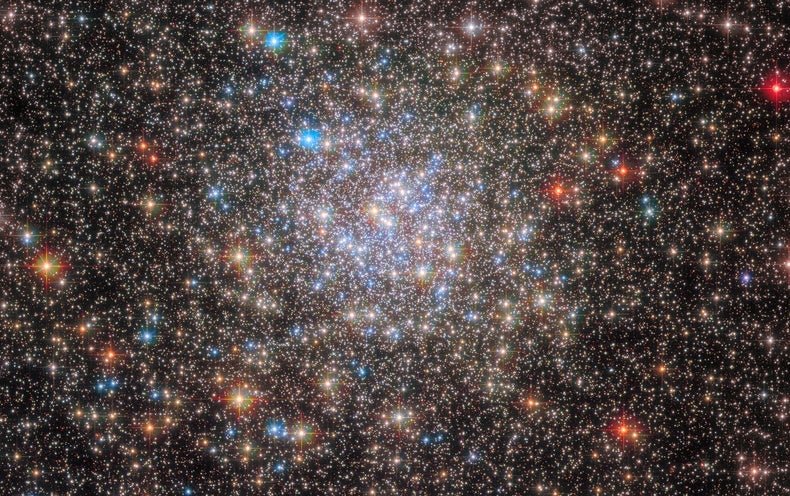
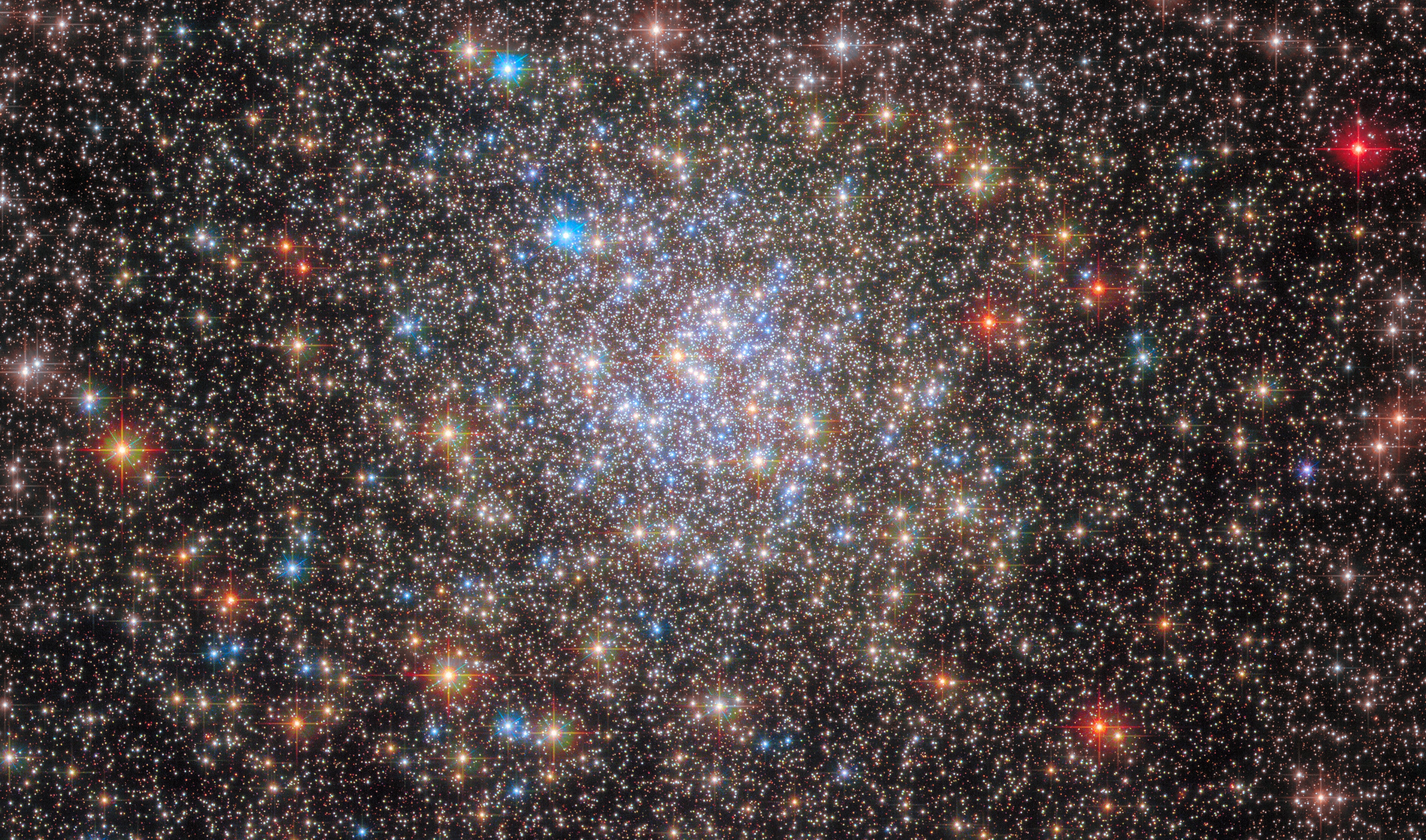
Editor’s Note (8/25/23): This article was edited after posting to correct the image of the globular cluster NGC 6355.


