China’s massive military parade this week featured a who’s who of well-dressed dictators, a fleet of laser-armed trucks, new hypersonic weapons, beach landing craft and, of course, thousands of uniformed troops marching in intricately coordinated unison. But it left out what might be China’s most important new military asset: a growing ecosystem of small and nimble dual-use AI companies partnering with the Chinese military.
A new report from the Center for Security and Emerging Technology draws attention to China’s growing appetite for AI-related tech, not just from a handful of big, surveillable state-backed enterprises but from a growing cadre of relatively young outfits emerging from universities and private labs. Those partnerships make it harder for the United States to track what new weapons China is developing and prevent U.S. investors or technology collaborators from helping them.


A significant portion of the technology, like software for piloting drone swarms or advanced navigation systems, have both a civilian and military purpose—much like Chinese flagged fishing and “research” vessels, non-military ships that many U.S. military and national security leaders describe as China’s “maritime militia.”
Much of the technology listed in the report has clear applications for potentially improving the military value of a non-military ship. This includes contracts for semantic modeling software, which uses sensed data and AI to help ships understand where they are without having to rely on GPS. The capability is of limited value to commercial vessels, but high value to ships engaged in military operations.
A company called Beijing SOUVI Information Technology received contracts for drone control systems and intelligent sensing software that could allow a single operator with little training to steer a swarm of drones. It could also allow a Chinese navy operator to operate merchant vessels performing a coordinated operation with the Chinese military.
There is precedent for Chinese civilian ships conducting coordinated military maneuvers, such as in July 2023, when a group of Chinese fishing vessels effectively created a blockade around a reef in the Philippines, escorted by the Chinese navy. China’s fleet of so-called merchant craft are also working with the Chinese coast guard and navy in exercises, harassing local fishermen and potentially sabotaging undersea infrastructure from the Philippines to the seas of South America.
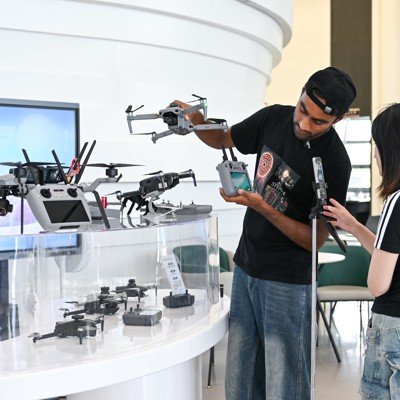
Another company, called JOUAV, markets vertical takeoff and landing drones and AI software to fuse data from advanced thermal sensors. A non-military trained crew aboard a fishing vessel could easily deploy those to pick out other ships at night or in poor weather well beyond the horizon, turning the civilian ship into an ISR node.
One of the report’s key findings is China’s growing use of smaller “nontraditional vendors,” or NTVs. While the country’s AI tech buying is still focused primarily on large, state-owned companies and research institutions, CSET found a list of small firms, mostly founded after 2010 and marketing commercial technology with military applications, which do not report state ownership ties on their websites. These include companies like iFlytek, which makes speech translation apps; PIESAT, which sells AI-enabled geospatial data useful for live location mapping; and JOUAV. It’s a portrait of a startup ecosystem that bears many similarities to Silicon Valley.
But while the Pentagon has spent years working to improve its ability to acquire dual-use technology and partner with startups that aren’t traditional defense contractors, CSET’s research indicates China’s reason for doing so is very different: “The vast majority of NTVs and research institutions in the dataset are not subject to U.S. sanctions.” In other words, China is working to trick consumers around the world into buying products and services that help the Chinese military grow stronger.
The tech that these firms are selling to the Chinese military runs the gamut from geospatial intelligence to training to drones, such as the Reaper-like Tengden TB-001 “Twin-Tailed Scorpion,” one of “the first known cases in which a non-[state-owned enterprise] supplied the PLA with a complete military end-use system.” Other products have a more clear dual-use purpose. For instance: helping commercial ships use sea robots more effectively to navigate and find fish, or effectively coordinate military-style maneuvers, such as blockading, with other militia boats.
One of the recent awards CSET tracked to PIESAT was for an “unmanned aerial vehicle virtual simulation training system,” which could serve either explicit military purposes by enabling drone operations, or more ambiguous purposes in assisting “research” vessels such as the ones increasingly showing up near Taiwan.
While China has traditionally used just a handful of government-selected companies to build its military gear, a separate paper from the U.K’s Centre for Emerging Technology and Security notes that AI companies enjoy more leeway in building products, finding funding, and hiring workers than do other companies.
“China’s AI funding structure still provides opportunities for smaller companies to benefit from financial incentives. This suggests a more dynamic and layered approach to state-led AI development, which shapes the wider environment for China’s AI firms rather than mandating direct control through state ownership or funding.”
DeepSeek is an example of a company that flew under the radar of Chinese authorities until it was launched. That’s significant because when U.S. business and national security leaders discuss AI competition with China, they frequently point to the robustness and profitability of the U.S. tech startup space and its support for entrepreneurs as a key advantage over China’s government-controlled system. But in reality, the AI portion of the Chinese tech ecosystem is beginning to more closely resemble the United States.
More importantly, national security leaders are increasingly recognizing that artificial intelligence is more important than any singular weapon, as it holds the promise of making a military or weapon far more effective, at little to no cost.