

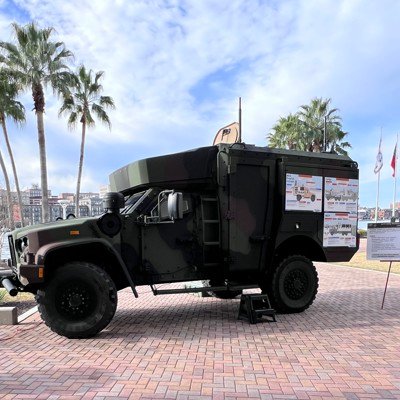
SAVANNAH, Georgia—If the war in Ukraine has taught the U.S. Army anything, it’s that command posts are too big and draw too much attention.
“If you watch the news for lessons learned from all of the operations we’re assigned to, we can’t continue to have this huge command post and be survivable. The risk to our formations is too great,” Brig. Gen. Marne Sutten, deputy chief of staff, G6, for U.S. Army Forces Command, said during a panel at the Army’s Technical Exchange Meeting 11. There are “still concerns in FORSCOM that we’re not giving commanders the flexibility that they need—they’re still tethered to large amounts of power…And so, commanders want a command post that they can utilize, at the time of their choosing, to give orders.”


Commanders have responded by using available equipment to create mobile command posts that “pop up” and use different data platforms to improve flexibility, Sutten said. Leaders are also rethinking how many command posts they actually need.
“We need something that’s smaller in form factor, even in a Stryker unit,” said Col. Ryan McChrystal, commander of the 2nd Cavalry Regiment, via video conference on the panel. “We’re going to need to adapt. Should be able to take this kit out of the Stryker and put it into the basement of a building…maybe it’s in a parking garage and we’re plugging into fiber.”
Information must be able to quickly move across multiple channels—including cables on the ground and satellites in orbit—with the ultimate goal of automatically toggling between them when signals fail.
The problem is particularly pronounced for what the military calls fires—using weapons on a target—because precision is critical to avoid friendly fire.
“If I don’t have reliable comms as a fires unit, or as a [combat arms brigade], then it’s…harsh language,” said Col. Bryan Babich, director of the Mission Command Center of Excellence, which is in charge of evaluating and developing standards for command and control solutions for the Army. “We’ve got to be able to hide in plain sight” while “constantly on the move and constantly under surveillance.”
“I need to understand where those maneuver forces are at all times, because I’m providing those close fires for them. So that’s that data. That’s information that I’m going to need in [real time],” said Babich, who previously led the Mission Command Training Program.
Out with the old
The Army has a new strategy for command posts that focuses on how to best buy the highly configurable technology commanders need, while folding in lessons from ongoing conflicts such as Russia’s war on Ukraine, according to an industry executive.
“When you have all these disparate requirements, these new systems that are coming on and these dynamic requirements, that software integrated function now suddenly becomes a very important key,” the executive said. “We’ve been seeing them kind of shift their focus in terms of how they thought they were going to initially build and acquire these things to kind of a new, more adaptable, flexible approach that puts software at the center.”
But it’s still not clear if the Army’s goal is possible to achieve.
“All the components exist right now. So everything from the comms infrastructure, where they’re talking about either relying on terrestrial or LEO—those functions exist and those capabilities exist,” the executive said. The components needed on the data side and for a common operating picture also exist. What’s missing is the ability to “rapidly configure” to fit whatever the mission and environment call for.
“I think that’s the part where the software comes in and is able to quickly adapt and rewire exactly how that command post functions,” the executive said.
Software > hardware
There’s been a push to change how the Army buys, especially when it comes to software—to move from being overly specific to a focus on soldier-led requests for capabilities.
The Army’s TITAN program, a software-laden command post for the intelligence community, could serve as a blueprint for the rest of the service.
“Commanders want to employ their network in unique ways, whether that’s how they configure their command post, how they collaborate with their staff,” said Mark Kitz, the Army’s top buyer for networks and communication tech, who previously led the TITAN effort as the program executive officer for IEWS. “I think our ability to get responsive to commanders in their network needs is the biggest challenge,” whether it’s providing new waveforms or providing a kit that allows command posts to be smaller and more dispersed.
That latter part is key as the Army works to reduce electronic emission signatures that make command posts an easy target for adversaries. But it’s not yet clear how those command posts will shrink.
“I don’t know the answer to that,” Kitz told reporters, noting the newly released request for information to industry. “Our prior strategy was: here’s one big vehicle that has all the servers in it. If that vehicle goes down, now we can’t move our compute and storage capability.”
One of the main questions the Army wants defense companies to answer is how it can disperse data storage and computing power across multiple locations.
Ideally, the Army wants to offer commanders a “standard set of options” that allows them to go from a Joint Light Tactical Vehicle in motion into a building, and “it’s very easy [to] just pop it off and you take it” inside, Kitz said.
“That technology exists, but how can I do that in a tactical way on a tactical network,” he said. “So this RFI is asking the industry exactly that question” to meet commanders’ needs to be “smaller, lighter, faster.”


