

Partner Article
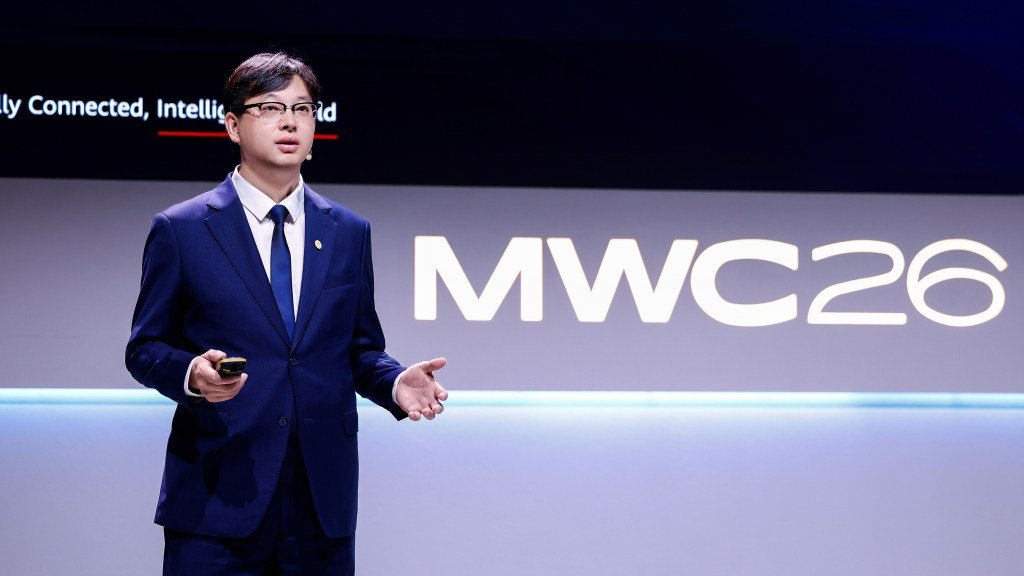
At Mobile World Congress 2026, Fang Xiang, Huawei VP and President of Wireless Solution, outlined the company’s vision for what it calls the “Agentic MBB”.
Speaking at the Huawei’s product and solutions launch, Fang argued that the rapid emergence of AI agents is fundamentally reshaping the way we think about network topology.
Huawei predicts that by 2035, the global landscape will include 900 billion agents, with 90% of these running on mobile devices, creating a paradigm shift for network requirements.
Huawei’s response is to combine new AI-driven network intelligence with upgraded radio and baseband hardware, aimed at delivering higher uplink capacity, lower latency and more adaptive resource management.
“Agentic MBB (mobile broadband) is the key step towards an intelligent era,” Fang said. “It will fully unleash the potential of diverse services.”
Uplink and low latency to become essential
According to Fang, the shift towards AI-driven applications will lead to far more diverse and demanding MBB workloads. While traditional mobile networks have been largely optimised for downlink traffic, the rise of AI agents will increase the importance of uplink, low latency, and ubiquitous coverage.
“As more 5G applications emerge, experience requirements for mobile broadband begin to diversify,” he said. “Different users have distinct network needs.”
A key driver is the growth of multimodal AI interaction, where agents process multiple types of data simultaneously.
“For multi-modal interactions, it requires gigabit uplink capability,” Fang said. “Agents must process text, videos, and images at the same time, so they will need five-times the uplink capability we have today.”
Latency will also become more critical as AI services evolve from asynchronous cloud queries to real-time systems involving robotics, automation, and immersive experiences.
“For AI robots to be human-like, an end-to-end latency of 400ms is essential,” Fang said.
A latency of 400ms or less – often termed the ‘Doherty Threshold’ – has long been a metric for keeping user engaged when interacting with a computer.
Finally, broad coverage remains a limitation. If agent-enabled devices are to expand beyond today’s smartphones to include vehicles, robots, and a wide range of connected objects, high quality coverage cannot be limited to urban areas.
“Agent-powered devices will extend beyond current boundaries,” Fang said. “We must extend high-quality coverage across villages, roadways, and uncovered areas.”
Reconstructing the network of the future
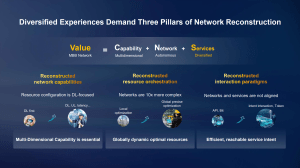
To meet these requirements, telcos will soon be forced to completely rethink their approach to mobile network build.
The first step, according to Fang, is to shift from a downlink-focussed approach to a more holistic model prioritising uplink, latency, and coverage, as mentioned above.
Secondly, improved resource management will be paramount. With the networks themselves growing more complex and with billions of AI agents running over the top, manual network orchestration will soon be impossible. Automation must be infused throughout O&M, evolving into what Fang calls an ‘Intelligent Dynamic Management’ model.
Finally, diversified services and customer experiences will require a closer understanding of the customer’s unique needs, allowing the network to respond proactively to ensure high quality service.
“By evolving from API-based interaction to service-based intent interaction, the network can truly understand service needs,” Fang said.
Huawei’s tools for an Agentic MBB
To support this shift, Huawei has introduced a set of new products and technologies designed to embed AI into both network management and the underlying radio infrastructure.
Among these innovations is a new RAN Agent. Built on Huawei’s telecom foundation model, the RAN Agent is designed to enable intent-driven network automation. The RAN Agent works as part of a closed-loop automation system covering forecasting, analysis, decision-making and execution. It connects northbound to operator systems via an A2A-T interface to interpret service intent, and southbound to Huawei’s Adaptive Air base stations to implement network changes.
This RAN Agent is supported by Huawei’s RAN Digital Twin System (RDTS), which models the physical network assets, devices, and the surrounding environment. The RDTS then provides the digital foundation of real-time data on which the Agent can operate.
Combined, this means that the RAN can autonomously adjust based on the users’ requirements, optimising the network in terms of user experience, O&M efficiency, and energy usage.
“RAN Agent creates a complete closed loop—forecast, analyze, decide, and execute. This makes true single-domain autonomy a reality, delivering all-scenario experiences, intelligent network management, and ultimate energy efficiency,” said Fang.
Alongside the RAN Agent and enhanced RDTS capabilities, Huawei also showcased its GigaGreen Plus series, which incorporates new antenna architectures and materials designed to improve performance and efficiency.
“Powered by innovations in new materials, advanced antenna architectures and engineering, it expands coverage by 15%, sets new benchmarks for energy efficiency, and cuts size and weight by 30%,” explained Fang.
The series includes the tri-band ultra-wideband MetaAAU and a 256-transmit antenna unit operating in the 6 GHz band. These are designed to support 5G-Advanced deployments capable of delivering up to 10 Gbps downlink and 1 Gbps uplink speeds.
Huawei also unveiled its next-generation UBBPi baseband platform, which uses a chiplet-based architecture and near-memory computing to increase performance. The system doubles both capacity and energy efficiency compared with the previous generation, while enabling what Huawei describes as “all-scenario cell-free” networking. This involves using distributed access points to eliminate cell boundaries, promoting seamless performance.
“All-scenarios cell-free is vital to a service-centric experience,” Fang said, adding that that advanced coordination algorithms will allow the baseband to optimise resources across time, frequency, and spatial domains. This doubles cell-edge experience and improves average experience by 40%.
Preparing for an Agentic world
Ultimately, Huawei’s is that a network’s ability to understand and respond to the needs of AI-driven services in real time will be vital to operators’ success. By combining intent-driven automation through its RAN Agent and Digital Twin systems with new Adaptive Air radio and baseband platforms, the company is positioning its portfolio as the infrastructure foundation for a future of AI-driven experience and commerce.
“Together, we will build powerful, green, reliable and intelligent mobile networks,” he said. “Let’s catch the opportunities and create greater value in a fully connected intelligent world.”


