

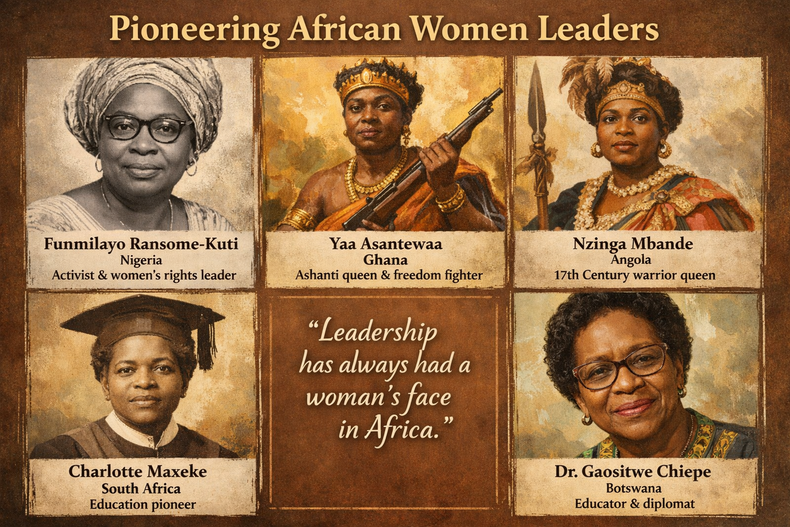
Africa’s history contains many women whose work shaped politics, education, resistance movements and community life long before their stories received broader attention. These women were not simply participants in history, they helped shape its direction.
One striking example comes from Nigeria: Funmilayo Ransome-Kuti. In the 1940s, Ransome-Kuti organised thousands of market women to protest colonial taxation policies that placed heavy burdens on female traders. Their demonstrations culminated in the Abeokuta Women’s Revolt, forcing major concessions and demonstrating the power of organised grassroots activism.
In what is now Benin, an all-female military regiment known as the Dahomey warriors emerged in the 17th century. Historians note that the exploits of the Dahomey warriors amazed many European explorers and slave traders. They were described as highly skilled in hand-to-hand combat and fought with weapons similar to machetes.
Further west, another formidable figure became a symbol of resistance to imperial domination: Yaa Asantewaa of present-day Ghana. In 1900, British colonial officials demanded the sacred Golden Stool, an emblem of Ashanti sovereignty. When some leaders hesitated to confront the British militarily, Yaa Asantewaa stepped forward. She famously said: “Is it true that the bravery of Asante is no more? I cannot believe it. It cannot be! I must say this: If you, the men of Asante, will not go forward, then we will. I shall call upon my fellow women […]” As queen mother, she rallied warriors and led the resistance. Her leadership remains one of the most enduring symbols of African resistance to colonial rule.
In the region of present-day Angola, Nzinga Mbande was a 17th-century ruler who was queen of the kingdoms of Ndongo and later Matamba. She is remembered for her political skill, military leadership and resistance to Portuguese colonial expansion. After first serving as a diplomat for her brother, she took power in the 1620s and spent decades leading armies, forging alliances and defending her territories against the Portuguese slave trade. Nzinga remains a symbol of strategic leadership and women’s political authority in African history.
Across the continent, women also reshaped societies through intellectual and institutional leadership. One of the earliest pioneers of African women’s education was Charlotte Maxeke. Born in 1871 in South Africa, Maxeke became the first Black South African woman to earn a university degree abroad. After studying in the United States, she returned to South Africa and dedicated her life to social reform, education and community development. At a time when racial segregation and gender discrimination severely restricted opportunities, Maxeke’s work helped lay the foundation for future generations of African women in academia and civic leadership.
Southern Africa also produced one of the continent’s most influential education reformers: Dr. Gaositwe Chiepe. Born in 1922 during Botswana’s colonial era, Chiepe became the first Motswana woman to receive an advanced university education. She later served in several ministerial roles, including Minister of Education and Minister of Foreign Affairs. She became Botswana’s first woman to serve in the cabinet. Her leadership helped shape Botswana’s post-independence education system, strengthening access to learning in what would become one of Africa’s most stable democracies.
Taken together, these stories reveal that African women have long played important roles in resistance, social reform, governance and intellectual life. These women were never merely observers of history, they organised protests, led resistance movements, founded schools and helped shape public institutions. Their stories also offer lessons for contemporary Africa.
They remind us that civic participation and leadership have always drawn from a wide cross-section of society: From the mass mobilization organised by Ransome-Kuti to the defiant stand led by Yaa Asantewaa, women have long been part of movements that shaped the continent’s trajectory. They also highlight the enduring importance of education. Leaders such as Charlotte Maxeke and Dr. Gaositwe Chiepe did more than achieve personal academic success, they helped open doors for future generations. Perhaps most importantly, their lives illustrate that Africa’s traditions of leadership are broader and more diverse than is often assumed.
The challenge today is remembrance. Across much of the continent, school curricula still devote more attention to colonial administrators than to African women who resisted them. Public monuments and museums rarely commemorate female leaders unless they achieved global recognition. Correcting that imbalance requires deliberate effort, from educators, historians, researchers and media institutions alike. Integrating these stories into classrooms, scholarship and public storytelling can enrich the way Africa understands its own past.
Africa’s history has been shaped by queens who organised resistance, educators who built institutions, diplomats who strengthened young nations and figures who inspired liberation. Their names may not always dominate in history books or international headlines, but their influence remain embedded in the foundations of modern African societies. Remembering them this Women’s History Month is not only an act of historical recognition, it is also a reminder of the many ways leadership has taken root across Africa and how their inspiration continues to shape the continent’s future.


