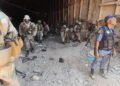
The terrorist attack on the airport serving Niger’s capital, Niamey, in January provided another example of how Sahelian extremists threaten the security of Burkina Faso, Mali, Niger and West Africa as a whole.
During the January 29 attack, 30 Islamic State-Sahel Province fighters used armed drones, small arms and mortars to assault Dori Hamani International Airport and military Air Base 101. The base houses Nigerien military drone operations and the headquarters for the Alliance of Sahel States (AES). The alliance is the mutual defense and economic union Burkina Faso, Mali and Niger created in 2023 after leaving the Economic Community of West African States.
“The attack was not an isolated security breach, but a deliberate, high-value operation aimed at Niger’s military and strategic infrastructure,” analysts with African Security Analysis wrote shortly after the attack. “The strike represents a notable operational escalation by IS-Sahel.”
By the end of the two-hour battle, all attackers had been killed or captured. But their assault achieved a key aim, according to African Security Analysis.
The nighttime attack was intended to undermine state authority and test security forces’ response. The attackers also wanted to show that they and other terror groups remain an active threat despite intense counterterrorism operations across the Sahel, analysts wrote.
The attack on Niger’s airport is emblematic of the ongoing threats that IS Sahel, al-Qaida-affiliated Jama’at Nusrat al-Islam wal-Muslimin (JNIM) and other terror groups pose to the three landlocked nations and to their coastal neighbors, according to researcher Caleb Weiss with the Bridgeway Foundation.
“The Niamey assault underscores concerns about insecurity in the Sahel and beyond,” Weiss wrote recently for the Foundation for Defense of Democracies’ Long War Journal.
Beyond Niger, Mali has begun to recover from JNIM’s monthslong siege that sought to choke the capital, Bamako, and upend Mali’s economy. In September 2025, JNIM began intercepting fuel convoys entering Mali from Côte d’Ivoire and Senegal. In one incident, they burned a dozen fuel trucks entering from Senegal.
The blockade made daily life difficult for Bamako residents as fuel ran short. After three months, JNIM loosened its blockade in early 2026 without explanation. But the psychological impact of the blockade remains.
“What about tomorrow?” Aissata, a sales assistant at a Bamako supermarket, told The Africa Report. “What if the blockade returns or if the terror group decides to attack the market or any infrastructure in the city?”
In Burkina Faso, JNIM conducted more than 500 attacks in 2025, according to SITE Intelligence Group. Extremists control up to 60% of the country, essentially surrounding the capital, Ouagadougou, as public faith in the government continues to erode.
Nighttime attacks on military supply lines and improvised explosive devices have restricted the military and volunteer militias to territory near their bases in rural areas of the Centre-Nord, Est and Sahel regions.
With security forces bottled up, terrorists launched a deadly attack in the northern community of Titao in mid-February, killing 80 soldiers and militia members and at least 20 civilians. JNIM attacked a military camp, market and area communication facilities.
“These dynamics are likely to continue in the coming months, particularly in areas bordering Mali and Niger, where armed group presence and mobility remain structurally entrenched and show no indication of slowing,” African Security Analysis researchers wrote.
Despite their success at controlling much of Burkina Faso’s countryside, terrorists lack the numbers and the firepower needed to conquer the capital, according to analysts Djiby Sow and Hassan Koné with South Africa’s Institute for Strategic Studies.
Deteriorating conditions across the AES countries stand in stark contrast to claims from all three junta leaders that they would bring terrorists to heel in a way that their democratic predecessors could not, an unnamed senior lecturer at Bamako’s University of Legal and Political Sciences told The Africa Report. The speaker requested anonymity due to fear of reprisals.
Mali’s military is stretched thin by the persistent terror attacks and by defections to JNIM, the senior lecturer said, adding: “The junta doesn’t seem to have an answer to the terror expansion, not even its counterparts in Niger and Burkina Faso.”