

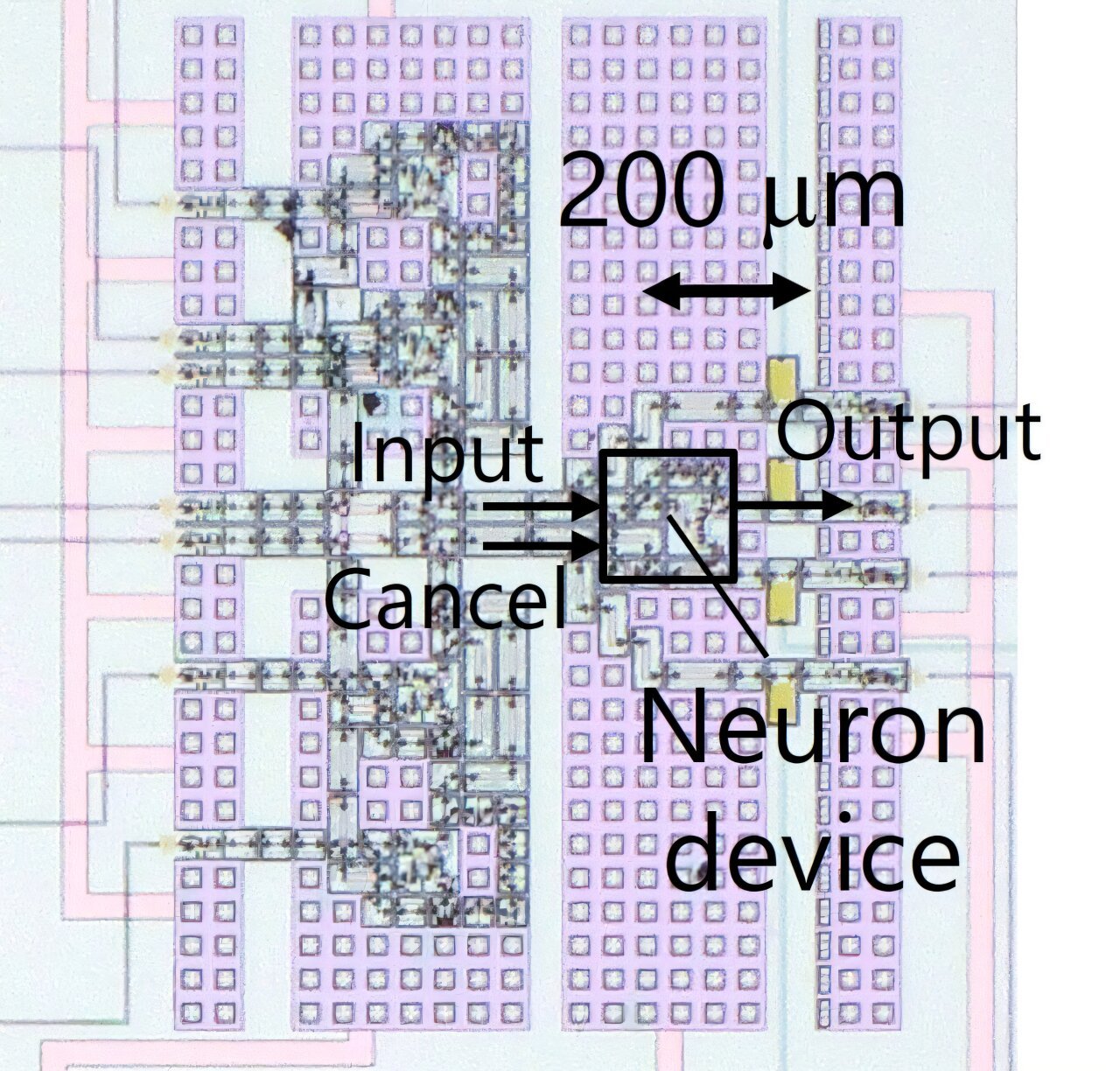

A research team has developed a neuron device that holds potential for application in large-scale, high-speed superconductive neural network circuits. The device operates at high speeds with ultra-low-power consumption and is tolerant to parameter fluctuations during circuit fabrication.
Their research is published online in the journal Neuromorphic Computing and Engineering.
Neuromorphic computing is a computing approach that mimics how the human brain works. Using dedicated hardware, the neuromorphic system achieves high-speed and low-power artificial neural networks. In a neuromorphic system, the neuronal circuit elements must behave like biological neurons’ activation functions.
To achieve practical artificial neural networks, researchers construct large-scale networks equipped with adjustable synaptic weights. Synaptic weights describe the strength of the connection between two nodes. These networks must be capable of dynamic reconfiguration and fine-grained modulation of synaptic strengths in order to support complex learning tasks.
To use neuromorphic computing in the next generation of AI applications, both the neuronal and synaptic device technologies must be advanced. While neuromorphic computing has potential applications in artificial intelligence because of its potential to surpass conventional deep learning frameworks for energy efficiency and computational speed, there are some significant challenges to achieving practical, large-scale neuromorphic systems.
“Neuromorphic circuits, which mimic the functioning of a human brain, are being studied as a new computational paradigm. However, in the hardware implementation of neuromorphic circuits, the variation in characteristics of elemental circuits, such as neuron devices, causes degradation in the performance of the neural network,” explained Yuki Yamanashi, a professor at Yokohama National University.
The team’s research introduces digital processing using superconducting circuits that employ the magnetic flux quantum, determined by physical constants, as a signal carrier. Magnetic flux describes the total magnetic field that passes through a surface. A magnetic flux quantum describes the fundamental unit of magnetic flux in a superconductor. The team’s method eliminates variation in the characteristics of the elemental circuits and allows them to achieve a neuron device with ideal input-output characteristics.
The team developed a novel compact superconductive neuron device that implements the Rectified Linear Unit (ReLU) activation function. This function solves the problems caused by the vanishing gradient problem, where the activation function’s gradient diminishes and weight updates become small. The gradient is a measurement of the neural network’s error changes as small adjustments are made with its internal settings. With deep neural networks, the gradients become so small that the weight updates are impacted. This problem impedes effective training, especially in deeper networks.
The team’s proposed circuit realizes the ReLU input-output characteristic through frequency conversion between input and output signals, based on digital information processing by a single flux quantum logic circuit. Single flux quantum logic is a superconductor technology that processes information very quickly and efficiently.
A key advantage of the team’s design is its remarkable robustness against device variability because of the inherent digital nature of single flux quantum logic. This advantage directly addresses the limitations of previous analog-based approaches.
Even with up to 20% variation among individual circuit parameters, the circuit achieves the ideal ReLU input-output characteristic. This robustness of this device is a marked improvement over conventional analog-based neuron devices, whose performance is highly sensitive to device nonuniformity. It also represents a major step toward the scalable integration of superconducting neural networks.
Earlier research on circuit implementation of artificial neural networks has been attempted. However, those earlier devices suffered from relatively high-power consumption and limited capacity to emulate complex biological neuronal dynamics. The team’s neuron device combines high-speed and ultra-low-power operation with inherent tolerance to device parameter variations. This crucial feature mitigates the performance degradation that is often observed in large-scale neural networks that rely on analog neuron circuits susceptible to characteristic variation of neuron devices.
“This neuron device exhibits ideal input-output characteristics and resolves the issue of characteristic variation when integrating neurons. Consequently, it contributes to the hardware implementation of large-scale neural networks using superconducting circuits, enabling ultra-high-speed and low-power operation,” said Yamanashi.
Looking ahead, the team hopes to implement a large-scale superconducting neural network and demonstrate learning, using the neural network. “We believe this circuit has the potential for significant contributions to high-performance neuromorphic computing with superconductive circuits.”
More information:
Yuto Ueno et al, High-speed, ultra-low-power, and robust superconductive neuron with ReLU activation, Neuromorphic Computing and Engineering (2025). DOI: 10.1088/2634-4386/ae0aee
Yokohama National University
Citation:
Team develops high-speed, ultra-low-power superconductive neuron device (2025, October 17)
retrieved 17 October 2025
from https://techxplore.com/news/2025-10-team-high-ultra-power-superconductive.html
This document is subject to copyright. Apart from any fair dealing for the purpose of private study or research, no
part may be reproduced without the written permission. The content is provided for information purposes only.


