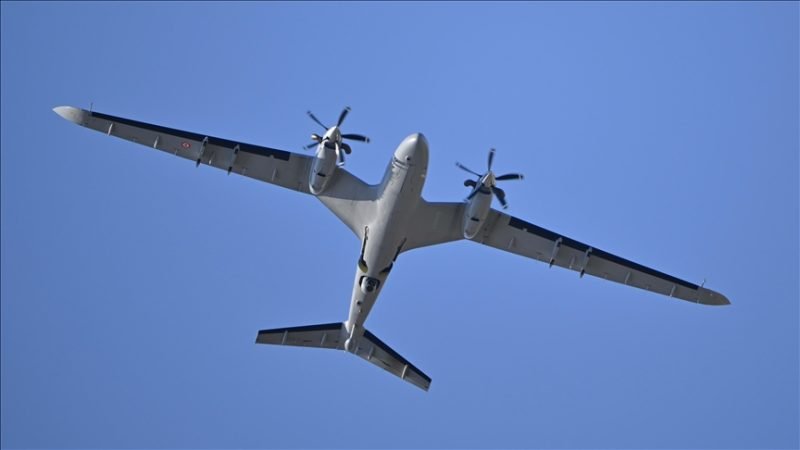
Sudan’s military has suffered yet another setback in its aerial campaign against the paramilitary Rapid Support Forces, with the downing of a Baykar Bayraktar Akinci drone over Mershing in South Darfur.
This event, occurring just a few days ago, marks the second loss of such an advanced unmanned combat aerial vehicle this year alone, as confirmed by field commanders from the Rapid Support Forces. The drone had reportedly bombed the nearby Manawashi market, resulting in at least two fatalities—a woman and a Rapid Support Forces soldier—while injuring a market worker and another woman who required immediate hospital treatment. Eyewitness accounts relayed to Radio Dabanga described the strike’s immediate aftermath, with survivors rushing the wounded to medical facilities amid the chaos. Anti-aircraft fire from the Rapid Support Forces then engaged the aircraft, causing it to ignite in mid-air before it plummeted into a residential neighbourhood in Mershing, approximately 15 kilometres from the market site. Fortunately, residents reported no additional casualties or property damage from the crash itself.
Videos circulated to Radio Dabanga captured the dramatic scene, showing the drone engulfed in flames as it descended under sustained gunfire. Rapid Support Forces commanders identified the wreckage as that of a Turkish-made Baykar Bayraktar Akinci, though independent verification remains pending. This claim aligns with patterns observed in the conflict, where both sides increasingly rely on drones for strikes and reconnaissance, transforming the battlefield into a domain of high-tech attrition. The incident follows a pattern of Sudanese Armed Forces drone operations in South Darfur, including attacks on the region’s capital, Nyala, twice within the same week. On Saturday, a strike coincided with the swearing-in of Rapid Support Forces leader Mohamed Hamdan Dagalo, known as Hemedti, as president of the Sudan Founding Alliance, a parallel government aligned with his faction. Eyewitnesses described a rocket, suspected to originate from a drone, striking the crowded Yashfin Specialised Hospital in Nyala, claiming at least 35 lives among patients and their companions, with expectations that the toll could climb higher. A subsequent attack on Tuesday inflicted an unconfirmed number of casualties, further straining local medical resources already overwhelmed by the ongoing war.
For the SAF, its sophisticated drone fleet has been a vital tool in maintaining control over contested regions, particularly in Darfur, where the RSF has been pressing its campaign to seize El Fasher, a city under siege since mid-May 2024.
The Sudanese Armed Forces have not acknowledged responsibility for these strikes, maintaining a silence that leaves room for speculation about their strategic intent. Such operations aim to disrupt Rapid Support Forces’ logistics and morale, but they also risk alienating civilian populations caught in the crossfire. The Rapid Support Forces have a history of countering Sudanese Armed Forces air assets effectively, having downed multiple warplanes and drones in both North and South Darfur. These successes have compelled the Sudanese Armed Forces to curtail aircraft deployments around key areas like El Fasher, where ground-based threats loom large. Pro-army sources have pointed to the deployment of highly efficient anti-aircraft systems by the Rapid Support Forces in Nyala, bolstering their defensive posture. Jakud Makwar, deputy head of the Sudan People’s Liberation Movement-North, earlier noted the arrival of advanced anti-aircraft equipment in Darfur, predicting its imminent use in movement-controlled zones. Satellite imagery has corroborated these claims, revealing sophisticated air defence installations at Nyala airport, which likely played a role in recent engagements.
This latest downing represents more than a tactical loss; it indicates a potential shift in the conflict’s aerial dynamics. The Rapid Support Forces’ ability to consistently neutralise the Sudanese Armed Forces’ air superiority challenges the military’s reliance on unmanned systems for precision strikes. Earlier this year, in July, the Rapid Support Forces claimed another Akinci over El Fasher, North Darfur, marking the first confirmed destruction of this model in the Sudanese theatre. Reports from June detail a similar incident in Nyala, where air defences brought down an Akinci following a strike near the airport.
The Baykar Bayraktar Akinci stands as a formidable asset in modern warfare, designed for high-altitude, long-endurance missions that extend beyond traditional drone capabilities. Developed by the Turkish firm Baykar, co-owned by the son-in-law of President Recep Tayyip Erdogan, the Akinci measures 12.2 meters in length, with a 20-meter wingspan and a height of 4.1 meters. It boasts a maximum takeoff weight of 6,000 kilograms and can carry payloads up to 1,350 kilograms, including a mix of munitions, sensors, and electronic warfare suites. Powered by twin engines, it achieves a top speed of 361 kilometres per hour, cruises at 280 kilometres per hour, and operates at altitudes up to 40,000 feet, with an operational ceiling of 30,000 feet.
Its range exceeds 7,500 kilometres, allowing for extended patrols, and it can loiter for over 24 hours, making it ideal for surveillance, targeting, and strike roles. The system features triple-redundant flight controls, fault-tolerant architecture, and integration with satellite communications for beyond-line-of-sight operations, enhancing its resilience in contested environments. In Sudan, the Sudanese Armed Forces have employed the Akinci to target Rapid Support Forces supply lines, artillery positions, and strongholds in regions like Nyala, El Fasher, Geneina, and Kordofan, leveraging its precision-guided munitions for disruptive effects.
Yet, the Akinci’s vulnerabilities have become apparent in this conflict. Despite its advanced evasion features, such as low-observable design elements and electronic countermeasures, ground-based air defences have proven capable of interception. The Rapid Support Forces initially depended on basic anti-aircraft guns in 23mm and 14.5mm calibres, supplemented by man-portable air-defence systems like the Soviet-era SAM-7 and Chinese FN-6. However, the introduction of more sophisticated systems, reportedly supplied by the Wagner Group, has elevated their capabilities. These enhancements include integrated radar-guided missiles and possibly Chinese-origin equipment funnelled through the United Arab Emirates, which has been accused of bolstering the Rapid Support Forces with advanced weaponry in violation of international embargoes. In August, evidence emerged of UAE-supplied Chinese air defence systems reaching the Rapid Support Forces’ hands, tipping the balance in aerial confrontations. This collaboration has aimed at neutralising the Sudanese Armed Forces’ Akinci fleet over the past two months, with mixed results until recent successes.
The Sudanese Armed Forces’ drone program extends beyond the Akinci, incorporating models like the Bayraktar TB2, delivered by Egypt in October 2024 amid warming ties between Cairo and Ankara. These TB2s have seen action in Khartoum state and el-Gezira, targeting Rapid Support Forces convoys and artillery, including an assault on the Baka Bridge near Wad Madani. In April 2025, two Turkish Air Force A400M Atlas transports landed in Port Sudan, suspected of carrying additional drone shipments from Baykar, sustaining the flow despite global sanctions. A March 2025 Washington Post investigation, based on leaked documents, messages, and financial records, exposed Baykar’s covert supply of $120 million in drones and warheads to the Sudanese military in 2023. The deal encompassed at least eight TB2 drones, three ground control stations, and 600 warheads, routed through intermediaries to evade U.S. and European Union arms embargoes on Sudan’s warring parties. Baykar has remained silent on these allegations, even as Turkey portrays itself as a neutral mediator in the Sudanese crisis.
The Rapid Support Forces have not been passive in this aerial arms race. In early May 2025, their own drone strikes on Port Sudan targeted Turkish experts training Sudanese Armed Forces personnel on Akinci operations, injuring several who were subsequently evacuated to Turkey. Despite these disruptions, Sudanese Armed Forces Akinci drones persisted in hitting Rapid Support Forces positions across various fronts. The United Arab Emirates’ reported partnership with the Rapid Support Forces to dismantle this fleet had yielded limited outcomes until the downing of Mershing, which some analysts view as a breakthrough. Social media platforms, particularly X, have buzzed with footage and commentary on these events, with users sharing videos of the flaming descent and debating the implications for the Sudanese Armed Forces’ air power. One post confirmed Akinci’s identity through wreckage analysis, while others tallied the losses, estimating three such drones downed this year alone.
This incident unfolds against a backdrop of intensified ground manoeuvres. Sudanese army officials, including deputy commander General Shams al-Din Kabashi, have worked to solidify control in Kordofan during recent visits to El Obeid, demanding that irregular armed groups vacate urban areas and return to the frontlines. The Rapid Support Forces’ campaign to seize El Fasher holds both tactical and emblematic value, as they already dominate four of Darfur’s five states. Capturing the city would consolidate their regional hold, prompting the Sudanese Armed Forces to intensify drone bombardments on supply routes and fortifications. However, the Rapid Support Forces’ upgraded defences now pose a credible deterrent, forcing a reevaluation of aerial tactics.
The broader Sudanese conflict, erupting in April 2023 between the Sudanese Armed Forces led by General Abdel Fattah al-Burhan and the Rapid Support Forces under Hemedti, has devolved into a proxy struggle laced with foreign interests. Turkey’s support for the Sudanese Armed Forces contrasts with the United Arab Emirates’ backing of the Rapid Support Forces, channelling resources through Chad and other conduits. Russia’s Wagner Group, now rebranded as Africa Corps, has supplied anti-air systems to the Rapid Support Forces, while Iran has provided Mohajer-6 drones to the Sudanese Armed Forces, escalating the technological arms race. These interventions exacerbate civilian suffering, as seen in the Nyala hospital strike and a drone attack on a UN aid convoy in North Darfur last month, which destroyed trucks carrying essential food supplies.
Humanitarian fallout remains dire, with millions displaced and famine gripping parts of Darfur. The World Health Organisation chief reported a separate drone strike on an El Fasher hospital in January, killing 70 and injuring 19, illustrating the indiscriminate nature of these weapons. Amnesty International has documented the use of advanced Chinese weaponry by the Rapid Support Forces, supplied via the United Arab Emirates in breach of arms embargoes, including systems involved in a March drone strike near al-Malha. Such violations highlight the fragmented geopolitical order fueling the war, where regional powers pursue influence through arms proxies.