


– Advertisement –
In the early hours of January 19, 2026, at about 1:16 a.m., Mrs. Mmseoma was travelling with her pregnant daughter-in-law and two grandchildren when their bus ran into a long standstill on the Lokoja-Abuja highway.
After enduring long hours in the gridlock, the travellers finally felt a brief sense of relief as traffic began to clear slowly. However, that relief soon gave way to unease when they encountered groups of cattle accompanied by herders crossing the road in the dead of night, a sight that stirred deep fear amid widespread concerns about insecurity and highway kidnappings in Nigeria.
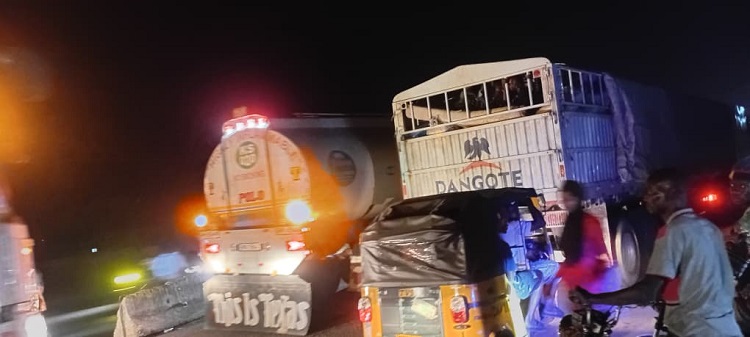
“Because of the kidnapping stories we watch and hear about in Nigeria, I thought we were about to be kidnapped,” she recalled. “It was midnight. I was with children and a pregnant woman, so fear gripped me.”
Passengers and the driver later assured her that the cattle belonged to migrating herders moving their livestock due to seasonal changes. As the bus drove past without incident, her fear eased.
That calm, however, did not last.
Soon after, the vehicle ran into another gridlock, this time lasting several hours. By then, it was past 2 a.m., and passengers were asked to disembark. Soldiers and other visibly exhausted men, some of them fellow travellers who had removed their shirts because of the heat, worked through the night to manage the congestion, directing vehicles through narrow gaps to create space for movement. At various points, passengers sat or lay on the bare ground to rest while waiting for traffic to clear.
“My grandchildren needed to relieve themselves. One young woman was crying because she was menstruating and had no convenient place to change. My pregnant daughter-in-law also had to come down,” Mrs. Mmseoma said. “It was a very bad experience, and we didn’t even know what caused the gridlock.”
“If I had money, I would advise people to fly,” she added. “Nigerian roads are not safe for long-distance travel.”
Sleeping in Reception Areas
For another traveller, Jidex, the journey turned into an overnight ordeal weeks earlier, on December 22, 2025.
After leaving Abuja early in the morning, his vehicle reached Lokoja by 10 a.m. and then remained stuck under the scorching sun and heat until late evening. By nightfall, the driver advised passengers to stop at Kabba, warning that the next stretch of road would be dangerous after midnight.
“I didn’t have money for a hotel room, and everywhere was already full,” Jidex said. “I begged the hotel manager to allow me to sleep in the receptionist’s area because nobody wanted to inconvenience their room space further.”
He described the experience as humiliating and exhausting, one he never expected from a major federal highway.
Why the Gridlocks Keep Happening
Residents and youth leaders in Lokoja say the recurring gridlocks are not mysterious.
Abdulkadir Hamisu, a Lokoja resident, explained that the highway is meant to be a dual carriageway, but construction on one lane remains incomplete.
“Most times, tankers and trucks carrying coal have accidents on the road,” he said. “When that happens, they completely block one lane. Since the other lane is still under construction, movement becomes very difficult.”
According to him, during the December festive period, a fallen tanker blocked the road for several days.
“People had to abandon their vehicles and use motorcycles to pass through Lokoja to their destinations,” Hamisu said. “The gridlock lasted about eight days because the tanker was not removed on time.”
Another resident, Yahaya Muktar, identified poor road conditions around First NNPC, Felele, Nataco, and New Market as major contributors.
“Lokoja is a gateway to many states, so during Christmas, New Year, and Sallah, traffic volume becomes extremely high,” he said. “With bad roads and frequent accidents, the situation quickly turns into gridlock.”
Market days also worsen congestion, as heavy trucks dominate the highway, leaving little room for smaller vehicles and pedestrians.
Muktar further explained that protests sometimes erupt after accidents, further delaying traffic for hours.
Efforts to speak with relevant government and road management officials proved futile as of the time of filing in this report.
Environmental and Safety Costs
Beyond inconvenience, residents say the gridlocks carry environmental and public-health consequences.
Hours-long idling by trucks and vehicles increases air pollution, especially in densely populated parts of Lokoja. The dominance of fuel tankers and coal trucks also raises concerns about spills, fire risks, and harmful emissions along the corridor.
Women, children, the elderly, and pregnant travellers are often the most affected, forced to spend long hours outdoors without access to toilets, shelter, or clean water.
Known Solutions but Slow Action
Residents interviewed agree that solutions are not far-fetched.
They include completing the second lane of the highway, creating alternative routes for heavy-duty trucks, restricting tanker movement to specific hours, enforcing speed limits to reduce accidents, and improving emergency response time for clearing fallen vehicles.
“The problem is not that we don’t know what to do,” Hamisu said. “The problem is that it is not done on time.”
Travellers like Mrs. Mmseoma say every journey along the Lokoja-Abuja highway remains a gamble, one that exposes families not only to traffic delays, but to fear, environmental stress, and physical risk.
By Oyeyemi Abolade


