

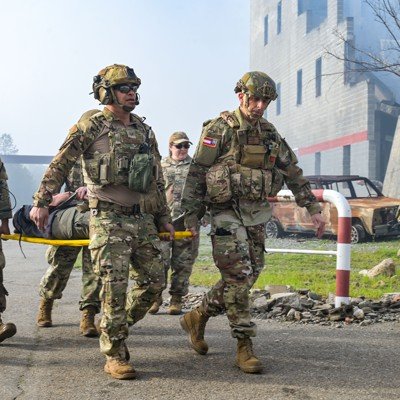
A recent executive order from the White House, “Achieving Efficiency Through State and Local Preparedness,” calls on state and local agencies to take greater responsibility in building resilience to cyber threats, natural disasters, and other emerging hazards. This emphasis on “local forces for local missions” is timely—and essential. Yet, as the Department of Defense reportedly considers cutting 90,000 active-duty Army soldiers, with an inevitable workload increase for the National Guard, a critical question arises: who will fill the gap?
One answer has been hiding in plain sight: Title 32 State Defense Forces, or SDFs.
State Defense Forces are military units authorized under federal law but organized, trained, and led by individual states. Unlike the National Guard, they cannot be federalized, but like the National Guard they are force multipliers, particularly in times of crisis. They are often composed of former active-duty service members, seasoned professionals with deep expertise in military operations, as well as experienced civilian professionals. Skills and experience are abundant. Even better, they operate at a fraction of the cost of National Guard or active-duty forces.
In the past few years, we’ve seen the value of these forces in action:
- The California State Guard, a component of the California Military Department, was mobilized during recent wildfires to support evacuation efforts, logistics coordination, and emergency operations centers.
- The Texas State Guard, a component of the Texas Military Department, has supported Operation Lone Star along the U.S.–Mexico border, integrated with the Texas National Guard to provide manpower, infrastructure support, and critical skills.
- The recently reactivated Florida State Guard stepped up during three back-to-back hurricanes, delivering manpower, logistical support, and emergency response capabilities in devastated communities. They also deployed into Georgia and North Carolina under the authority of an interstate compact, demonstrating how SDFs can operate across state lines when requested by governors.
- During the national COVID response, SDFs across the country supported testing sites, managed logistics, and bolstered local emergency management operations.
Expanding on the underused Title 32 State Defense Forces, a number of states including Maryland, Tennessee, South Carolina, Ohio, Texas, California, Washington, Louisiana and Virginia are using their civilian cyber professional expertise to improve their state’s cyber defenses.
These examples aren’t anomalies—they’re proof of concept.
However, expanding SDFs comes with concerns, some legitimate. Some point to potential redundancy with the National Guard and civilian agencies, or worry about inconsistent standards and oversight, given the absence of direct federal engagement. And of course there are questions about the cost.
These concerns are valid but manageable with clear operational guidelines, better federal-state coordination, and standardized interoperability measures. The Emergency Management Assistance Company, as seen in Florida’s deployments, can formalize cross-state collaboration, offering a structured response mechanism and alleviating concerns about misuse or political influence.
Nonetheless, expanding and properly equipping SDFs will require more government funds. Still, SDFs operate largely with volunteer personnel, at a fraction of the cost of the National Guard. Such an investment appears modest in context, especially given the demonstrable returns in capability and flexibility during emergencies.
Yet State Defense Forces remain dramatically underused. Despite being cost-effective, locally controlled, and highly skilled, they are rarely integrated into broader federal and state emergency planning frameworks. Why?
Because the system doesn’t yet make it easy.
A 2014 Department of Defense Inspector General report recommended that the Department of Defense establish clear guidelines and policies to improve coordination and communication, better integrate State Defense Forces into national defense and emergency preparedness plans, and clarify rules for State Defense Forces’ access to and use of federal equipment and resources. All of this is doable under current law.
To realize the full potential of Title 32, we need action in three key areas:
· Northern Command and the Department of Homeland Security should do more to facilitate SDF growth and engagement. These agencies should help integrate SDFs into regional and national emergency preparedness plans, exercises, and operations.
· Allow SDFs more access to federal resources. Right now, federal assets are often limited to use by federally controlled forces. Let’s change that. If a state can field trained, ready, and willing forces under Title 32, they should have access to the same tools to protect lives and infrastructure.
· Create standards for interoperability across SDFs: operational standards, communications protocols, equipment compatibility, and shared training opportunities to help create a seamless system of layered defense and response.
The EMAC already provides the mechanism for collaboration beyond state borders—Florida’s deployment to Georgia and North Carolina is a model. We should encourage more states to use this and similar agreements and develop shared contingency plans.
The looming reduction in Army end strength demands creative, cost-effective solutions. State Defense Forces are already organized, already active, and already proven. They are, in fact, the embodiment of the President’s vision: local forces, ready for local missions, backed by national strategy.
It’s time we stop overlooking this force and start investing in it. Our resilience—and readiness—depends on it.
Robert Hastings is a retired brigadier general of the Texas State Guard and principal of Robert Hastings & Associates, a consultancy specializing in strategy, marketing, communications, and government affairs within the aerospace and defense sectors.


