Five years ago, SpaceX launched Starlink, which has since grown into its biggest revenue driver, expanding to over 100 countries. But as Starlink scaled, it faced a major hurdle: accepting payments in developing markets, where traditional banking infrastructure is unreliable, slow, and prone to blocking transactions. Many local banks across Africa, Latin America and Asia struggle with international payments, forcing SpaceX to look for alternatives.
To bypass these challenges, SpaceX turned to stablecoins, a fast-growing method for cross-border payments already widely used in emerging markets. The company partnered with Bridge, a stablecoin payments platform, to accept payments in various currencies and instantly convert them into stablecoins for its global treasury. This move positioned Bridge as a viable alternative to correspondent banks in markets where traditional financial systems fall short. Soon after, Stripe took notice, acquiring the startup for more than $1 billion and solidifying Bridge’s reputation and driving up its valuation as an infrastructure player, solving inefficiencies in global finance.
The rise of stablecoins—now a $205 billion market—is driven by real-world utility, not speculation, particularly in emerging markets where the most compelling use cases unfold. Cross-border payments in these regions are typically slow and expensive, involving multiple intermediaries. For example, a textile manufacturer in Brazil paying a supplier in Nigeria might have to go through several banks and currency exchanges, each adding fees and delays. Stablecoins remove this friction, enabling cheaper, near-instant transactions.
Adoption and investor interest surge
This growing demand has led to massive transaction volume growth for startups providing stablecoin cross-border solutions for businesses in Africa and emerging markets.
Yellow Card, which provides a platform that lets users convert fiat to crypto and back to fiat, doubled its annual transaction volume to $3 billion in 2024 from $1.5 billion in 2023. Conduit, which enables stablecoin payments for import-export businesses in Africa and Latin America, saw its annualized TPV jump to $10 billion from $5 billion. Lagos-based Juicyway, which facilitates cross-border payments using stablecoins, has processed $1.3 billion in total payment volume to date.
Investor interest has also surged, with top venture firms backing stablecoin-powered fintechs targeting these markets. Peak XV and HongShan, the firms that split from Sequoia, co-led a $10 million seed round in KAST, a neobank that lets users hold and spend stablecoins. Sequoia itself was a major backer of Bridge. Yellow Card raised $33 million, led by Blockchain Capital. Conduit, which raised a $6 million seed round last year, is finalizing another round. Meanwhile, QED Investors led a $9.9 million investment in Cedar Money, a stealthy fintech using stablecoins for cross-border transactions. Initialized led an $8.5 million round in Caliza, which is bringing real-time transfers to Latin-America using USDC. Tether itself invested a sizable check in an African stablecoin infra and liquidity provider, TechCrunch has learned.
The trend is clear: stablecoins are no longer a crypto experiment—they are becoming a core part of financial infrastructure in emerging markets to move money globally. As adoption accelerates, the question is not if stablecoins will transform payments but how quickly they will stand alongside—or even replace—outdated financial systems.
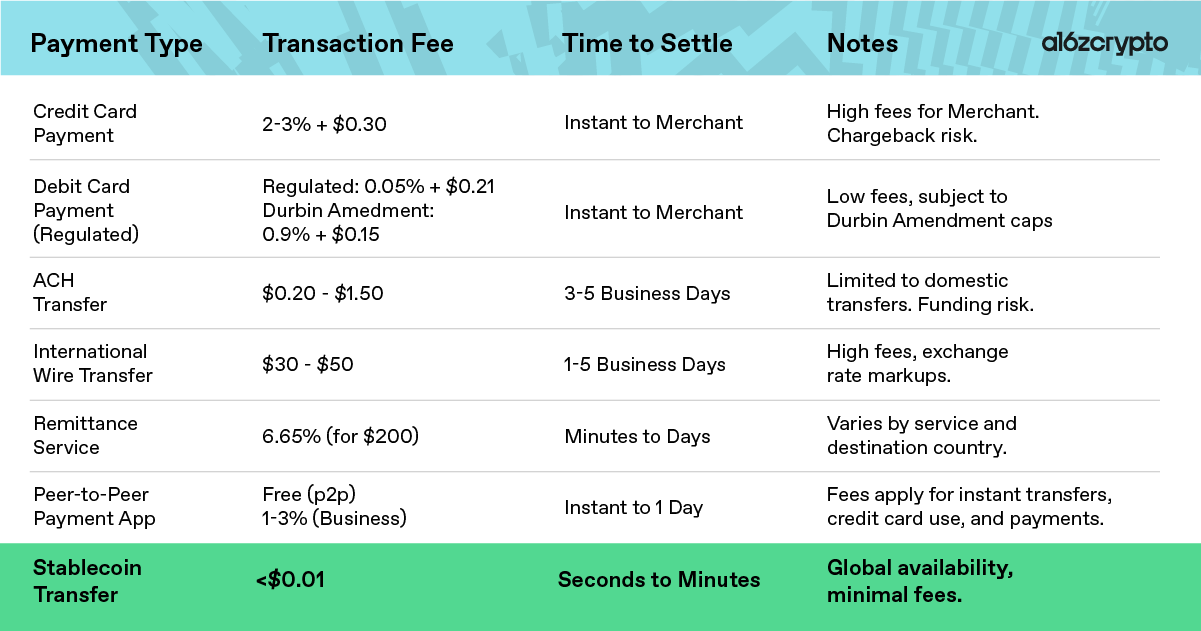
Some numbers reflect this shift. According to a16z, sending $200 from the U.S. to Colombia via stablecoins costs less than $0.01, compared to $12.13 using traditional methods. Payment platforms are adapting, making a cut albeit a smaller one than the traditional middlemen rails. Stripe, for instance, now charges 1.5% for stablecoin transactions, 30% lower than its standard card fees. Businesses and individuals are also using stablecoins as a hedge against inflation and a more stable store of value, with USDT and USDC becoming critical tools.
Applications outside cross-border and remittance
While cross-border payments and remittances have driven early adoption, stablecoins are now gaining traction in consumer finance, payroll, and, partly, retail transactions.
This January, Brazilian unicorn Nubank introduced a feature rewarding USDC holders with a 4% annual return, following a tenfold increase in customer-held USDC last year. Now, 30% of Nubank’s users have USDC in their portfolios. Nubank joins other fintech giants like Venmo, Apple Pay, PayPal, Cash App, and Revolut, which already enable in-app stablecoin transactions.
Beyond consumer savings, stablecoins are reshaping global payroll. As remote work expands, startups like Rise allow companies to pay contractors using stablecoins. The platform lets businesses pay in fiat while contractors receive stablecoins like USDC or USDT, avoiding currency volatility. Last November, Rise raised $6.3 million in Series A, fueling its expansion in stablecoin-powered payroll solutions.
“The market is going where we are building and it’s only a matter of time until the big players get in the arena. They will offer stablecoins by partnering, acquiring, or building a crypto payment infrastructure,” Rise CEO Hugo Finkelstein told TechCrunch.
And while retail adoption of stablecoins has been slower, but startups like Cashnote.io are testing solutions. The platform, developed by Korean fintech Korea Credit Data and Web3 VC firm Hashed, enables merchants to accept credit card and digital asset payments via a point-of-sale system. Merchants can process payments using stablecoins without the restrictions of credit card limits and consumers can use digital assets for everyday purchases.
Both firms are testing the platform in the Abu Dhabi Global Market (ADGM), one of the most crypto-friendly regulatory environments globally. Cashnote.io is projecting to go live with merchants in the region over the coming months, with UAE-based digital assets infra provider Fuze acting as the settlement partner. Fuze raised a $14 million seed in 2023.
Yet, despite stablecoins’ potential to streamline payments globally, concerns remain. For one, critics warn that stablecoins could disrupt monetary policy. As they become more common in global finance, some worry they could mirror past concerns about dollarization, where economies rely too heavily on the U.S. dollar instead of building independent financial systems.
Similarly, their efficiency comes with trade-offs. Unlike government-backed currencies, they depend on private companies like Circle and Tether to maintain their value. These companies use cash reserves, short-term securities, and other financial assets to keep stablecoins pegged to the U.S. dollar. However, the 2022 collapse of TerraUSD shows how vulnerable stablecoins can be.
Regulatory shifts could make or mar adoption
Governments and regulators worldwide are paying attention, and their actions will influence stablecoin adoption. Some regions like Abu Dhabi’s ADGM, for example, have positioned themselves as crypto-friendly zones, enabling fintech firms to experiment with stablecoin payments. Hashed CEO Simon Kim says Cashnote.io could only work in the region due to the region’s structured and supportive legal framework.
“There’s hardly a government like Abu Dhabi that accelerates innovation from new challengers abroad like this,” Kim told TechCrunch. “It has many sandboxes and government support systems for testing innovative and new crypto infrastructure.”
Similarly, the UAE made headlines last year when a court ruling permitted salaries to be paid in crypto, reinforcing the country’s position as a global hub for digital asset innovation.
Africa presents a different show. In many cases, innovation moves faster than regulation, forcing policymakers to react only after fintech proves its value—just as they did with mobile money, according to Zekarias Amsalu, co-founder of one of Africa’s top fintech events. He believes regulators, rather than being overtly cautious, should embrace stablecoins as they already help reduce cross-border transfer and remittance costs by up to 75%.
“If you are willing to formalize Franco Valuta [policy that allows the import of goods without using foreign exchange from a bank] when the dollar crunch bites, against all real risks, why not consider formalizing stablecoins that are provided by licensed exchanges with all transparency and compliance?” Amsalu posits.
Whether their stance changes or not may depend on how regulation shapes up in the U.S., which is considering new laws that would have a global impact on stablecoins: A strict regulatory approach—though unlikely—could slow adoption and impose tighter financial controls on issuers. On the other hand, a pro-stablecoin stance could encourage more countries to create clear licensing rules for digital assets. “These are very strong signals for investors,” Finkelstein said.