


Materials are often considered to be one phase, but many engineering materials contain two or more phases, improving their properties and performance. These two-phase materials have inclusions, called precipitates, embedded in the microstructure.
Alloys, a combination of two or more types of metals, are used in many applications, like turbines for jet engines and light-weight alloys for automotive applications, because they have very good mechanical properties due to those embedded precipitates. The average precipitate size, however, tends to increase over time—in a process called coarsening—which results in a degradation of performance for microstructures with nanoscale precipitates.
Researchers at the University of Illinois Urbana-Champaign have identified a novel pathway to stabilize the nanoscale precipitates in alloys. In a new study, materials science and engineering professor Pascal Bellon, postdoctoral researcher Gabriel Bouobda Moladje and their collaborators show that it is possible to utilize nonequilibrium processes to stop precipitate coarsening, which results in stable nanostructures.
The results of this research were recently published in Physical Review Letters.
“In the last two decades, researchers have realized that having nanoscale inclusions in the structure that can actually be very beneficial to the material,” Bellon says. “The challenge is that spontaneously, these small particles want to grow bigger.”
Think of it like making pasta: when oil is added to the boiling water, the oil drops may be small when first added and stirred, but if stirring is stopped, the droplets will combine together to form larger drops. This is the coarsening process. “If we are interested in the distribution of small-scale objects, we have to work against this natural tendency for things to coarsen,” Bellon explains.
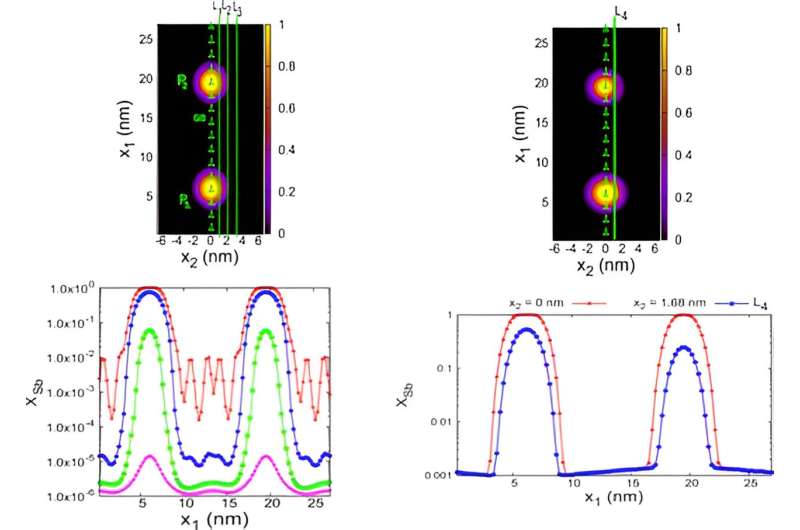
The team used computational modeling to investigate precipitates formed at the domains between different crystals of the material, called grain boundaries, when subjected to irradiation, a nonequilibrium force. In an equilibrium environment, forces are balanced and there is no net change to the material. In most applications, however, hard materials are subjected to nonequilibrium forces like irradiation, or even stirring. Therefore, it is important to understand how precipitates evolve in such nonequilibrium environments.
“We were particularly interested in alloys subjected to energetic particle irradiation,” Bellon says. “This is a situation that, for instance, happens in materials used for nuclear applications. It’s also the case for materials used in space, where they are bombarded by cosmic rays. What we were specifically looking at was a model alloy of aluminum and antimony.”
In alloys of aluminum and antimony, antimony wants to form precipitates, like oil wants to form droplets in water. The researchers found that when irradiated, precipitates would form at the grain boundaries as expected. But they also found that instead of coarsening and continuing to grow, the precipitates would reach a certain size, and stop. This is called arrested coarsening behavior and was an unexpected result.
This approach could be applied to other materials systems where the transport of species plays an important role, like the transport of ionic species between electrodes in batteries. In battery materials, it can be advantageous to have small precipitates, since large precipitates can generate a lot of stress to the material. In such a case, the suppression of coarsening would be beneficial.
Following this computational research, Bellon, along with UIUC MatSE professors Robert Averback and Marie Charpagne, plan to start exploring experimental validation of the results recently published. Bellon says, “We’re excited to combine modeling, theory and experiments, while taking advantage of all the Materials Research Laboratory tools, to test the predictions from computer simulations at an experimental level.”
More information:
G. F. Bouobda Moladje et al, Convection-Induced Compositional Patterning at Grain Boundaries in Irradiated Alloys, Physical Review Letters (2023). DOI: 10.1103/PhysRevLett.131.056201
Provided by
University of Illinois Grainger College of Engineering
Citation:
Stabilizing precipitate growth at grain boundaries in alloys (2023, August 17)
retrieved 17 August 2023
from https://phys.org/news/2023-08-stabilizing-precipitate-growth-grain-boundaries.html
This document is subject to copyright. Apart from any fair dealing for the purpose of private study or research, no
part may be reproduced without the written permission. The content is provided for information purposes only.


