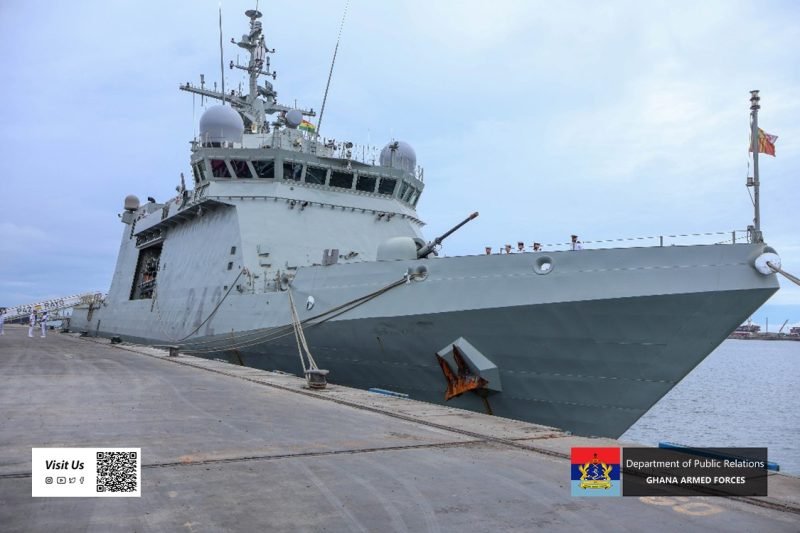
Lieutenant Commander José Antonio Parejo Cabezas, commanding officer of the Spanish offshore patrol vessel BAM Rayo (P-42), met with Commodore Solomon Asiedu-Larbi, flag officer commanding the Ghana Navy’s Eastern Naval Command, on October 9, 2025, in Tema. The two leaders discussed ways to deepen ties between their navies, focusing on joint exercises, personnel swaps, and joint efforts to safeguard sea lanes in the Gulf of Guinea. This port call marks a step in Rayo’s ongoing deployment along West Africa’s coast, which began on September 1, 2025, as part of Spain’s contributions to European Union maritime presence operations.
Parejo Cabezas outlined how Rayo’s mission supports local forces in defending their waters from illicit activities. Spain stations these vessels in the region to build confidence among partners and deter threats that cross borders. He praised the Ghana Navy’s role in maintaining stability in the area, describing Ghana as a steady ally amid rising regional tensions. Asiedu-Larbi, who took command of the Eastern Naval Command on September 1, 2025, after leading the Naval Training Command, stressed the value of such visits. He pointed out that sharing intelligence and conducting drills together helps counter dangers like piracy and illegal fishing, which demand coordinated responses from multiple nations.
The exchange ended with the swap of commemorative plaques, a gesture that seals commitments to ongoing collaboration. These routines build personal connections that pay off during real operations.
Rayo belongs to the Meteoro class of Buques de Acción Marítima (BAM), or maritime action vessels, designed by Navantia for versatile patrol duties. At 93.9 meters long, with a beam of 14.2 meters and a draft of 4.2 meters, the ship displaces about 2,670 tonnes. Two MTU 16V diesel engines, paired with electric motors for quieter propulsion, drive her to a top speed of 20 knots. She carries enough fuel for a 5,000-nautical-mile range at 15 knots, ideal for extended patrols without frequent refuelling. The core crew numbers 47, though she can accommodate up to 76 with additional specialists for specific tasks.
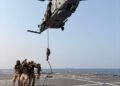
Armed with a 76-millimetre Oto Melara gun forward, remote weapon stations, and anti-ship missiles in modular launchers, Rayo balances firepower with flexibility. Her helicopter deck and hangar support a medium-lift rotorcraft, such as the NH90, for surveillance or boarding operations. Sensors include a Thales Herakles radar for surface and air tracking, plus sonar for underwater threats. This setup lets her handle everything from routine traffic monitoring to high-stakes interdictions, though designers traded heavy armour for speed and endurance to cover vast ocean areas. Based at Las Palmas in the Canary Islands under the Naval Command there, Rayo forms part of a quartet in the class, with two more under construction as of September 2025.

Spain deploys Rayo through the EU’s Coordinated Maritime Presences initiative, which rotates assets to support allies without permanent bases. Earlier this year, Spanish units joined Obangame Express 2025, a multinational drill in May that honed skills against smuggling and piracy across zones from Cape Verde to Angola. Rayo herself stopped in Nigeria on September 26, 2025, for similar talks with the Western Naval Command. These moves fit into broader EU efforts, like training teams in Benin since October 2025, to equip local forces with tactics for boardings and vessel protection.
The Gulf of Guinea faces persistent challenges that justify such partnerships. Piracy incidents rose 25 per cent in 2025, with 15 attacks reported in the first nine months, up from 12 the year before. While totals remain the lowest in three decades, strikes often turn violent: crews endure kidnappings, with 11 seafarers taken hostage in those events. Groups target oil tankers and cargo ships for fuel theft or ransoms, exploiting weak patrols near ports like Tema. Illegal fishing drains fish stocks, fueling disputes, while arms smuggling adds to instability from onshore conflicts. Ghana’s Eastern Naval Command, headquartered in Tema, patrols this eastern stretch, using fast attack craft and offshore vessels to enforce exclusive economic zones. Asiedu-Larbi’s team integrates U.S.-donated patrol boats with local assets to monitor 550 kilometres of coastline.
Vessels like Rayo bring advantages in reach and tech that smaller fleets lack. Her electric propulsion cuts noise for stealthy approaches, and the modular design allows quick swaps for mission kits, from pollution response gear to drone launchers. Yet trade-offs exist: the light armament suits low-intensity threats but limits her in peer conflicts, pushing reliance on allied air cover. For Ghana, hosting Rayo opens doors to Spanish expertise in radar integration and cyber defences for ships, areas where budgets constrain upgrades.
These visits do more than exchange pleasantries. They knit together operations so that when a suspicious vessel appears on radar, calls go out across borders without delay. As threats evolve, from drone-assisted hijackings to encrypted smuggling networks, navies like Spain’s and Ghana’s gain from pooled resources. Rayo’s stay in Tema highlights how routine diplomacy at sea keeps the Gulf safer for trade routes that carry 10 per cent of global oil.