

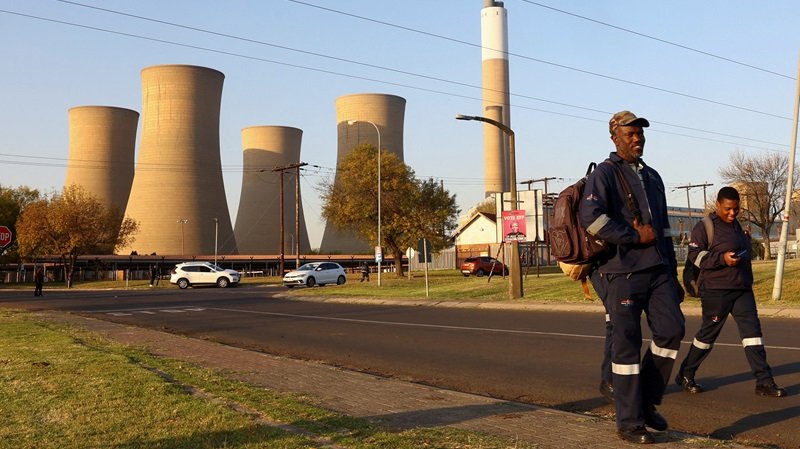
South Africa has successfully disbursed $5.5 billion of its groundbreaking $8.5 billion Just Energy Transition Partnership (JETP) funding, marking a significant acceleration in implementation after initial delays, according to the latest Presidential Climate Commission report released this week.
The disbursement rate of 65% represents a dramatic improvement from the 23% recorded in late 2024, driven primarily by streamlined regulatory processes and enhanced coordination between international donors and local implementing agencies.
Renewable Energy Deployment Exceeds Targets
The program has facilitated the addition of 4.2 gigawatts of renewable energy capacity since 2024, surpassing the initial 3.8GW target for this phase. Solar photovoltaic installations account for 2.8GW, while wind projects contribute 1.4GW, according to data from the South African Wind Energy Association and Solar Power Africa.
Eskom’s transmission grid upgrades have proven crucial to this success, with $1.8 billion allocated to infrastructure improvements enabling better renewable energy integration. Load shedding incidents have decreased by 78% compared to 2023 levels, representing the most stable electricity supply in over a decade.
“The coordination between our international partners and domestic institutions has reached an unprecedented level of efficiency,” said Dr. Crispian Olver, Executive Director of the Presidential Climate Commission. “We’re seeing tangible results in communities that depend on coal for their livelihoods.”
Coal Region Transition Programs Show Mixed Results
The Mpumalanga and Limpopo coal belt regions have received $2.1 billion in dedicated transition funding, supporting approximately 85,000 workers and their families. However, implementation has varied significantly across different municipalities.
The Emalahleni Local Municipality has successfully established three green hydrogen production facilities, creating 2,400 direct jobs. Meanwhile, the Steve Tshwete Local Municipality has struggled with project delays, with only 40% of allocated funds disbursed due to administrative capacity constraints.
Skills Development and Reskilling Initiatives
Technical and vocational education programs have trained 12,500 former coal workers in renewable energy technologies, with an 73% job placement rate. The University of the Witwatersrand and Stellenbosch University have received $340 million to establish green technology research centers.
“The human capital development component is where we’re seeing the most transformative impact,” noted Dr. Melissa Fourie, Deputy Director-General at the Department of Higher Education and Training. “These aren’t just jobs – they’re career pathways into a sustainable energy economy.”
International Partner Coordination Mechanisms
The JETP’s governance structure, led by Germany, France, the United Kingdom, the United States, and the European Union, has evolved significantly since initial implementation challenges in 2022-2023.
The World Bank has disbursed $1.4 billion through its South Africa Energy Sector Recovery Program, while the African Development Bank has contributed $980 million focused on grid modernization. The European Investment Bank’s $1.1 billion facility has prioritized manufacturing localization, with 34% of renewable energy components now produced domestically.
Private sector co-financing has reached $3.2 billion, exceeding the original $2.8 billion target. Standard Bank and Nedbank have established dedicated green finance divisions, mobilizing an additional $1.8 billion in domestic capital.
Remaining Implementation Challenges
Despite progress, significant obstacles persist. Environmental impact assessments for large-scale projects continue to face delays, with 18 renewable energy projects worth $2.3 billion still awaiting final approvals from the Department of Forestry, Fisheries and Environment.
Municipal debt levels in coal-dependent regions remain a concern, with aggregate debt reaching R47 billion across affected municipalities. The National Treasury has allocated $450 million specifically for municipal financial recovery programs.
Forward-Looking Investment Implications
The JETP’s success is catalyzing broader renewable energy investment across sub-Saharan Africa, with Nigeria and Kenya seeking similar international partnerships. South Africa’s experience provides a template for large-scale energy transition financing, though the model’s replicability depends heavily on existing institutional capacity and donor coordination.
For institutional investors, the program demonstrates that patient capital combined with strong governance frameworks can deliver measurable results in emerging market energy transitions. The remaining $3 billion in funding will focus on manufacturing localization and regional energy integration, offering opportunities for infrastructure and industrial investment through 2028.

