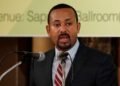
South Africa’s foreign minister, Naledi Pandor, said the country’s citizens fighting for the Israel Defence Forces in Gaza faced prosecution upon their return. This statement followed tension between South Africa and Israel amid the “humanitarian catastrophe” resulting from Israel’s war against Hamas in Gaza.
There is a history of South African citizens of Jewish descent fighting for Israel, but the number fighting for Israel in the current war on Gaza is unknown. The Conversation Africa asked Michelle Nel, an expert in international law and military law, for her legal insights.
Which South African law bars its citizens from fighting in foreign wars or armies?
South Africa explicitly prohibits citizens from rendering any foreign military assistance without the permission of the National Conventional Arms Control Committee. The committee is appointed by the president and controls all issues related to conventional arms.
Section 198(b) of the constitution precludes South African citizens from participating in any foreign armed conflict. The Regulation of Foreign Military Assistance Act, 1998 effectively criminalises such actions.
In an apparent hardening of the South African government’s position against Israel, Pandor has not only threatened to have South African citizens fighting in the Israel Defence Forces prosecuted. The government also warned in December 2023 that naturalised South Africans could have their citizenship revoked for joining foreign armed forces engaged in wars the country didn’t agree with.
Citizenship is governed by the South African Citizenship Act of 1995. It can revoke South African citizenship where a citizen engages, under the flag of another country, in a war that the Republic does not support.
However, section 20 of the constitution also determines that no citizen may be deprived of citizenship.
What does the law prohibit?
The constitution creates a wide framework for prohibiting participation by citizens in armed conflict.
South Africans are prohibited from engaging in any kind of mercenary activity, or taking part in any military action on behalf of a foreign country, without the express authorisation of the National Conventional Arms Control Committee. Legal entities (such as a company), permanent residents and foreign nationals are also prohibited from rendering such assistance within the borders of the country.
“Foreign military assistance” is widely defined. It includes not only the actual rendering of such assistance, but any attempt to render assistance, any encouragement, incitement or solicitation thereof.
It criminalises:
providing advice or training any personnel or operational support
recruitment
medical services
procurement of equipment
security services such as those rendered by private military companies in areas of conflict
assisting in coups or furthering the military interests of parties to a conflict.
The Regulation of Foreign Military Assistance Act is set to be repealed by the Prohibition of Mercenary Activities and Regulations of Certain Activities in Country of Armed Conflict Act, 2006, which is yet to be promulgated. This new act goes as far as prohibiting the rendering of humanitarian assistance in a country of armed conflict, unless the organisation involved is duly registered with the arms control committee.
How has the law been applied in the past?
In 2009, the Palestinian Solidarity Alliance handed a list of 73 South Africans of Jewish descent who had fought for the Israeli military in 2008 and 2009 to the National Prosecuting Authority. The authority declined to prosecute. This was followed by a case brought against another South African citizen serving in the Israel military in 2014. A docket was opened in the Western Cape, but no information could be found as to whether he was in fact prosecuted.
In 2015, about 100 former South African soldiers reportedly left to train the Nigerian military to combat Boko Haram. The then defence minister, Nosiviwe Mapisa-Nqakula, reportedly said that they should be arrested upon their return to South Africa. Information on whether these arrests and prosecutions in fact took place is not readily accessible.
Many South Africans continue to serve in foreign armed forces and private military companies. Yet, the prosecuting authority has not succeeded in prosecuting any. Some cases have been settled by way of plea bargain, with fines and suspended prison sentences.
Ultimately the efficacy of the legislation depends on its consistent enforcement. The history of inconsistent prosecution and accountability in terms of the mercenary activities act raises questions about the prosecuting authority’s ability to successfully prosecute the South Africans fighting for Israel.
Do other countries have similar laws? Why are they good to have?
Very few countries have legislation prohibiting their nationals from joining foreign armed forces. The UK prohibits its citizens from joining foreign armed forces. In the US they may forfeit their citizenship. Joining a foreign force fighting against the US is seen as treason.
The Netherlands does not prohibit citizens from joining a foreign armed force as long as the country is not at war with the country concerned. Canadians are prohibited from joining any foreign armed force that is at war with a friendly nation.
There are more countries prohibiting mercenaries. They include France, Germany and the UK. South Africa is among the few that prohibit any form of engagement in the service of a foreign force.
Since the war between Russia and Ukraine in February 2022, questions have been raised about the legal status of foreigner volunteers fighting in support of Ukraine within the wider ambit of international law.
Some of them have been killed. What would happen to those captured by the enemy?
The treatment of these foreign nationals could complicate diplomatic relations. It is therefore in the interest of any country to control its citizens’ ability to participate in foreign conflicts.
Written by Michelle Nel, Lecturer in Criminal and Military law and the Law of Armed Conflict at the Faculty of Military Science, Stellenbosch University.
Republished with permission from The Conversation. The original article can be found here.