

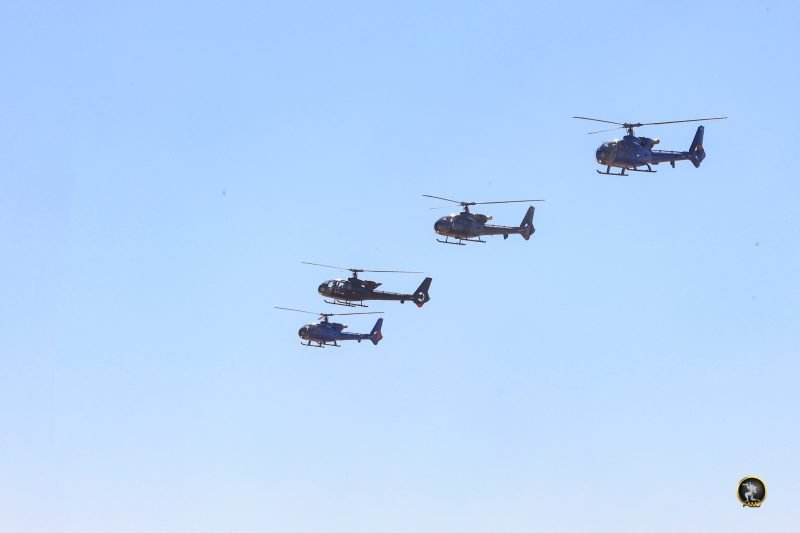
At least four Aérospatiale Gazelle light helicopters have been exported from South Africa to Libya, where they have joined the air wing of General Khalifa Haftar’s Libyan National Army (LNA). The transfer appears to exploit a legal loophole using demilitarised, civilian-registered aircraft, placing the shipment in direct violation of the active United Nations (UN) arms embargo on Libya.
The helicopters were reportedly flown from Lanseria International Airport, near Johannesburg, over the past several months. Recent flight data, including a flight on September 18, 2025, involved a Belarusian-registered Ilyushin Il-76 (Il-76) cargo aircraft operated by TransAvia Export Airlines.
Flight plans for the shipments reportedly listed Amman, Jordan, as the final destination, with a refuelling stop in Nairobi, Kenya. This route is now believed to be a diversion. The Il-76 transports allegedly deviated from their filed plans to deliver the helicopters to Benghazi, the LNA’s primary stronghold in eastern Libya. LNA forces are known to be actively restoring their aviation capabilities at the nearby Benina Airbase.
This transfer exposes a well-documented weak point in international sanctions. According to defenceWeb, he helicopters involved are former British and French army models, which were “demilitarised,” brought to South Africa, and placed on the civilian aircraft registry. South African registrations, including ZU-R00 and ZU-RZR, were identified.
Because the aircraft were registered as civilian, they likely did not fall under the stringent regulations of South Africa’s National Conventional Arms Control Committee (NCACC). This would allow the shipment to bypass the legal requirement for a verified End-User Certificate (EUC), a document designed to prevent arms from being diverted to unapproved destinations or embargoed actors.
Despite their “demilitarised” status, the Gazelle is a capable military platform. The French Army operated the SA 342M variant as a successful anti-tank gunship armed with HOT missiles; other versions were equipped with 20mm cannons. Reports suggest the LNA-bound helicopters were refitted with armour and door-mounted machine guns, quickly returning them to a light attack and reconnaissance role.
The four helicopters were reportedly seen in a flypast over Benghazi, their South African civilian markings covered by Libyan flag stickers.
The export has caused a political reaction in South Africa. Chris Hattingh, a Democratic Alliance (DA) Member of Parliament who serves on the Joint Standing Committee on Defence, is questioning the Minister in the Presidency, Khumbudzo Ntshavheni, who oversees the NCACC.
Hattingh asserts that because the helicopters were designed for military use, they should be controlled under South Africa’s National Conventional Arms Control Act. He stated that clearing the aircraft for Jordan, only for them to appear in Libya, constitutes a “clear diversion” that the law is meant to prevent.
South Africa’s Department of Transport (DoT) has stated it is “reviewing” all Il-76 flights from this year to determine if other assets were similarly exported. The UN Security Council renewed the arms embargo on Libya in May 2025, and French delegates to the UN called for “full compliance” with the embargo as recently as October 14, 2025.
Similarly, South African-registered Gazelles were also operating in Mozambique some years ago in the hands of private military contractors. One was shot down in 2020.


