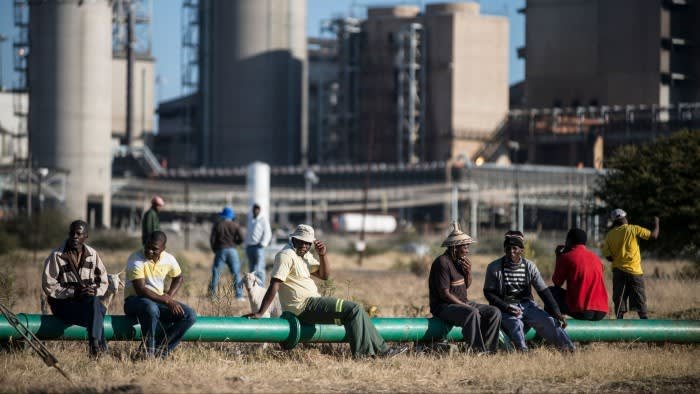
A group of workers laid off from Anglo American sat drinking in the early morning sun outside a makeshift township bar in Ga-Puka, deep in South Africa’s platinum mining belt.
“The sad truth is that it’s us ordinary South Africans who are suffering. Government and the mine [shareholders] get rich, we are just thinking how we will survive,” said one, an engineering contractor, swigging from a can of beer.


The discovery in the 1920s of vast platinum reserves beneath the tranquil farmland north of Pretoria transformed the region. Today, job offers are scant for those relocated to the barren, sun-baked settlement of Ga-Puka.
While other platinum miners in the region have also slashed jobs, Anglo American Platinum, along with the LSE-listed miner’s iron ore unit Kumba, have come under the spotlight after BHP’s £31bn offer last month. The Australian miner’s unsolicited bid was conditional on Anglo demerging its Johannesburg-listed divisions.
A sharp decline in platinum group metal prices, used in everything from medical equipment to diesel car exhausts, has contributed to a 45 per cent fall in Amplats’ shares in the past year, with rising costs leading to a headcount reduction by almost a fifth.

The downturn in the platinum metals markets has come as South Africa’s mining industry has been embattled by power outages and crumbling infrastructure after years of government under-investment. Anglo’s journey from a South African corporate wealth creator to prey for a rival miner reflects the country’s own decline as a mining powerhouse, as well as the rising risks of doing business in the country.
“You can’t get away from the fact that South Africa is a very onerous environment for big mining companies in which to invest, let alone explore new resources,” said Michael Cardo, author of Harry Oppenheimer: Diamonds, Gold and Dynasty, a biography of the son of Anglo’s founder who chaired Anglo for 25 years.
“What’s under way now almost has the feeling of the sun setting on a corporate empire.”
Foreign investors last year perceived South Africa to be in the bottom 10 — lower than Mali and Burkina Faso — out of 62 mining jurisdictions, according to a survey from Canadian think-tank Fraser Institute.
Delays by the government in setting up industry basics such as a mining cadastre — a public online map that lists available mining or prospecting rights — have contributed to holding up a pipeline of projects, according to the Minerals Council.

Years of often violent wildcat strikes have also hastened the search for alternatives to platinum metals and exploration elsewhere.
“The government is the problem, and their only interest is in themselves,” said Joseph Mathunjwa, leader of a powerful platinum miners union, who has sought to translate clout in the shafts into political power by registering a new political party for elections this month.
More than a decade ago, Mathunjwa’s breakaway Association of Mineworkers and Construction Union, or AMCU, was at the forefront of organising militant strikes demanding fairer wages and better working conditions. That culminated in the 2012 Marikana massacre at Lonmin’s platinum mine, on the western platinum belt, when police acting on government orders summoned four mortuary vans before opening fire on the miners and killing 34 of them.
“I think many mining companies just look at the politics here, see how there are so many stumbling blocks in the way, and just don’t want to own assets in South Africa. It is just very messy to run assets here,” said Peter Major, director at Mining for Modern Corporate Solutions.
Anglo was the heart of industry which transformed South Africa from a colonial backwater to the world’s biggest diamond and gold producer, laying the foundations for Africa’s most industrialised economy.
The company started off in 1917 after Ernest Oppenheimer, a German-born diamond trader, raised £1mn to found the Anglo-American Corporation to mine gold around Johannesburg. The gold fields were among a steady stream of South African asset sales, but the company remains a sprawling international business spanning coveted copper mines in Peru and Chile.

In its birthplace, it has long had to navigate a fraught relationship with the governing African National Congress.
“Anglo American in its heyday was a behemoth, which was of concern to the ANC government,” said Gary Ralfe, whose 40-year career at Anglo included tenure as chief executive of De Beers.
Two decades ago, Thabo Mbeki, president at the time, reacted angrily to comments by Anglo CEO Tony Trahar that operating in South Africa came with political risk. Mbeki fired back that Anglo had been built on the labour of the “poor and the despised . . . during the years of white minority rule”.
A move to the London Stock Exchange in 1999 hurt investor sentiment and had lasting real-world consequences for South Africa, too. “There was an enormous repository of intellectual capital built up locally and in mines throughout southern Africa, which . . . to a considerable extent dissipated,” said Ralfe.
This month, mines minister Gwede Mantashe echoed Mbeki’s anger in response to the proposed break-up of Anglo, saying it “was born and grew here, out of our cheap labour . . . so you can’t want Anglo and not want South Africa”.
BHP backpedalled with a statement that the Australian miner’s proposal to exit Anglo’s remaining South African assets was not a negative reflection on the country. Mantashe told The Financial Times that his own view of the Australian miner remained “negative”.

Despite a series of critical mis-steps that encouraged BHP’s offer, Anglo remains a leading private employer and investor in the country.
The miner has poured more than $6bn into South Africa in the past five years, invested heavily in renewables projects and been a driving force in business efforts to work with President Cyril Ramaphosa’s government to fix the electricity and logistics crises.
Still, for an upcoming generation of South Africans, the mining sector already seems to be in the rear-view mirror. The industry accounts for just over 6 per cent of total GDP compared to the 1980s, when its contribution was about a fifth.
On a sunny Monday afternoon in Johannesburg’s downtown business district, few students streaming out of an imposing neoclassical building that today houses a business school for underprivileged youth, knew that the building had once been Anglo’s iconic headquarters.
“Anglo American? Was that a mining company?” asked 19-year-old Sinethemba Somana, turning to a friend in puzzlement.
The question would have been all but unthinkable when Anglo was a household name and occupied almost a dozen buildings whose faded signposts still crop up between pawnshops and dank taverns in the now-derelict business district.
“Was it gold mining?” asked another 22-year-old student whose own father had been a gold miner. “We’d never go into mining.”