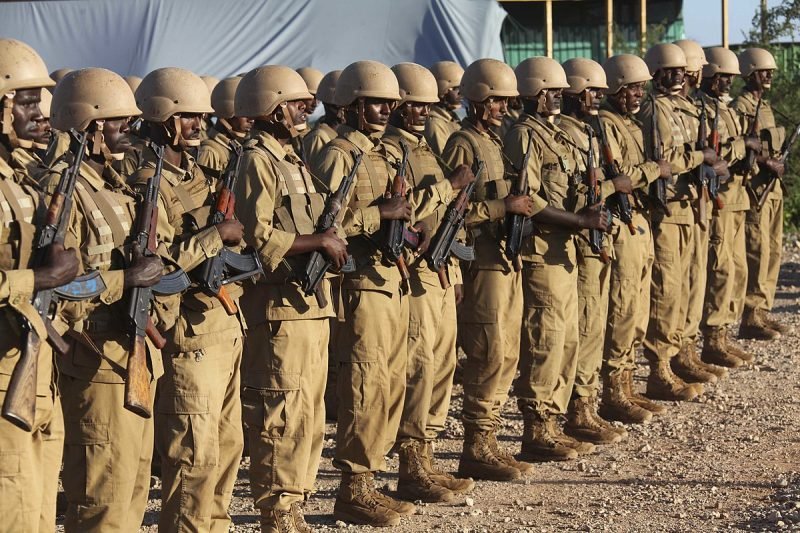
Somalia and Djibouti have formalised a new agreement that paves the way for an additional deployment of Djiboutian troops on Somali soil, a move aimed at bolstering stabilisation efforts in a country long plagued by conflict. The pact, signed on Wednesday in Djibouti City by Somali Defence Minister Ahmed Moallim Fiqi and acting Djiboutian counterpart Ali Hasan Bahdon, reflects a deepening of security cooperation between the two neighbouring nations.
While specific details such as troop numbers and timelines remain undisclosed, the agreement is framed as a practical response to the growing threat posed by the al-Qaeda-affiliated group al-Shabaab, which continues to destabilise Somalia and cast a shadow over the broader Horn of Africa region. The joint statement released by Somalia’s Ministry of Defence following the signing provides some insight into the scope of this arrangement. It explains that the agreement will “govern the additional deployment of Djibouti Armed Forces personnel on Somali territory in accordance with the priorities agreed between the two parties.”
This carefully worded statement suggests a tailored approach, with both nations aligning their efforts to address specific security challenges. The ministry went on to elaborate that the deal outlines the “modalities of intervention, reciprocal obligations, and coordination mechanisms,” all of which are grounded in a spirit of cooperation and mutual respect. This language points to a well-thought-out framework, designed to ensure that the deployment serves the interests of both Somalia and Djibouti while maintaining a clear operational focus. Djibouti’s role in Somalia is far from new.
For years, this small but strategically positioned nation has been a vital contributor to peacekeeping efforts in Somalia, particularly through the African Union Mission in Somalia (AMISOM) and its successor, the African Union Transition Mission in Somalia (ATMIS). Djiboutian troops have been stationed in key locations such as Beledweyne, Buula-burte, and Jalalaqsi in the Hiraan region of Hirshabele state, where they have supported the Somali National Army (SNA) in its fight against al-Shabaab.
This latest agreement builds on that legacy, reinforcing Djibouti’s position as a steadfast partner in Somalia’s struggle for stability. The joint statement describes the pact as part of a broader effort to strengthen the long-standing bilateral relations between the two countries, which share not only geographical proximity but also a common interest in a peaceful and secure region. The timing of this deal is particularly telling. It comes amid a marked increase in al-Shabaab’s activities, especially in south-central Hirshabele state, where the group has intensified its attacks on the SNA and local allied militias.
The joint statement explicitly notes a “doubling” of such assaults over the past five months, during which strategic villages and towns have fallen into the hands of the insurgents. Al-Shabaab, now in its seventeenth year of waging a brutal insurgency against the Somali government, remains a formidable adversary. Its fighters regularly target security forces, government officials, and civilians, adapting and regrouping despite years of military pressure. The additional deployment of Djiboutian troops is thus a timely boost to Somalia’s efforts to reclaim lost ground and push back against the group’s advances. While the exact scale of the deployment remains under wraps, the emphasis on “coordination mechanisms” in the agreement suggests that the Djiboutian forces will be carefully integrated into ongoing military operations.
These efforts are likely to focus on areas where al-Shabaab’s presence is most deeply entrenched, such as the volatile south-central regions. The reference to “priorities agreed between the two parties” indicates that Somalia and Djibouti have a shared understanding of the operational goals, which could include securing key towns, protecting civilian populations, or disrupting the group’s supply lines. Given the fluid nature of the conflict in Somalia, where control of territory can shift rapidly, this level of coordination will be crucial to ensuring the deployment has a meaningful impact. Beyond its immediate military implications, the agreement reflects Djibouti’s broader commitment to peace and security in Somalia.
The joint statement describes this commitment as “unwavering,” a sentiment backed by Djibouti’s long history of involvement in regional security initiatives. Located at the crossroads of Africa and the Arabian Peninsula, Djibouti has leveraged its strategic position to play an outsized role in efforts to stabilise the Horn of Africa. Its participation in AMISOM and ATMIS has been a cornerstone of these efforts, and this new troop deployment can be seen as an extension of that vision. The statement’s reference to a “shared vision of regional stability” further emphasises the mutual stakes involved—both nations stand to benefit from a Somalia free of the chaos and extremism that have spilled across borders, driving refugee flows and threatening wider security. The signing of the agreement in Djibouti City, attended by senior defence officials from both countries, adds a layer of diplomatic weight to the military commitment.
The presence of Ministers Fiqi and Bahdon signals that this is not just a technical arrangement but a strategic partnership with strong political support. This high-level engagement is essential for the deal’s success, as it will require ongoing coordination and resources from both governments to sustain the deployment over time. The ceremony itself serves as a public affirmation of the ties between Somalia and Djibouti, rooted in a history of collaboration and a shared determination to confront the region’s challenges. That said, the agreement is not without its hurdles. The lack of transparency around the number of troops and the timing of their deployment raises questions about how quickly Djibouti can mobilise its forces and how they will fit into Somalia’s complex security landscape.
The conflict in Somalia is shaped by more than just al-Shabaab—clan rivalries, competing militias, and a fragile political environment all complicate military operations. The joint statement’s mention of “reciprocal obligations” suggests that both sides have considered these challenges and established a framework to address them, but the real test will come when the troops hit the ground. Effective implementation will demand adaptability, clear communication, and a willingness to adjust plans as the situation evolves. The deal also arrives at a pivotal moment for Somalia’s security arrangements. The African Union Transition Mission in Somalia is slated to wind down by December 2024, prompting concerns about a potential gap in security as international forces withdraw. While Djibouti’s additional troops are not directly tied to ATMIS, their presence could help mitigate some of the pressure on the Somali government as it works to strengthen its own forces. The SNA has made strides in recent years, but it is still a work in progress, and external support remains vital.
Djibouti’s decision to step up its contribution offers a measure of continuity in the fight against al-Shabaab, providing Somalia with a critical ally at a time of transition. In the broader context, this agreement is a clear example of the importance of regional cooperation in tackling Somalia’s security woes. While international players like the United States, Turkey, and the African Union have played key roles, the involvement of neighbouring countries like Djibouti carries a special weight. These nations feel the direct consequences of Somalia’s instability and have a vested interest in its recovery.
By committing additional troops, Djibouti is not only aiding Somalia but also investing in the stability of the Horn of Africa as a whole—a region that has long grappled with conflict, terrorism, and humanitarian crises. In the end, the troop deployment pact between Somalia and Djibouti stands as a practical and hopeful step forward in the effort to bring peace to a troubled nation. It builds on years of partnership, responds to an urgent and growing threat, and reflects a shared resolve to see a more stable future.
While challenges remain—not least the need to translate this agreement into effective action on the ground—the commitment shown by both countries offers a glimmer of optimism. As Djiboutian troops prepare to join the fight, the agreement serves as a reminder that Somalia’s battle against extremism is a collective one, and that its neighbours are ready to stand by its side.