

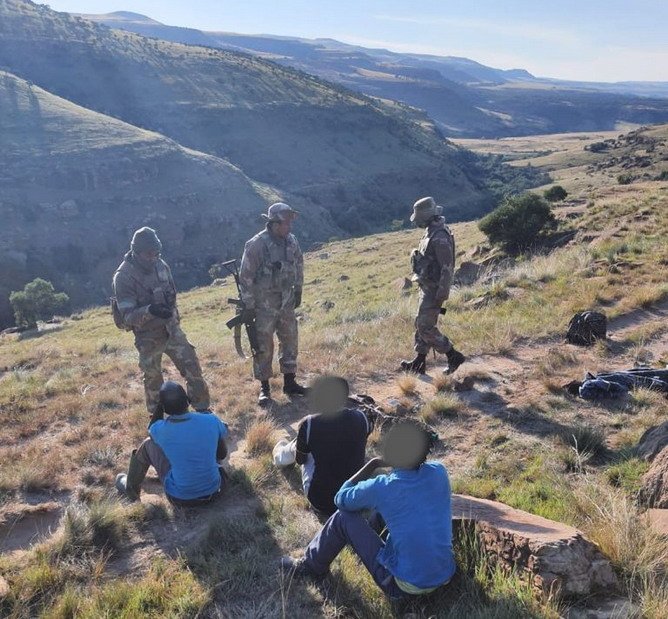

Proof the well-known military dictum that has it one cannot control what isn’t patrolled is aptly illustrated by the efforts of soldiers deployed along the Lesotho border in February.
Soldiers, based on the Eastern Cape, Free State and KwaZulu-Natal borders of landlocked Lesotho did not intercept a single smuggler from the mountain kingdom last month, compared to January when contraband valued at R14.5 million was stopped from unlawfully entering South Africa along the same borders.
For their camouflage battledress colleagues deployed in the ongoing border protection tasking – Operation Corona – on the Botswana, Eswatini, Mozambique and Zimbabwe borders it was a different picture with smugglers relieved of unspecified contraband valued at R17 million in February. The majority of the haul, as it were, handed to police and SA Revenue Service (SARS) officials, came from Botswana, according to the Joint Operations Division of the SA National Defence Force (SANDF), with a value of R10 873 069. Mozambican smugglers had contraband worth R3.8 million confiscated with Zimbabweans losing R2.1 million worth of “stock” and Swazis R94 250.
Soldiers “relieved” drug mules of R4.1 million worth of unspecified narcotics coming from Eswatini, Mozambique and Zimbabwe in February, with Mozambicans attempting entry to South Africa via the KwaZulu-Natal and Mpumalanga borders.
Lesotho, usually a top offender in the illegal grazing stakes with Basotho livestock farmers seeking greener South African pastures in the Eastern Cape and Free State provinces, produced a single offender almost matching the success achieved in preventing illegal movement of contraband. He or she temporarily lost stock valued at R36 800, which will be returned when a fine has been settled.
Small livestock, generally goats and sheep, worth an estimated R103 200 and belonging to Zimbabwean pastoralists was impounded by soldiers in Limpopo.
Interceptions of illegal immigrants in February amounted to 604, less than the January figure when 907 Zimbabweans alone found themselves as “guests” of the Department of Home Affairs (DHA). In this category, the 444 Zimbabweans intercepted on the Limpopo border were the most from a single country.
All told soldiers put paid to vehicles worth an estimated R5.3 million illegally exiting South African en route to Botswana, Mozambique and Zimbabwe. They also apprehended 32 wanted criminals in February.
2026 has been a busy one for soldiers on border patrol. January statistics from Joint Operations indicate that soldiers seized nearly R17 million worth of contraband, apprehended over 1 000 illegal immigrants, detained 80 criminals, seized R2.5 million worth of drugs, and recovered R2.7 million worth of stolen vehicles. Other January successes included seizing R290 000 worth of boats, and R3.5 million worth of livestock.
Deployments along the about 4 860 km of land border are executed by individual companies from mainly SA Army infantry and Reserve Force units, managed by provincial joint operations tactical headquarters. There are currently 15 companies, called “sub-units” by the Department of Defence (DoD)/SANDF, utilised for the border protection and sovereignty tasking.
Meanwhile, men and women in National Police Commissioner, General Fannie Masemola’s SA Police Service (SAPS) are, along with Commissioner Michael Masipato’ Border Management Authority (BMA), contributing to the national border protection effort.
Police involvement, aimed at “dismantling” cross-border criminal networks, SANews reports, recently saw a strategic operation involving 15 Free State SAPS teams and units. Run from the Free State resort town of Clarens in the “fourth quarter of the 2025/26 financial year” police were supported by, among others, the BMA, DHA, National Department of Health (NDH) and the SA Revenue Service (SARS). The operation concentrated on the Thabo Mofutsanyana District bordering Lesotho. Twenty-eight arrests, including seven for stock theft, with stock recovered, were made with 14 undocumented persons detained.
Beyond arrests, the multi-disciplinary teams focused on tightening regulations and seizing illicit substances, the government news agency reports, noting “large quantities of crystal meth and Mandrax were removed from the streets” with over 147 litres of liquor confiscated from an unregistered dealer”.
Sixteen outlets were fined for being non-compliant with the Liquor Act.
“These inter-provincial operations are the cornerstone of the SAPS strategy to intensify the fight against cross-border crime. By synchronising efforts across provincial lines, SAPS aims to close the gaps utilised by syndicates and ensure a safer South Africa,” police are reported as saying by SANews.


