Therapy for the dangerous infectious disease of tuberculosis faces the challenge of pathogens frequently being resistant to several common antibiotics. Researchers of Karlsruhe Institute of Technology (KIT) have now developed nanoparticles to deliver new antibiotics directly to the lungs.


Surfactants ensure that the highly fat-soluble antibiotics disperse very finely in water and can be inhaled. First tests at the Research Center Borstel, Leibniz Lung Center, reveal a high effectiveness and good compatibility of the nanocarriers of antibiotics. The researchers have reported their findings in ACS Nano.
Tuberculosis is the infectious disease with the highest death rate worldwide. As reported by WHO, therapy-resistant tuberculosis infections are increasing. Tuberculosis represents a special challenge for two reasons: First, the bacteria encapsulate in tissue, mostly in the lungs, where they may be inactive for years and cause symptoms long after the primary infection. Second, tuberculosis bacteria often are resistant against two or more common antibiotics. Increasing occurrences of therapy-resistant strains are caused by insufficient drug concentrations at the place of infection and a premature termination of the treatment due to the often severe side effects of the antibiotics.
A nanomedical approach can help to reduce the development of further resistances. Nanoparticles will be used to carry new antibiotics directly to the source of infection and infected cells. In this way, drug concentrations may be increased locally in the lungs. “However, newly developed antibiotics often are lipophilic and fat-soluble and cannot or can hardly be administered in water. They can hardly be absorbed when contained in the stomach, blood, or cell fluid,” explains Professor Claus Feldmann, Head of a research group at KIT’s Institute for Inorganic Chemistry (AOC).
Presently, patients suffering from tuberculosis are treated with high doses over a long time in order to have the pathogens reached in the foci of infection. The partly severe side effects, such as liver damage, often cause terminations of the therapy, a result of which is the development of further resistances. In the future, nanoparticles will be used for the specific delivery of antibiotics.
“We have already tested several nanocarriers for transporting antibiotics to the tuberculosis pathogens in mice. The new nanocarriers developed by our colleagues at KIT now convinced me that it is possible to directly deliver high doses of antibiotics to the foci of tuberculosis in the lungs without affecting other organs,” says Professor Ulrich E. Schaible, Head of the Cellular Microbiology Group and Director of the Research Center Borstel, Leibniz Lung Center.
KIT-developed particles contain very high drug concentrations
Researchers at KIT’s Institute for Inorganic Chemistry have succeeded in producing nanoparticles with extremely high concentrations of antibiotics. “Concentration of the antibiotic is up to 99% of the total weight of the particles,” Feldmann says. “According to literature, a maximum of 10% only has been usually reached so far.”
The KIT-made nanocarriers can be dispersed in water. When inhaled, the aerosol enters the depth of the lungs. At the Research Center Borstel, researchers under the direction of tuberculosis expert Schaible, in cooperation with other partners from Germany, Austria, and Belgium, tested the effectiveness of the nanoparticles with good results in both the lab and in a living organism. “Still, a lot of work will be needed until this aerosol formulation can be applied to humans,” Schaible says.
Nanocarriers overcome biological barriers
The amorphous nanoparticles for inhalation contain a Bedaquilin concentration of 69% or a BTZ-043 concentration of 99%. Both antibiotics are effective against multi-resistant tuberculosis bacteria. Surfactants make the highly lipophilic antibiotics disperse in water. Dispersions with 4.0 mg of Bedaquilin / ml or 4.2 mg BTZ-043 / ml remain stable for several weeks.
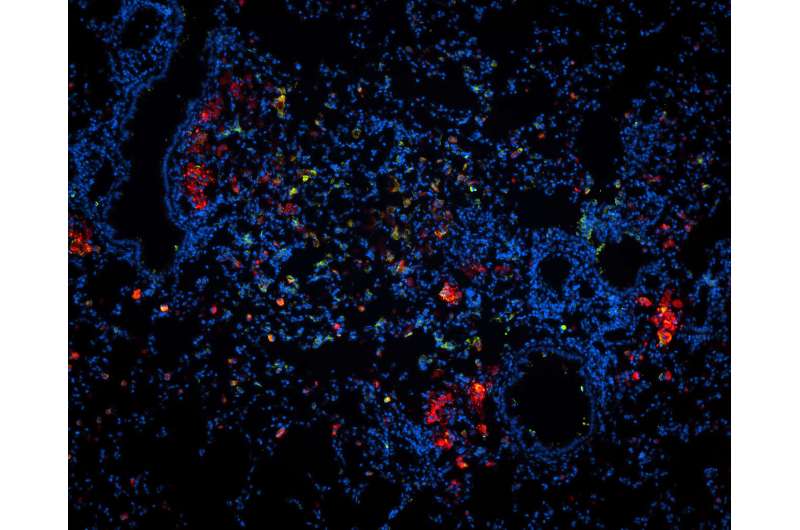
When tested in mice, the effectiveness of nanoparticle dispersions exceeded that of conventional BTZ-043 solutions for pulmonary inhalation by 50%. The nanocarriers proved to be capable of overcoming various biological barriers. High concentrations were measured in the lungs, but not in the liver and spleen.
More information:
David Rudolph et al, Amorphous Drug Nanoparticles for Inhalation Therapy of Multidrug-Resistant Tuberculosis, ACS Nano (2023). DOI: 10.1021/acsnano.3c01664
Provided by
Karlsruhe Institute of Technology
Citation:
Tuberculosis therapy: Smallest particles could deliver drugs to the lungs (2023, June 27)
retrieved 27 June 2023
from https://phys.org/news/2023-06-tuberculosis-therapy-smallest-particles-drugs.html
This document is subject to copyright. Apart from any fair dealing for the purpose of private study or research, no
part may be reproduced without the written permission. The content is provided for information purposes only.