Energy insecurity has become an increasing concern for a number of countries, but Singapore’s position is uniquely challenging.
The city state is rich, but short of land and natural resources. Singapore can only rely on imports, but how best it can navigate the competing demands of the trilemma – sustainability, reliability and affordability – can provide some lessons internationally applicable.
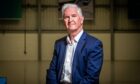
Senoko Energy head of engineering Marcus Tan explained to Energy Voice that Singapore’s Energy Market Authority (EMA) is seeking to find a balance. Solar and wind power is likely to play a key role, backed up with LNG supplies.
Senoko is one of Singapore’s major power companies, providing around 20% of electricity demand. The company has been working in Singapore since 1977 and was the first to import piped gas from Malaysia.
“While multiple technologies will play a role in Singapore’s energy transition, solar energy will likely take centre stage in the near term,” said Tan.
“Most of our solar energy is expected to come via import, given that Singapore is land-scarce and lacks other resources for alternative energy such as wind, geothermal, or hydropower.”
Singapore’s government has set a target of reaching 1.5 GWp of solar by 2025 and 2 GWp by 2030. Under the Green Plan, the government also called for 200 MWh of energy storage, a target it achieved in December 2022.
Tan noted the country was also working on research, to improve efficiency and cost in solar.
“Technologies like hydrogen, carbon capture, utilisation and storage (CCUS), and advanced energy storage solutions will also be crucial to Singapore’s energy transition.”
Tan suggested energy storage would be crucial to manage supply and demand. The state has begun various pilot projects in this area.
Transportation
In December 2022, the EMA called for companies to register interest in providing ammonia deliveries for bunkering, on Jurong Island. In October 2023, it announced it had shortlisted six groups, from 26 proposals, to go into the next phase.
This aims to generate 55-65 MW of power from low carbon ammonia via direct combustion while also providing at least 100,000 tonnes per year of ammonia bunkering.
Singapore is also working to tackle public transport. The plan calls for electric buses to make up half the fleet by 2030, with diesel buses removed by 2040. It will also expand the rail network, by around 360 km, and cycling paths.
Senoko’s Tan noted by email the shift to electricity for transportation. “Singapore has also implemented the carbon tax to encourage businesses to reduce their carbon footprint”, he said.
“The transportation sector is also a significant contributor to carbon emissions. Encouraging the adoption of electric vehicles in Singapore and improving public transportation infrastructure can help reduce emissions in this sector.”
Infrastructure
In order to support this shift towards electrification, though, Singapore needs to increase generation and transmission.
“Currently, solar energy is the most viable renewable energy option for the country but harnessing it to power the nation will come with obstacles that need to be addressed,” Tan said. “In the long term, Singapore could also be plugged into a regional power grid to trade electricity with its neighbours, which would increase its diversification of renewable energy supply and security.”
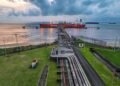
Singapore LNG (SLNG) announced plans for a second LNG terminal in October, adding another 5 million tonnes per year. This should be up and running by the end of the decade. The country already has one terminal, with 10mn tpy of capacity.
Tan said expanding LNG infrastructure would “meet growing demand for natural gas and enhance the country’s energy security”.
Gas accounts for around 92% of Singapore’s fuel mix. Tan said that a move to reducing emissions would necessarily involve “an increase in imports of renewable energy from neighbouring countries with abundant resources like solar or wind power”.
Indeed, while SLNG was doubling up on its gas facilities, the EMA granted approval to Sembcorp Utilities to import power from Vietnam. The plan involves offshore wind “and potentially other forms of generation”, EMA said, with delivery via subsea cables running for around 1,000 km.
Lower carbon
Singapore has plans to import up to 4 GW of low-carbon power by 2035. The energy regulator has approved 4.2 GW thus far, spanning solar, hydro and wind power. EMA has also expressed interest in geothermal, in addition to hydrogen.
Senoko has expressed interest in the latter. The company signed a memorandum of understanding (MoU) with City Energy on studying import and supply of hydrogen between our facilities in the northern part of Singapore.
“We are doing our part to work with hydrogen and its derivatives, supporting the commercialisation of the hydrogen chain while also decarbonising our existing assets. This is with the aim of enabling Singapore to purchase and use hydrogen the way it currently uses natural gas,” Tan explained.
The state has recognised Senoko’s work in implementing change, giving the company an award for a gas turbine upgrade in 2021. The utility is also participating in Singapore’s plans to import renewable energy.
“Close collaboration between the government, energy companies, and other stakeholders will be crucial in this journey,” Tan said. “Senoko Energy continues to work closely and support EMA to ensure energy security and affordable power for Singapore during this transition phase and keeping its carbon footprint the lowest possible in consideration.”
Recommended for you