

In footage captured by a drone last winter, a Russian tank slams into a Ukrainian trench line and the soldiers riding on top rush in. But within minutes, the Russians lie dead, repulsed by an aggressive counter-assault.
The video was posted by Ukrainian troops who attributed their success, in part, to training received in-country from a small non-government organization. Its Canadian founder thinks groups like his could be the perfect solution to a policy debate about how to provide Western-style training within Ukraine.


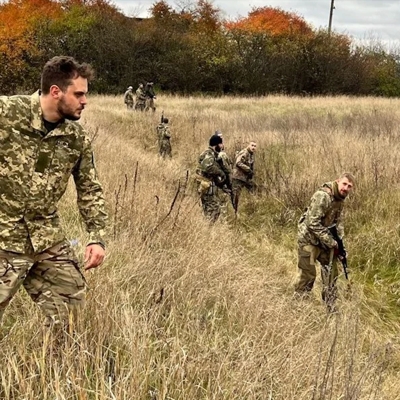
Sabre Training Advisory Group, founded by former Canadian soldier Kevin Leach, has provided military training for Ukrainian units since November 2022. The group says it has trained 3,600 soldiers on everything from basic squad tactics to leadership strategies for officers and senior enlisted troops. With an average ratio of one instructor to every ten soldiers, the group can train up to 100 soldiers at a time, said Leach, speaking in an interview during a trip to Washington, D.C. Its small staff of former soldiers relies on part-time volunteers who shuttle into Ukraine from jobs elsewhere.
While training goals can vary based on the time they’re given, Leach said he was “very confident” that they had gotten two groups of 100 soldiers up to a NATO standard.
And that training has saved lives, Leach said. He said one Sabre-trained group had been sent onward to eastern Ukraine for six months, where some 30 of the unit’s 100 troops were killed or wounded. That’s a horrible toll, but far better than the 90-percent casualty rate suffered by some other Ukrainian units in the area, he said.
And Leach said Sabre could do a lot more, especially to help provide the trained officers that analysts say are critically short in Ukraine. If he can boost his staff to 33 instructors, Leach believes that he could train roughly at least 1,200 officers and NCOs per year, and at a total cost of just over $1.8 million.
If so, that would mean more trainees faster, and likely at far lower cost, than the Western militaries that have been training Ukrainians elsewhere in Europe. From the February 2022 invasion through last October, foreign militaries had trained 3,800 officers and NCOs, according to the officer who was helping to lead those efforts.
Such training would also serve to introduce Ukrainian troops to NATO’s “mission command” approach, which allows junior leaders to decide how they achieve their assigned missions. Leach says the Ukrainians he works with have complained that some of their leaders still use Soviet-era command practices that give junior officers little autonomy and prevent them from improvising when a combat plan goes awry.
A key aspect of Leach’s NGO-centric approach is that it can train Ukrainians in Ukraine, saving the time and money currently spent to bus them—air travel being too dangerous—to the NATO countries where their military trainers can operate.
In-country training would also allow more senior leaders to attend, Leach said. Ukraine rarely sends officers above the rank of captain outside the country, nor does it send large groups of junior officers abroad due to Ukraine’s need for them, he said.
Another advantage, Leach said, is that Ukrainian training ranges operate with less bureaucracy, especially when it comes to drones.
“If I want to go on an automatic grenade range and have the drone bombers practicing on the same range, I can do that,” Leach said.
Ukrainian troops have complained about the limited use of drones when training on U.S. bases.
Leach also suggested that NGOs could pass along to NATO militaries whatever lessons their trainees bring home from the field, as U.S. military training missions in Poland do.
Best of all for Washington policymakers, funding NGOs would be less escalatory than sending soldiers from NATO members to Ukraine, argued Leach.
“It’s just private citizens on their own time,” he said.
Leach said that he had seen an uptick in interest from NATO military representatives following reports in May that France was considering sending trainers to Ukraine. French President Emmanuel Macron was initially expected to announce such a plan during a visit by Ukrainian President Volodymyr Zelenskyy on June 7, but no announcement was made.
Some experts who have studied foreign efforts to train Ukrainian troops said the idea of using NGOs makes sense. It could be particularly useful for studying drones and counter-drone tactics, as well as more general lessons on how to speed up training cycles, said Will Reno, a Northwestern University professor who has worked on a Pentagon project studying how the United States can improve foreign military training.
However, Reno was skeptical that there was sufficient political will in the U.S. for direct backing of NGOs, citing the White House’s desire to manage escalation risks.
But without better training, Ukraine will continue to lose more troops than it might—and continue to struggle to replace them. Leach said he has sympathy for Ukrainians who dodge the draft.
“I don’t blame those guys,” he said. “A NATO-style training program inside of Ukraine will help to alleviate that.”


