

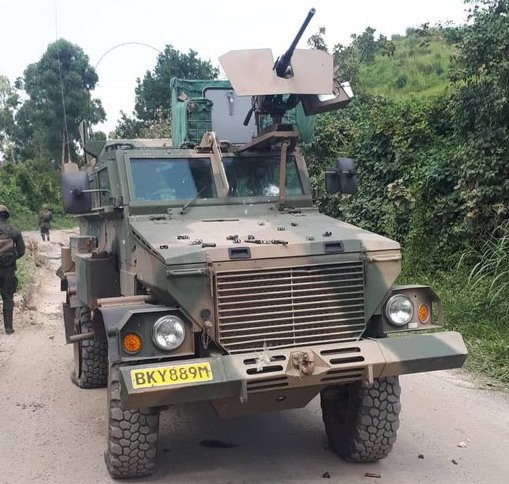

For decades, the South African National Defence Force (SANDF) has been entangled in a complex and costly engagement in the Democratic Republic of Congo (DRC), with millions spent, equipment lost, and, most tragically, countless South African soldiers dead. The SANDF’s engagement in the DRC is its longest-running deployment in history, occupying the mind of almost every South African Presidency to date.
The MONUSCO (United Nations Organisation Stabilisation Mission in the Democratic Republic of Congo) mission, to which South Africa contributes through Operation Mistral, is plagued by liquidity challenges, resulting in the reduction of its capabilities, hampering both personnel and equipment.
MONUSCO has not been spared from Donald Trump’s global institutional funding cuts. This reality has drastically affected the capabilities of the mission, potentially endangering South African troops that are part of the MONUSCO deployment. This comes after SANDF troops that were part of the Southern African Development Community Mission in the DRC (SAMIDRC) suffered horrid battlefield losses in early 2025, with 14 South Africa soldiers killed fighting M23 rebels.
In a recent presentation to the Joint Standing Committee on Defence, the Department of Defence painted a grim picture of the latest Operation Mistral rotation taking place. The grimmest reality is the reduction in the strength of the RSA Battalion located within the Force Intervention Brigade (FIB). The RSA Battalion is comprised of critical elements such as the Tactical Intelligence Unit (TIU), Air Medical Evacuation Team (AMET), Composite Helicopter Unit (CHU), and Quick Reaction Force (QRF). Hence, the reduction of key force elements such as the Composite Helicopter Unit and QRF would essentially leave our troops naked and vulnerable.
It must not be forgotten that critically injured SANDF troops and equipment that were part of the SAMIDRC deployment had to wait over a month to be extracted due to a lack of air capacity.
The adage “amateurs study tactics; professionals study logistics” exists for a reason. In the context of peacekeeping, logistics and planning are not just a supporting function, it is the primary strategic enabler and constraint. This will almost certainly affect the mission readiness and preparedness of SANDF troops forming part of the rotation. One must then pose the question: are we setting up our troops for failure and in doing so, sending our young men and women to die in one of the most complex conflicts on the African continent?
The revelation that only 27% of our standing and regular forces are fit for deployment and combat-ready is nothing short of a national security risk in itself.
This clear decrease in deterrence capability, coupled with the lack of intelligence synergy between SADC, the African Union, and East African Community (EAC), does not just create a vacuum, it actively multiplies the risk for our SANDF troops. The troops are essentially operating blind in a complex battlefield where adversaries (like M23) are highly networked, making the reduction of the Tactical Intelligence Unit even more illogical.
In late December 2025, the UN decision to renew the mandate of MONUSCO came after South African parliamentarians heard that a rotation of what is called the RSABATT (Republic of South Africa Battalion) to MONUSCO took place between 7 and 13 December 2025. This continued display of arrogance by the senior leadership of the SANDF essentially renders the SANDF as an authority unto itself while also putting the lives of our soldiers in harm’s way, something that was not even mentioned to members of the Joint Standing Committee on Defence in the 5 December briefing.
A pathway forward should see that an urgent and transparent capability audit is undertaken, whereby both Cabinet and the South African Parliament must candidly assess whether the specific units allocated to form part in the Operation Mistral rotation have the necessary equipment, logistics, medical, and intelligence support required for the current threat level within their area of operation and responsibility.
Additionally, the renegotiating of the mandate and role of the SANDF within the mission must be adjusted to better match its capabilities, where they may focus on specific, achievable objectives while addressing identified capability gaps.
The situation facing the South African National Defence Force is a perfect storm of strategic overreach and systemic decay. It is a cycle where political ambition, constrained by global funding cuts and compounded by a crippling domestic readiness crisis, crashes against the immutable reality of logistics. To continue down this path, deploying under-equipped, under-resourced soldiers into a high-threat environment, is not merely poor strategy; it is an abdication of the fundamental duty of care a nation owes to those who serve in its name.
The choice is stark: either undertake an urgent, transparent, and realistic recalibration of the mission’s scope to match South Africa’s actual capabilities or knowingly prepare for further tragedy. The Democratic Republic of the Congo must not become a monument to South Africa’s failed commitments, written in the lives of its soldiers and the erosion of its own security.
Nicholas Gotsell MP is a member of the Democratic Alliance and a member of the Joint Standing Committee on Defence (JSCD).


