Many birds’ feathers are remarkably efficient at shedding water — so much so that “like water off a duck’s back” is a common expression. Much more unusual are the belly feathers of the sandgrouse, especially Namaqua sandgrouse, which absorb and retain water so efficiently the male birds can fly more than 20 kilometers from a distant watering hole back to the nest and still retain enough water in their feathers for the chicks to drink and sustain themselves in the searing deserts of Namibia, Botswana, and South Africa.
How do those feathers work? While scientists had inferred a rough picture, it took the latest tools of microscopy, and patient work with a collection of sandgrouse feathers, to unlock the unique structural details that enable the feathers to hold water. The findings appear today in the Journal of the Royal Society Interface, in a paper by Lorna Gibson, the Matoula S. Salapatas Professor of Materials Science and Engineering and a professor of mechanical engineering at MIT, and Professor Jochen Mueller of Johns Hopkins University.
The unique water-carrying ability of sandgrouse feathers was first reported back in 1896, Gibson says, by E.G.B. Meade-Waldo, who was breeding the birds in captivity. “He saw them behaving like this, and nobody believed him! I mean, it just sounded so outlandish,” Gibson says.
In 1967, Tom Cade and Gordon MacLean reported detailed observations of the birds at watering holes, in a study that proved the unique behavior was indeed real. The scientists found that male sandgrouse feathers could hold about 25 milliliters of water, or about a tenth of a cup, after the bird had spent about five minutes dipping in the water and fluffing its feathers.
About half of that amount can evaporate during the male bird’s half-hour-long flight back to the nest, where the chicks, which cannot fly for about their first month, drink the remainder straight from the feathers.
Cade and MacLean “had part of the story,” Gibson says, but the tools didn’t exist at the time to carry out the detailed imaging of the feather structures that the new study was able to do.
Gibson and Mueller carried out their study using scanning electron microscopy, micro-computed tomography, and video imaging. They borrowed Namaqua sandgrouse belly feathers from Harvard University’s Museum of Comparative Zoology, which has a collection of specimens of about 80 percent of the world’s birds.
Bird feathers in general have a central shaft, from which smaller barbs extend, and then smaller barbules extend out from those. Sandgrouse feathers are structured differently, however. In the inner zone of the feather, the barbules have a helically coiled structure close to their base and then a straight extension. In the outer zone of the feather, the barbules lack the helical coil and are simply straight. Both parts lack the grooves and hooks that hold the vane of contour feathers together in most other birds.
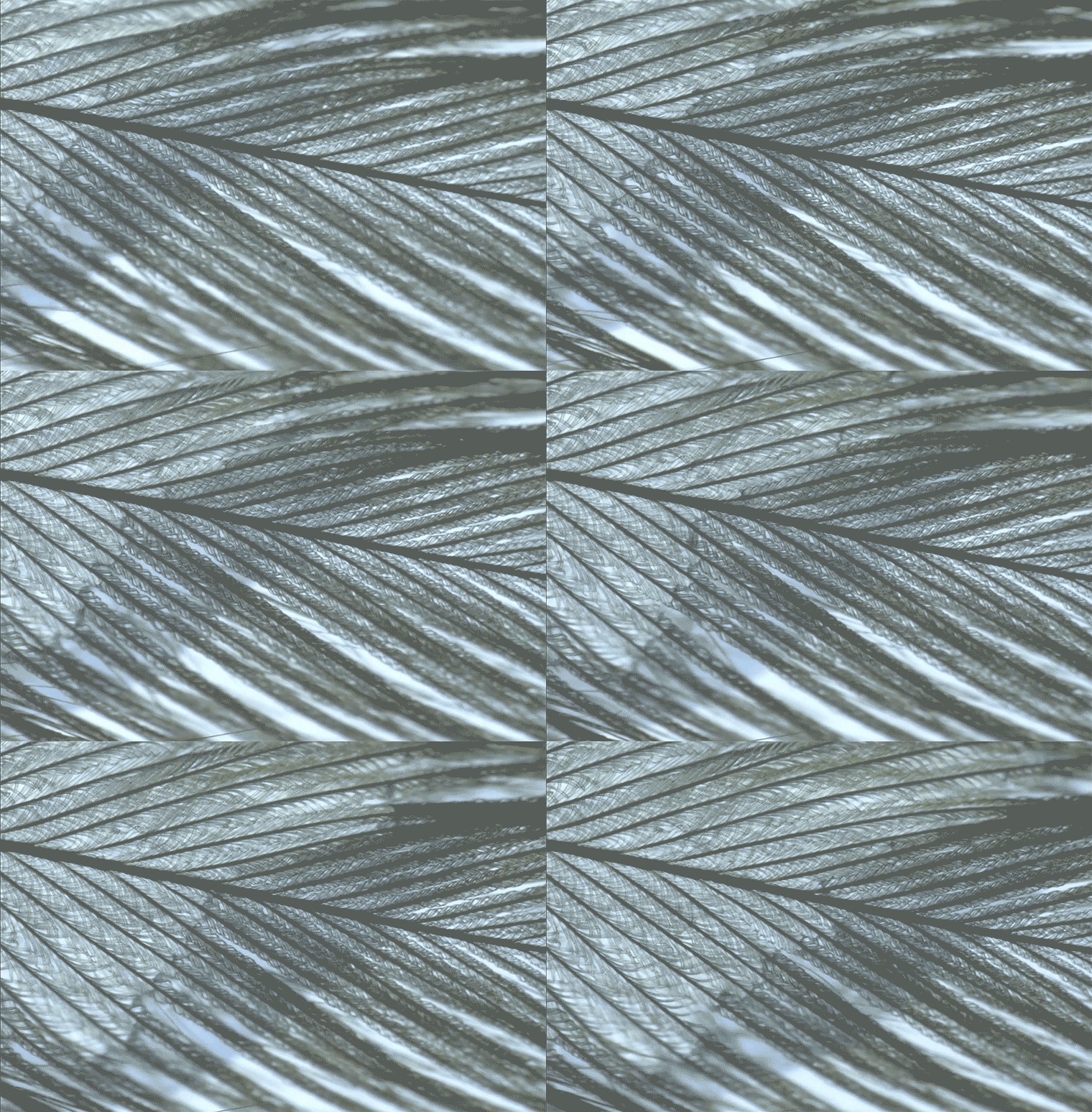
Credit: Specimen #142928, Museum of Comparative Zoology, Harvard University © President and Fellows of Harvard College.
When wetted, the coiled portions of the barbules unwind and rotate to be perpendicular to the vane, producing a dense forest of fibers that can hold water through capillary action. At the same time, the barbules in the outer zone curl inward, helping to hold the water in.


The microscopy techniques used in the new study allowed the dimensions of the different parts of the feather to be measured. In the inner zone, the barb shafts are large and stiff enough to provide a rigid base about which the other parts of the feather deform, and the barbules are small and flexible enough that surface tension is sufficient to bend the straight extensions into tear-like structures that hold water. And in the outer zone, the barb shafts and barbules are smaller still, allowing them to curl around the inner zone, further retaining water.
While previous work had suggested that surface tension produced the water retention characteristics, “what we did was make measurements of the dimensions and do some calculations to show that that’s what is actually happening,” Gibson says. Her group’s work demonstrated that the varying stiffnesses of the different feather parts plays a key role in their ability to hold water.
The study was mostly driven by intellectual curiosity about this unique behavioral phenomenon, Gibson says. “We just wanted to see how it works. The whole story just seemed so interesting.” But she says it might lead to some useful applications. For example, in desert regions where water is scarce but fog and dew regularly occur, such as in Chile’s Atacama Desert, some adaptation of this feather structure might be incorporated into the systems of huge nets that are used to collect water. “You could imagine this could be a way to improve those systems,” she says. “A material with this kind of structure might be more effective at fog harvesting and holding the water.”
“This fascinating and in-depth study reveals how the different parts of the sandgrouse’s belly feathers — including the microscopic barb shafts and barbules — work together to hold water,” says Mary Caswell Stoddard, an evolutionary biologist at Princeton University, who was not associated with this study. “By using a suite of advanced imaging techniques to describe the belly feathers and estimate their bending stiffnesses, Mueller and Gibson add rich new details to our understanding of the sandgrouse’s water-carrying feathers. … This study may inspire others to take a closer look at diverse feather microstructures across bird species — and to wonder whether these structures, as in sandgrouse, help support unusual or surprising functions.”
The work was partly supported by the National Science Foundation and the Matoula S. Salapatas Professorship in Materials Science and Engineering at MIT.