

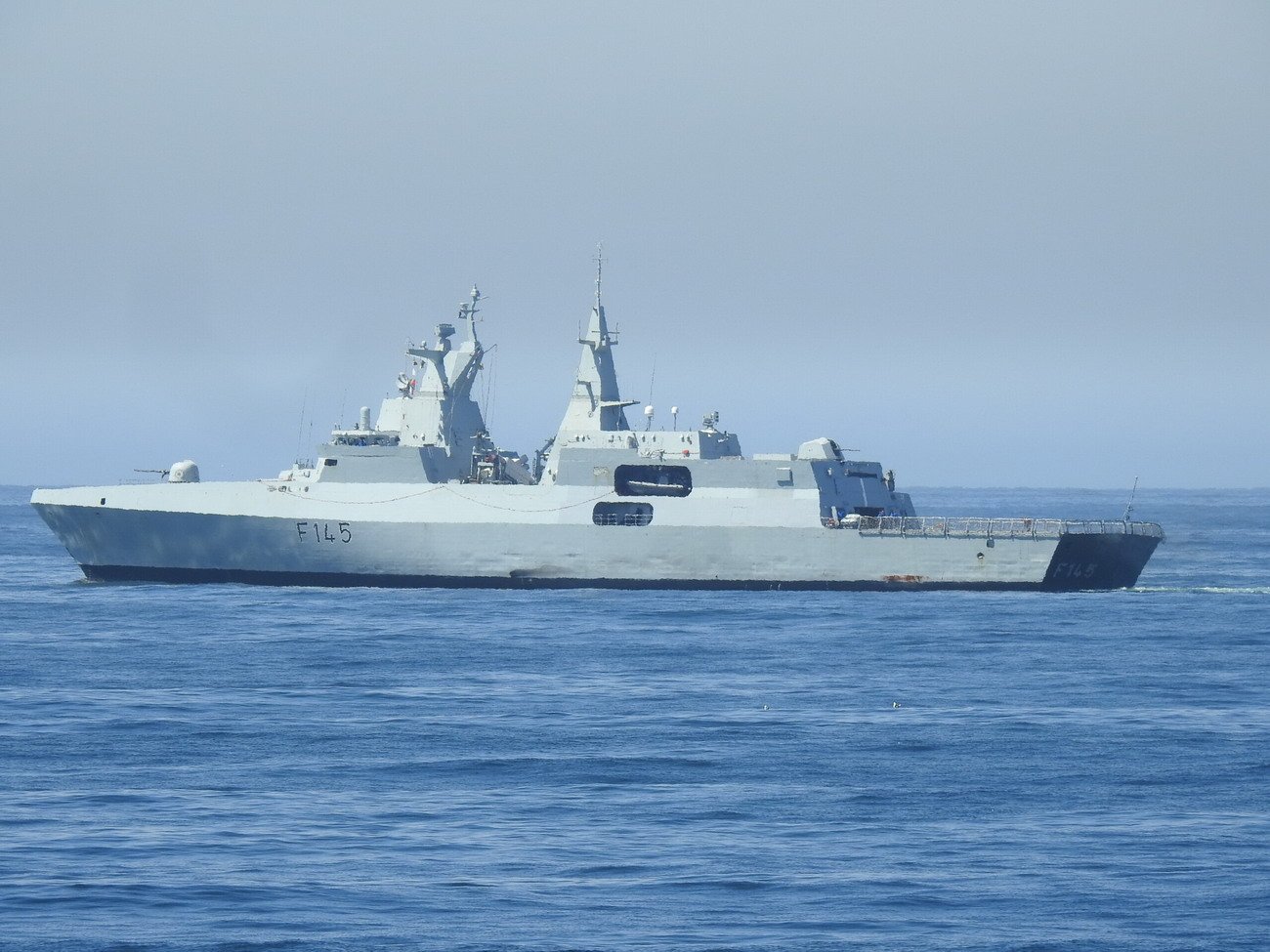
The South African Navy frigate SAS Amatola, currently participating in Exercise MILAN in India, will visit China, Malaysia, Kenya, and Tanzania on her return voyage home.
The vessel left Simons Town on 25 January, arriving in Visakhapatnam, India, in time to take part in that country’s International Fleet Review on 18 February. SAS Amatola is currently participating in Exercise MILAN 2026, underway at Visakhapatnam and in the waters of the Bay of Bengal. The sea phase of the exercise, which started on 21 February, wraps up today.
South African Navy activities in India also saw participation by the Chief of the South African Navy, Vice Admiral Monde Lobese, in the Conclave of Chiefs of the Indian Ocean Naval Symposium (IONS), convened in Visakhapatnam. The Conclave coincided with Exercise MILAN and the International Fleet Review 2026, forming part of a comprehensive programme of multinational maritime engagements hosted by the Indian Navy.
Established in 2008, IONS is a voluntary initiative designed to enhance maritime cooperation among Indian Ocean littoral navies. Conceived as an open and apolitical forum, it facilitates professional dialogue at Chief-of-Navy level, supported by specialised working groups. Its areas of focus include maritime security, humanitarian assistance and disaster relief (HADR), maritime domain awareness, information sharing, search and rescue coordination, and collective responses to non-traditional maritime threats such as piracy, trafficking and illegal fishing, Captain (SAN) Theo Mabina reported for the SA Navy.

The 2026 Conclave of Chiefs, convened on 20 February, brought together senior naval leaders from more than 40 navies. Deliberations centred on shared maritime challenges and the strengthening of cooperative frameworks to safeguard sea lines of communication and maintain regional stability.
Given that a substantial proportion of global trade transits the Indian Ocean, such discussions carry direct economic, security and geopolitical implications. Lobese led the South African delegation and underscored that the mission extended beyond ceremonial representation. He emphasised that the deployment of SAS Amatola and participation in the Conclave were strategically aligned with South Africa’s national interests, long-term defence partnerships and commitment to a cooperative, rules-based maritime order.
“Engagement at this level reinforced the SA Navy’s standing as a credible contributor to regional security architectures, particularly within the IOR. The Conclave afforded the Chief of the SA Navy the opportunity to engage directly with counterpart naval chiefs on matters of maritime governance, HADR coordination, maritime domain awareness and professional interoperability,” the SAN said.
After concluding her activities in India, SAS Amatola will make a port call in China, becoming the second Valour class frigate to do so after the SAS Spioenkop conducted a three-month, six-country visit to the Far East in 2008. Spioenkop visited Singapore, China, Malaysia, and Vietnam in October that year, and India and Mauritius in November. The ship conducted naval exercises with the Singaporean Navy, the People’s Liberation Army Navy of the People’s Republic of China, the Indian Navy and the Mauritian Coast Guard.
SAS Amatola is expected to arrive home at the beginning of May. The South African Navy said the Indian deployment marks an important milestone for South Africa’s maritime posture, reaffirming its role as an active contributor to multilateral naval cooperation in the Indian Ocean Region. It also reflects a measured return to long-range deployments, undertaken with careful planning, disciplined prioritisation and professional resolve.
The last major overseas deployment of a South African frigate occurred in early 2017, when SAS Amatola embarked on a multi-month mission to the United Kingdom to commemorate the centenary of the sinking of SS Mendi and to undertake advanced sea training. Several West African ports were also visited during that deployment. Since then, the South African Navy’s presence has largely been confined to regional waters.


