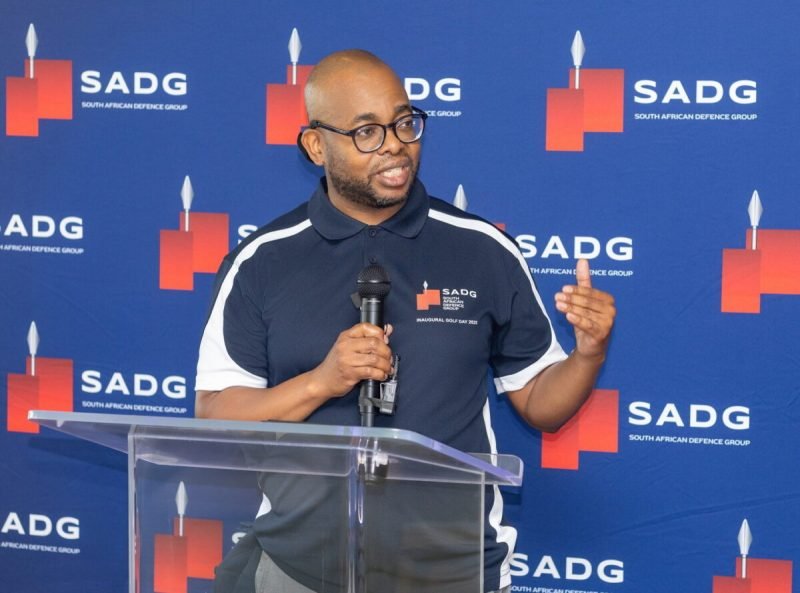
Sandock Austral Defence has officially rebranded as the South African Defence Group (SADG). The announcement, made at the Houghton Golf Club in early November, signals a shift from traditional equipment manufacturing to a capabilities-based model focused on sustainment, modernisation, and Public-Private Partnerships (PPPs).
Established in 2019, the company was previously a division of the Sandock Austral Group. The rebranding formalises its separation from Sandock Austral Shipyards, allowing the new entity to operate as a standalone defence and security business. According to CEO Dr. Mthobisi Zondi, the move is not merely cosmetic but represents a fundamental change in how the company engages with military clients, particularly in the Southern African Development Community (SADC).
“We invest a lot in developing capability that is flexible and adaptable,” Zondi said to DefenceWeb, adding that SADG first tries to understand the client’s problem and then offer access to solutions. “We first try to understand the client’s problem and then offer access to solutions.”
Reviving Naval Readiness: The Frigate Solution
A primary focus for SADG is the South African Navy’s (SAN) Valour-class frigate fleet. The four MEKO A-200SAN frigates have faced well-documented availability issues due to deferred maintenance and budget constraints. SADG is currently engaged with the Navy to implement an upgraded Integrated Platform Management System (IPMS)—the ship-wide network that monitors propulsion, electrical, and damage control systems.
Zondi noted that the Navy’s struggles with platform availability required a move away from traditional maintenance cycles. SADG is proposing an in-house predictive maintenance module that leverages Artificial Intelligence (AI) and Machine Learning (ML). This system analyses data from the IPMS to predict component failures before they occur, allowing for “just-in-time” maintenance that reduces costs and increases time at sea.
“Our team is continuously combing the solution space and the problem space for a match between solutions and the issues that the client is struggling with,” Zondi said.
Beyond the frigates, SADG is expanding its footprint on the Warrior-class Multi-Mission Inshore Patrol Vessels (MMIPVs). In collaboration with Global Command and Control Technologies (GC2T), SADG is promoting the ‘Mission Commander’ system. This tactical suite integrates an Electronic Chart Display and Information System (ECDIS), Blue Force Tracking, and inputs from the Transition 100 unmanned aerial vehicle (UAV). The system aims to give the MMIPVs—and potentially the Navy’s hydrographic survey vessel—a comprehensive multi-mission capability.
Landward Modernisation: Mamba and Rooikat
For the South African Army, SADG is executing upgrades on two legacy platforms: the Mamba armoured personnel carrier (APC) and the Rooikat armoured car.
The Mamba, a mine-protected vehicle that has seen decades of service, is the subject of a turret upgrade program. Originally featuring a manual mount for 7.62 mm or 12.7 mm machine guns, the system has evolved at the SA Army’s request into a Remotely Operated Weapon Station (ROWS). This modification moves the gunner inside the protected hull, drastically improving survivability during engagements.
The system, developed with a local defence partner, has passed testing and is scheduled for demonstration at the SA Army’s Exercise Vuk’uhlome. Zondi emphasised the modularity of the system, noting it can be adapted to other vehicle types. The wider Mamba modernisation plan uses a phased model to address affordability, with a prototype vehicle currently undergoing conversion for testing.
Simultaneously, SADG has been appointed to explore the rehabilitation of the Rooikat fleet. The 8×8 armoured reconnaissance vehicle, armed with a 76mm high-velocity gun, provides the SA Army with deep penetration and mobile firepower. SADG’s mandate covers roughly 42 vehicles, ranging from de-preservation (bringing vehicles out of long-term storage) to modernisation. This project involves a consortium of local companies, reinforcing the domestic supply chain.
Strategic Partnerships and Cross-Industry Tech
The rebranding emphasises collaboration over competition. Zondi highlighted partnerships with established South African firms, including Armormax (integrating SADG turrets onto 6×6 vehicles), Twiga (vehicle upgrades), and OTT (Ratel IFV upgrades).
The group is also aggressively targeting the unmanned systems market. Its combat drone, displayed at the Africa Aerospace and Defence (AAD) exhibition earlier this year, features a 30 kg payload and a 20 km range. While capable of carrying multiple 40 mm grenades for precision strikes, the platform is also marketed for Intelligence, Surveillance, and Reconnaissance (ISR) and force protection roles.
Navigating Budget Constraints
SADG’s strategy acknowledges the fiscal reality of the African defence market. With the SANDF budget under severe strain, the company aims to derive 65% of its revenue from non-military sources, repurposing defence technology for the commercial security sector.
Zondi cited a solution developed for a telecommunications client facing battery theft at cell towers. SADG deployed a layered security system utilising AI algorithms to analyse movement patterns, triggering non-lethal effectors such as high-decibel acoustic devices and strobes to disrupt intruders. Similar “Metropolitan Junction Protector Systems” are being marketed to the banking and retail sectors to secure critical infrastructure.
The Push for Public-Private Partnerships
Perhaps the most notable shift in SADG’s approach is its advocacy for Public-Private Partnerships (PPPs). Zondi argues that the traditional procurement model is too slow and capital-intensive for the current climate. He pointed to new PPP regulations gazetted in 2025 as a potential breakthrough, allowing industry to submit Unsolicited Proposals (USPs) directly to the SANDF.
Under this framework, Service Chiefs are obliged to respond to proposals within 45 days. This mechanism allows private industry to propose “contracting for capability”—where the contractor guarantees the availability of a system (like a frigate or a vehicle fleet) rather than simply selling parts.
“One of the things we hope to do as SADG is to work as a catalyst to transform the entire defence ecosystem at the policy level, institutional level, and regulation level,” Zondi stated. “There are a lot of capabilities that lie in the industry, but the SANDF is unable to access them because policy and procedures are outdated.”
By formalising the split from the shipyard business and consolidating its land and electronic warfare offerings, SADG is positioning itself not just as a supplier, but as a sustainment partner essential to the SANDF’s operational survival.