At 32 years old, Claude Hakorimana has witnessed firsthand how his native Rwanda has become one of the continent’s success stories in clamping down on poaching and wildlife trafficking.
At 14, he began hunting buffalo, wild boar and zebra from a community bordering Volcanoes National Park. Poaching was how his family and many others survived. Then local leaders, government officials and conservationists began educating the surrounding communities, explaining a host of issues. They explained the legal ramifications of poaching and trading wildlife parts, enforcement measures, and the long-term damage caused by poaching to wildlife, tourism and local livelihoods.
“We were taught about the negative effects of poaching, and it was made clear that anyone caught would face prison,” Hakorimana told Kigali-based newspaper The New Times for a January 22 article. “The combination of awareness campaigns and stricter enforcement pushed me to abandon poaching and rethink my future.”
In 2018, Rwanda passed a biodiversity law that redefined wildlife offences. The illegal killing of a protected species — such as a mountain gorilla, elephant or lion — carries a prison sentence of up to 20 years and fines of up to $8,000. The law also addresses every link in the trafficking chain, from illegal possession to transportation and trade of animal parts. Rwanda is considered a transit point for ivory, pangolin scales and primate body parts originating in Burundi and the Democratic Republic of the Congo.
A key element of Rwanda’s success was the creation of a single agency, the Rwanda Development Board, to manage tourism, economic development and conservation, including overseeing the country’s national parks and protected areas.
The board collaborates with the Rwanda Defence Force and the national police on thousands of anti-poaching patrols every year. Customs agents receive special training to report and track wildlife products and coordinate across borders on enforcement strategies.
To combat poaching, the board has evolved from a largely reactive approach to a proactive, multilayered strategy that blends technology-driven enforcement with community participation.
In 2017, the government doubled the price of gorilla-trekking permits to $1,500 per person. Prosper Uwingeli, chief warden of Volcanoes National Park since 2008, said the higher price allows for more money to reach local communities. The Tourism Revenue Sharing Scheme, launched in 2005, designates 10% of all park revenues for projects such as schools, water systems, health centers and agriculture infrastructure.
“Higher prices mean fewer tourists, but we still earn more money,” Uwingeli told Deutsche Welle. “This reduces pressure on the gorillas, giving us more to spend on conservation, research and the local population.”
Despite all efforts, poaching persists in Rwanda’s parks, and snares present an ongoing challenge, according to board Head of Conservation Eugene Mutangana.
“They are cheap, easy to make and hard to spot in dense forest, often fashioned from bicycle brake wires,” he told The New Times, adding that the board is testing advanced detection technologies to locate traps and monitor poacher activity.
The number of animal snares recovered in Volcanoes National Park has risen dramatically, from 446 in 2019 to 2,336 in 2025. But Mutangana believes the higher numbers reflect the effectiveness of those new technologies as well as expanded patrol coverage, which is uncovering traps that previously were undetected.
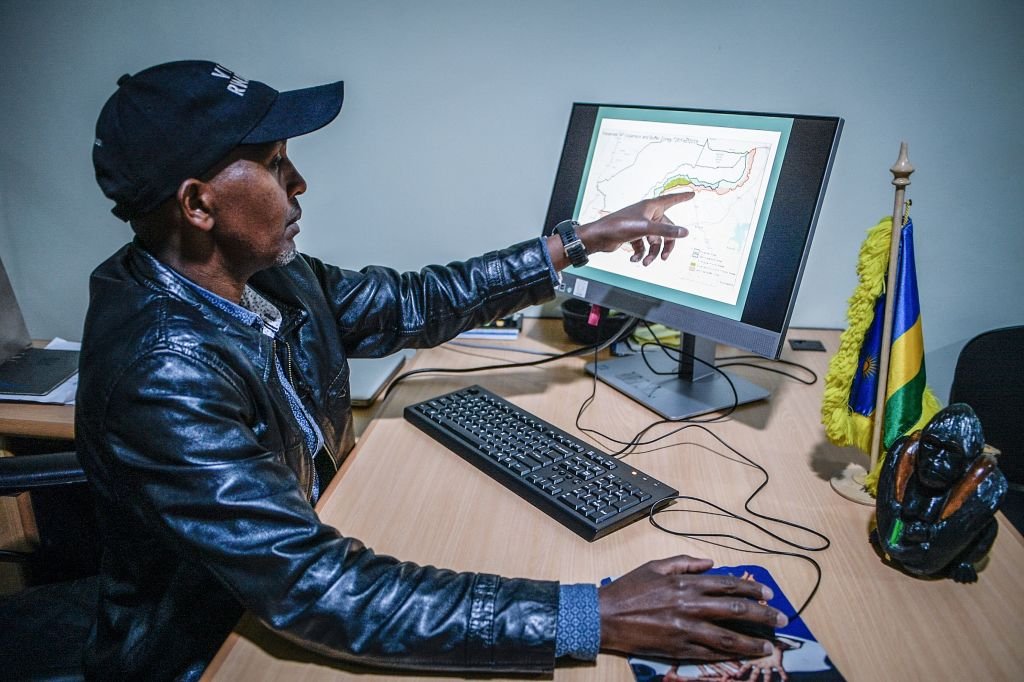
“Patrol frequency and coverage have increased, with specialized ‘sweep’ missions focused on locating and dismantling snares in high-risk zones,” he said. “Rangers now rely heavily on digital tools. GPS tracking is used to monitor gorilla groups, while CyberTracker and SMART (Spatial Monitoring and Reporting Tool) conservation technologies allow patrol teams to record the exact coordinates of each snare found. The data is analyzed to generate heat maps of poaching hotspots, enabling more targeted deployment of personnel and resources.”