


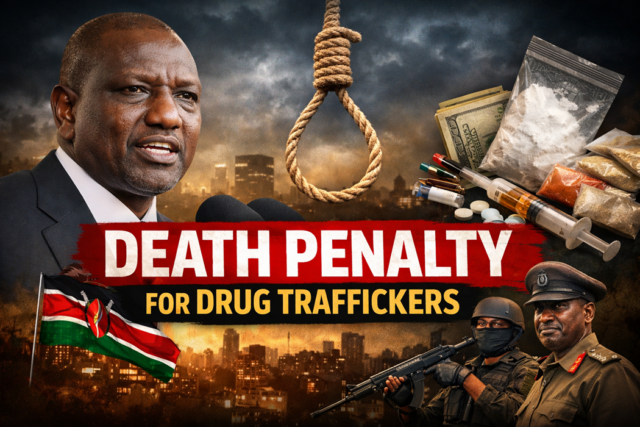
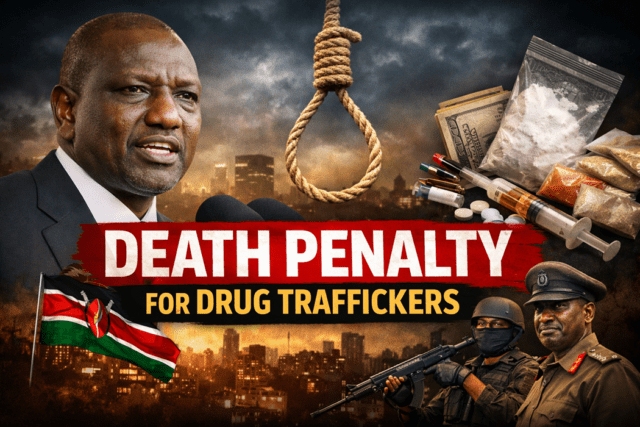
Kenyan President William Ruto has proposed sweeping changes to the country’s narcotics laws, including the introduction of capital punishment for convicted drug traffickers, in what the government has described as a drastic response to a growing national crisis.
Speaking on January 4, 2026, President Ruto announced that his administration is drafting new legislation. This would make drug trafficking — especially in hard drugs such as cocaine and heroin — punishable by death through hanging. The proposal specifically targets drug kingpins, large-scale traffickers, and organized narcotics networks operating within and across Kenya’s borders.
“A National Development and Security Emergency”
President Ruto described drug and alcohol abuse as a “national development and security emergency”, warning that the crisis is destroying families, weakening the workforce, and fueling crime and insecurity across the country.
According to figures cited by the President, one in every six Kenyans — approximately 4.7 million people — uses at least one substance of abuse. This includes alcohol, bhang, prescription drugs, and hard narcotics.
– Advertisement –
“Our laws are too lenient. A drug trafficker is fined Ksh1 million and goes back to business the next day. That cannot continue,” Ruto said.
Currently, Kenya’s narcotics laws allow courts to impose fines and prison sentences, but Ruto argued that penalties such as a Ksh1 million fine (about $6,400) are insignificant compared to the massive profits made by drug syndicates.
Targeting Kingpins, Not Addicts
The President emphasized that the proposed death penalty would not apply to users or small-scale offenders, but would be reserved for:
- High-level drug traffickers
- International and domestic drug kingpins
- Organized criminal networks dealing in hard drugs such as cocaine and heroin
The aim, he said, is to dismantle the financial and logistical structures behind the drug trade. It is not to criminalize addiction.
Asset Seizures and Crackdown on Illicit Brew
In addition to capital punishment for traffickers, the government plans to introduce laws allowing authorities to:
- Seize vehicles, land, houses, and businesses linked to drug trafficking and illicit alcohol trade
- Confiscate brewing equipment and transport assets used in the sale of illegal liquor
- Strengthen penalties against producers and distributors of toxic illicit brews responsible for deaths in rural and informal settlements
The measures are intended to remove the economic incentive behind the illegal trade.
Legislation Headed to Parliament
The executive branch is currently drafting the proposed amendments, which will soon be presented to Parliament for debate and approval. If passed, the reforms would represent one of the toughest anti-drug legal frameworks in Africa.
However, the proposal is expected to spark intense debate, particularly around human rights, constitutional protections, and Kenya’s international obligations, as the country has not carried out an execution since 1987, despite the death penalty remaining on the statute books for murder and treason.
Mixed Public Reaction
The announcement has triggered mixed reactions among Kenyans. Some citizens and leaders have welcomed the move, arguing that harsh punishment is necessary to protect youth and communities. Others warn that capital punishment could violate human rights and risk wrongful convictions.
Civil society groups are calling for stronger prevention, rehabilitation, and treatment programs alongside tougher enforcement.
A Defining Policy Moment
If adopted, the proposed law would mark a dramatic shift in Kenya’s approach to drug control. It would move from punishment-focused deterrence to a strategy that treats narcotics as a national security threat.
Whether Parliament approves the death penalty proposal or modifies it, President Ruto has made clear that his government intends to escalate its fight against drugs and illicit alcohol with unprecedented force.


