

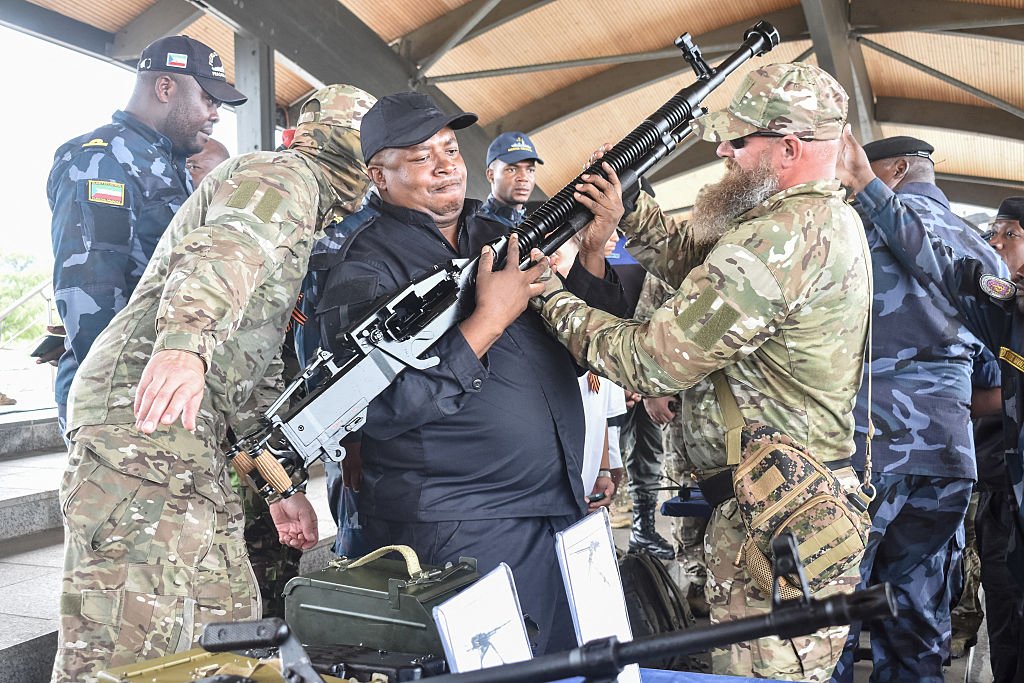
Russia’s presence in Equatorial Guinea recently expanded to include a new cultural center in the capital, Malabo.
The facility mirrors 16 operations in other African countries, such as the Central African Republic, where Russia aims to expand its influence. More than half of Russia’s 28 cultural centers worldwide are in Africa.
The new cultural center recently held a screening of “Blockade Diary,” a propaganda film Russia uses to recruit new fighters for its ongoing war against Ukraine. The cultural center opening follows the 2024 deployment of more than 200 Africa Corps mercenaries to Equatorial Guinea to protect President Teodoro Obiang Nguema Mbasogo and to train troops. The deployment mimics that of the Africa Corps’ predecessor, the Wagner Group, to the CAR nearly a decade ago.
While the government of Equatorial Guinea has denied that Russians are present in the country, witnesses have reported seeing white men in uniforms with Russian insignia on the streets of the Spanish-speaking country.
The deployment to Malabo and Bata followed President Obiang’s three visits to Russia and two trips to Malabo by Russian Deputy Minister of Defense Yunus-bek Yevkurov, the man tasked with using Africa Corps to expand Russia’s influence on the continent.
Russia has helped Equatorial Guinea establish a new 684-member military force known as the Rapid Intervention Brigade. Obiang has pledged to outfit the force with advanced Russian and Chinese weaponry, including armored personnel carriers and long-range missiles.
“Whatever their origin, Equatorial Guinea is not at war, and the presence of mercenaries does not present any benefit for the population,” Malabo resident Juvenal Osuan Ondo Mba told Le Monde and Agence France-Presse (AFP) last year.
Russia’s activities in Equatorial Guinea have raised concerns among the country’s exiled opposition leaders that Russia is trying to recruit more Africans to fight in eastern Ukraine. In March 2025, Equatorial Guinea’s defense ministry called for young Equatorial Guineans to apply for scholarship to receive military training in Russia. The leadership of Equatorial Guinea has denied sending citizens to fight on behalf of Russia.
Vice President Teodoro Nguema Obiang, the son of the president, said his nation’s citizens travel to Russia “to train in the prestigious universities of the Russian Federation.”
“At the end of their studies, (they) proudly return to the country to contribute to the defense of the homeland,” he told AFP.
The experience of hundreds of other Africans who have traveled to Russia recently suggests otherwise. Over the past year or so, more than 1,400 Africans from dozens of countries have arrived in Russian only to find themselves on the front lines in eastern Ukraine, many with little or no military training. Kenya and South Africa have both reported that their citizens went to Russia expecting jobs and were instead forced to sign untranslated military contracts written in Russian. Some reported that their passports were taken, making it nearly impossible for them to leave the country.
Francis Ndung’u Ndarua traveled from Kenya to Russia with the promise of working as an electrical engineer. He posted a video on social media a few months later warning other Africans against coming to Russia, according to the Nigeria news site Legit.
“You’ll end up being taken to the military even if you’ve never served in the military, and you’re taken to the frontline battle. And there are true killings,” Ndarua said. “Many friends have died in the name of money.”
Soon thereafter, Ndarua appeared in another video wearing a military uniform with a land mine strapped to his chest. A Russian speaker using racist slurs described him as a “can-opener,” a term for people forced to serve as suicide bombers to open holes in Ukrainian defenses.
As Russia expands its footprint in Equatorial Guinea, the publication Diario Rombe, an outlet for the exiled opposition, recently described Russia’s mission in Malabo this way:
“It is a question of recruiting citizens with no military experience, to be sacrificed in exchange for the presence of Russian mercenaries in Equatorial Guinea.”


