

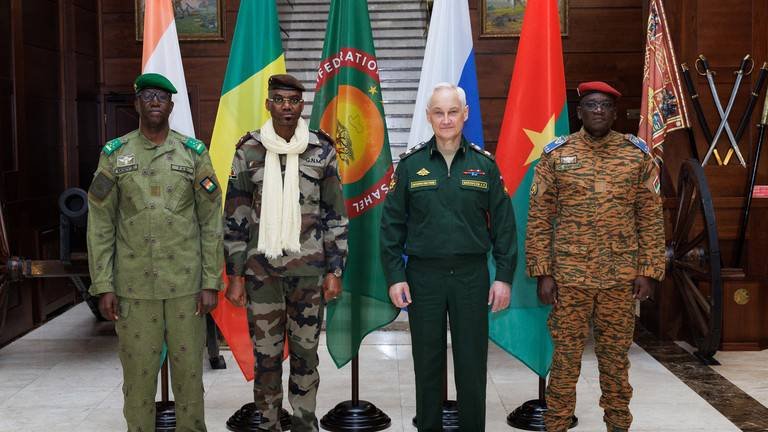
Russia has formalised a defence cooperation agreement with the Alliance of Sahel States, comprising Burkina Faso, Mali, and Niger, committing to assist in their struggles against terrorism and externally supported militant factions that have sown chaos in the region.
This pact, sealed during Moscow’s inaugural joint consultations with the military leaders of these nations, signals a deepening of ties as the three countries, governed by juntas following recent coups, pivot away from traditional Western partners like France and the United States. The meeting, hosted by Russian Defence Minister Andrei Belousov, took place amid Russia’s efforts to forge new alliances in Africa, where it has steadily expanded its footprint, including through military engagements, while facing Western isolation over its conflict in Ukraine.
Belousov expressed Russia’s backing for the AES nations’ defence of their sovereignty and territorial integrity, framing the alliance as a product of the Sahelian peoples’ independent pursuit of peace and progress. His Malian counterpart, Sadio Camara—a key figure in the junta advocating for closer Moscow relations—described defence as the primary domain of collaboration between the parties. Niger’s Defence Minister Salifou Modi and Burkina Faso’s Celestin Simpore also attended, contributing to discussions that culminated in a memorandum of understanding on defence matters. While specifics remain undisclosed, Belousov indicated Russia’s preparedness to offer extensive aid to stabilise the area, where jihadist violence risks spreading beyond the Sahel into wider West Africa.
The AES emerged from a mutual defence accord signed in September 2023, evolving into a full confederation by 6 July 2024, with commitments to broaden ties in security, economics, and social development. This bloc arose after the three states withdrew from the Economic Community of West African States at the year’s start, criticising it for yielding to French influence. The juntas, having ousted civilian governments in a series of takeovers, have rejected years of ineffective Western-led interventions that failed to curb insurgencies, instead embracing Russian mercenaries, notably from the Wagner group, to aid in combating Islamist militants.
Beyond the recent memorandum, cooperation has advanced through concrete projects. In September 2024, Mali, Niger, and Burkina Faso inked a deal with Russia’s Roscosmos agency to procure telecommunications and surveillance satellites. Hosted in Bamako, the agreement focuses on bolstering border monitoring and national security in the expansive, permeable Sahel, where insurgents exploit gaps to launch attacks. Mali’s Finance Minister Alousséni Sanou highlighted the satellites’ role in secure communications and managing crises like floods, droughts, and fires, which compound the region’s vulnerabilities. For nations battling persistent Islamist threats, this technology promises improved tracking of militant activities across remote terrains, potentially transforming response strategies in a zone where traditional ground patrols often fall short.
The alliance has also moved to establish a 5,000-strong joint force, equipped with its own air support, hardware, and intelligence apparatus, set to become operational soon. This unit will operate across the three countries, aiming to shield the AES from terrorist incursions through coordinated actions that leverage shared resources. In April 2025, Russia agreed to furnish weapons and training for this force, further entrenching its military presence and providing the juntas with tools to assert control amid ongoing instability.
Yet, these partnerships have encountered hurdles. In May 2025, Niger’s junta suddenly halted intelligence-sharing arrangements with Russia and Turkey, citing inadequate support that left surveillance efforts exposed. This decision, made under duress from internal military discord and external pressures, highlighted fractures within the regime and broader security dilemmas, as Niger—once a pivotal partner in regional anti-jihadist campaigns under ousted President Mohamed Bazoum—now navigates suspension from ECOWAS and strained alliances.
Tensions escalated further when Mali and Niger cut diplomatic relations with Ukraine in August 2024, accusing Kyiv of involvement in a devastating assault on Wagner and Malian forces. The incident, claimed by northern Tuareg rebels, unfolded over three days in late July, resulting in at least 84 Wagner mercenaries and 47 Malian soldiers killed, alongside the loss of two helicopters. This marked Wagner’s most severe setback since entering the conflict two years prior, exposing vulnerabilities in Russian-backed operations and prompting accusations of foreign meddling that fuelled the diplomatic rift.
For the AES states, Russia’s involvement offers a counterweight to Western dominance, providing mercenaries, arms, and technical aid without the conditions often attached to French or American support. Moscow’s strategy capitalises on anti-colonial sentiments, positioning itself as a reliable alternative amid failed interventions that have not stemmed the jihadist tide. However, the reliance on private military companies like Wagner introduces risks, including human rights concerns and potential exploitation of resources, as seen in other African engagements.
As Islamist groups continue to adapt, exploiting porous borders and local grievances, the AES-Russia axis aims to forge a more autonomous security framework. Yet, incidents like the Wagner defeat and Niger’s intelligence pullback reveal the fragility of these arrangements, where internal divisions and external pressures could undermine progress. For Moscow, the Sahel provides a theatre to demonstrate its global reach, diverting attention from Ukraine while securing economic footholds in minerals and trade. The coming months will test whether this military support translates into lasting stability or merely reshuffles the region’s power plays.


